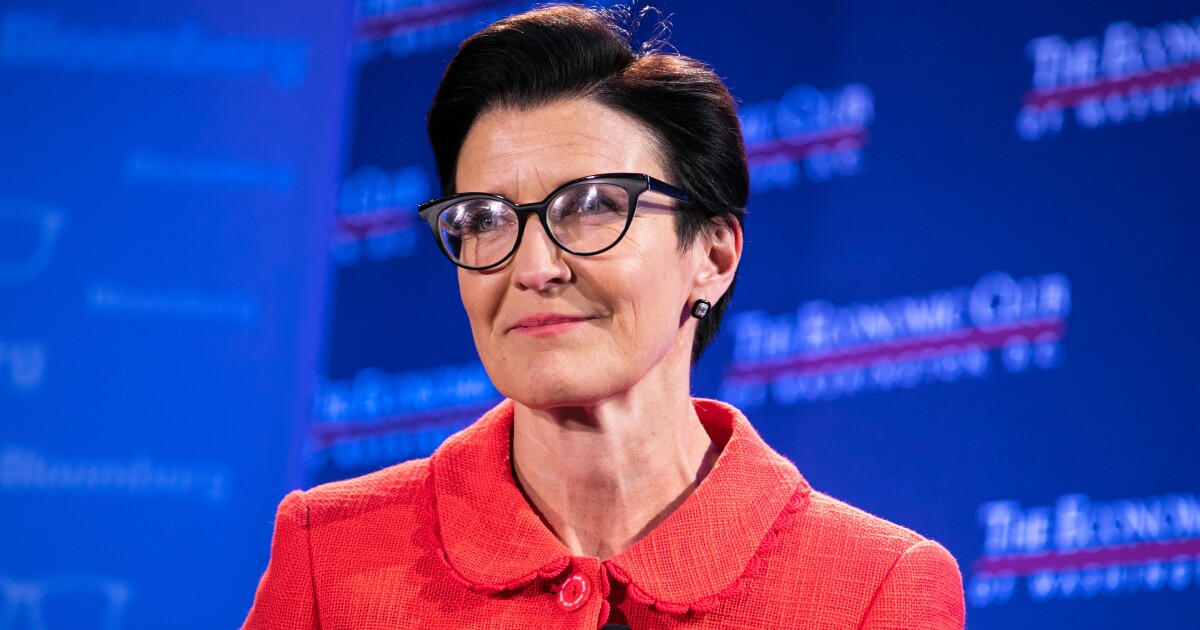
- Key insight: On Thursday, Citi will host its first investor day since 2022. The event will include presentations by CEO Jane Fraser and the leaders of each of the bank’s five businesses.
- What’s at stake: Having built credibility over the past four years, Citi’s challenge now is to present investors with a clear path forward with achievable targets, analysts say.
- Forward look: Citi is expected to announce new medium-term profitability targets. To date, the bank has not disclosed profitability goals beyond this year.
Citi will host its first investor day in four years on Thursday, and the message this time around is sure to be significantly different from the one delivered in 2022.
Processing Content
Back then, the strategy laid out by Citi CEO Jane Fraser and her management team was focused on fixing the megabank: turning it into a flatter, leaner organization with five interconnected business lines, through which it could generate more revenue and drive higher shareholder returns.
At the time, Fraser acknowledged that the $2.8 trillion-asset bank, which was created to be a so-called “financial supermarket” that sprawled across the globe, hadn’t lived up to its potential.
Today, much of the work to simplify Citi, internally and geographically, has been completed, and its five businesses are well-defined. After Citi spent several years in overhaul mode, its revenues are growing, its businesses are performing and its stock price has risen more than 85% over the past year. Executives remain confident that the bank will achieve a key performance metric, a return on tangible common equity of 10% to 11%, by the end of the year.
Investors are ready to hear about Citi’s new road map and how the company will execute its next chapter, even as it continues to operate under regulatory consent orders related to risk management and internal controls lapses. Executives have said the bulk of the remediation work is complete.
“This is the first time that Citi can discuss a company that is preparing for the next decade, at least since pre-Great Financial Crisis,” Mike Mayo, an analyst at Wells Fargo Securities, wrote in a recent research note. In his view, Citi is undergoing “its most significant restructuring in a generation.”
Citi’s investor day — scheduled to take place Thursday at the bank’s New York City headquarters — will include presentations from Fraser and the leaders of each of the five businesses. It will mark Gonzalo Luchetti’s first investor day since he became Citi’s chief financial officer in March.
Here are four areas to watch as Citi lays out its multiyear path.
Profitability targets
Citi will disclose new medium-term profitability targets, and those targets will be above the bank’s current stated goal of 10% to 11%, Fraser recently told Reuters. The bank’s return on tangible common equity in 2025 was 7.7%. The metric was 13.1% in the first quarter of 2026.
How high Citi will aim in terms of profitability, and how it expects each of its business lines to contribute, will be revealed Thursday. Services, banking and markets currently make up 77% of its earnings, Ebrahim Poonawala, an analyst at Bank of America Securities, said in a research note. The “heaviest lift” in terms of improving profitability will be in Citi’s wealth business, which contributes 6% to earnings, he wrote.
Some analysts expect Citi to announce two profitability targets, based on different time horizons.
John McDonald, an analyst at Truist Securities, wrote in a research note that he thinks the bank will announce a return on tangible common equity target of 12% to 13% by 2028, as well as a mid-teens target to cap off the decade. Scott Siefers, a Piper Sandler analyst, is predicting a slightly higher return on tangible equity target of 13% to 14% in the medium term, followed by an aspirational target of 15%, he wrote in a research report.
Key questions include how Citi plans to achieve its new target, whether through revenue growth, operating leverage or other means, and what capital ratio assumptions underlie the new target, Siefers wrote. A longer-term goal of 15% would put the company more in line with peers, Siefers said.
Overall, investors are watching for targets that make sense.
“May 7th is the first opportunity for management to align the financial targets with the strategic reality of what Citi actually is today,” David Chiaverini, a Jefferies analyst, wrote in his memo previewing the bank’s investor day. “What investors are looking for is a medium-term framework that reflects reality.”
Risk management
Despite risk-management improvements in recent years, Citi is still operating under a pair of regulatory consent orders dating back to the fall of 2020. Investors will be keen to hear any updates about the ongoing risk-management remediation work and whether executives think the bank is any closer to being freed from the consent orders, Mayo said in his note.
As of the first quarter, 90% of Citi’s risk-management programs are operating at or near their target state, up from more than 80% in the fourth quarter of 2025, executives told analysts last month. Mayo predicts that the consent orders, which were issued by the Federal Reserve and the Office of the Comptroller of the Currency, will be lifted sometime this year.
There are three questions worth asking at the investor day, according to Mayo.
First, what “inning” is Citi in when it comes to the risk-management transformation? Second, what “major milestones” still need to be achieved? And third, how much financial benefit should investors expect to see “fall to the bottom line” in the next few years?
The remediation work has been a huge factor in driving up Citi’s costs in recent years. In December, then-Citi CFO Mark Mason said the bank spent about $3.5 billion on risk-management improvements in 2025.
Being able to complete most of that work means a large chunk of related expenses will begin to roll off, which should lead to higher margins, creating “a natural operating leverage dynamic that compounds return on tangible common equity improvement,” Chiaverini said in his note.
The impact of AI
Fraser has promised to unveil details at the investor day about how the deployment of artificial intelligence fits into Citi’s go-forward strategy. She offered some initial thoughts last month, saying the bank is “methodically deploying AI at scale across the firm to drive revenues and process improvements, enhance client experiences and strengthen [the bank’s] defensive capabilities.”
The bank is expected to talk about both how AI will benefit each of its businesses and the four buckets in which it is deploying AI. Those buckets include revenue generation and client experience improvements; enhanced productivity and end-to-end process improvements; and defensive capabilities against cyber fraud and money laundering, Fraser said last month.
Citi’s services business is using AI to increase its speed and efficiency, Shahmir Khaliq, Citi’s head of services, recently told American Banker. The bank is using next-generation AI models to help people arrive at decisions faster and to digitize client-facing and internal processes, he said.
Retail branch plans
Citi’s retail bank is far smaller than those of other big banks. It has about 650 U.S. branches in six major cities, compared with JPMorganChase’s 5,300 branches and Bank of America’s 3,800, which are spread far and wide across the country. And Citi’s deposit costs are higher than those of JPMorgan, Bank of America and Wells Fargo, according to Erika Najarian, an analyst at UBS Securities.
In March, a news article said that Citi was considering buying a large regional bank as a way to obtain low-cost deposits. During Citi’s first-quarter earnings call, Fraser adamantly dismissed the notion, saying the company has plenty of opportunities to grow as it exists today.
“I want to be crystal clear: We are only interested in and focused on organic growth, period, end of story, for the whole firm,” she told analysts on the call.
In November, the bank reorganized the business previously known as U.S. personal banking, moving its retail bank into its wealth business, which is led by Andy Sieg. Branded cards and retail services — the other two legs of what was U.S. personal banking — remain together under the new business name of U.S. consumer cards, which is run by Pam Habner.
Regarding the future of the retail bank, “this is where the ‘big picture’ from Mr. Sieg would be helpful,” Najarian wrote in a research note.
“After all, peers like JPMorganChase and Bank of America have talked about continuing to grow organically via de novo branches in new markets. Citi has more recently been an ‘urban center’ retail bank,” she added.