


You’ll never believe it, but despite the endless promises of prosperity and liberation from the tyranny of work, late capitalism is proving—for ordinary workers and consumers, anyway—to be an ongoing exercise in basking in the freedom to choose from a smorgasbord of shit sandwiches.
One of the more odious developments on this front over the last couple of years has been the phenomenon of retailers using personal data to adjust the price a person—or a given demographic—is charged for goods or services. This practice—often called “surveillance pricing”—has begun to spread from its origins online into IRL locations like grocery stores, becoming such a concern that some US states have tried to ban it. Oh, you loved the experience of getting a personalized price increase on that flight you wanted? Just wait and see how much you’ll adore the same thing happening to your weekly groceries!
The practice manages to combine several of the most dystopian technologies of recent years. The price change algorithms are powered by AI and rely on crunching the vast swathes of personal data that big tech has been cheerfully accumulating for most of the 21st century. Such data can be used to extract money from consumers in all sorts of delightful ways—one recent example was the possibility of ride-sharing services quoting higher prices to people whose phone batteries were running low. Freedom of choice between price gouging and personal safety, delivered straight to you by the last vestiges of your smartphone’s power reserves!
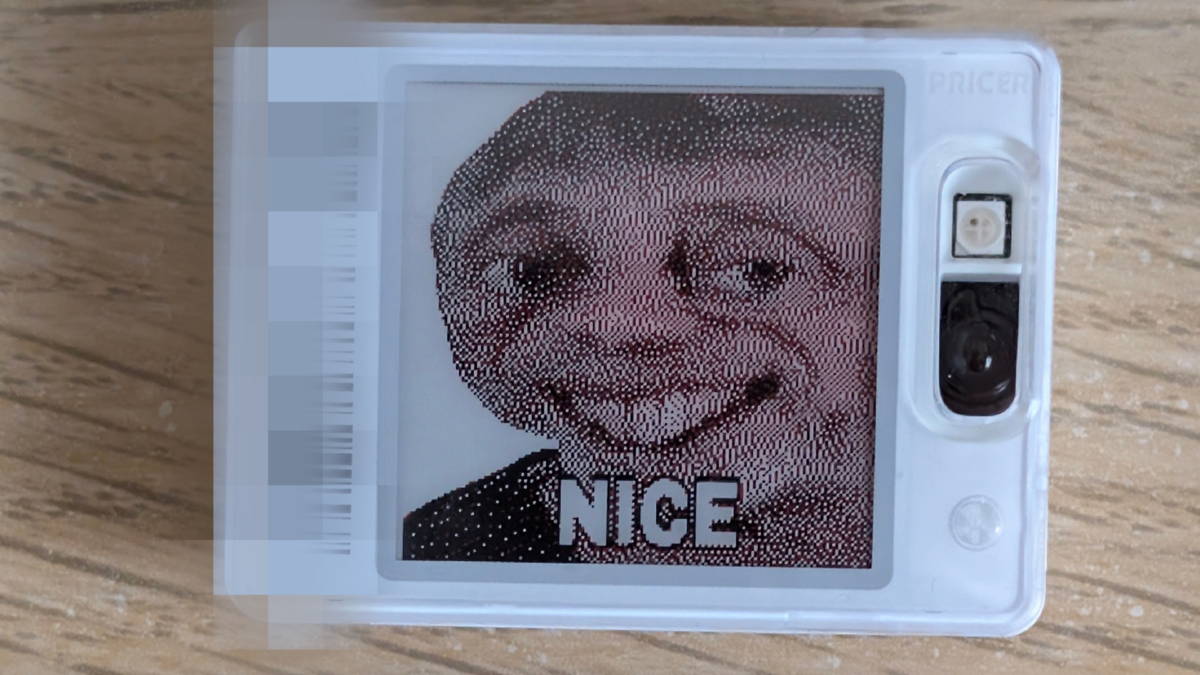
In stores, however, your special, personalized, and not so low, low price is delivered by a much more prosaic technology: an electronic shelf label (or ESL). And if you’ve been monitoring the development of surveillance pricing, you might be interested to hear about TagTinker, a new app for the ever-useful Flipper Zero hackng that can interface with those shelf labels.
It turns out that some varieties of ESL, at least, don’t use Bluetooth, Wifi, or anything modern and reasonably secure. Nope, all you need to communicate with those devices is a plain old infrared signal—which, as the project’s Github page notes, is “the same [signal] that you use in TV remotes.” The page goes on to point out that “the whole security [system] was relying on obscurity of protocol.” (For those interested, Furrtek.org has a pretty exhaustive breakdown of ESL security, or lack thereof, as well as progress on reverse engineering various ESL devices.)
TagTinker communicates with these little infrared devices. So what can you do once you’re in? Well, the most amusing use comes from the app’s facility for displaying a suitably sized and formatted image on the screen. As per the GitHub page, TagTinker can also “display text … and test patterns,” while Flippers with a WiFi Dev Board can also “unlock live, network-rendered tag designs.”
As you might expect, there’s a whopping great disclaimer on the GitHub page, making it clear that Tag Tinker is “an independent project intended strictly for educational research, security curiosity, and displaying digital art on hardware that you legally own,” and warning against using it for “illegal activities.” We endorse this warning wholeheartedly and absolutely advise against doing things like knocking multiple zeroes off the end of a number or replacing a price with a picture of a comically large penis.