


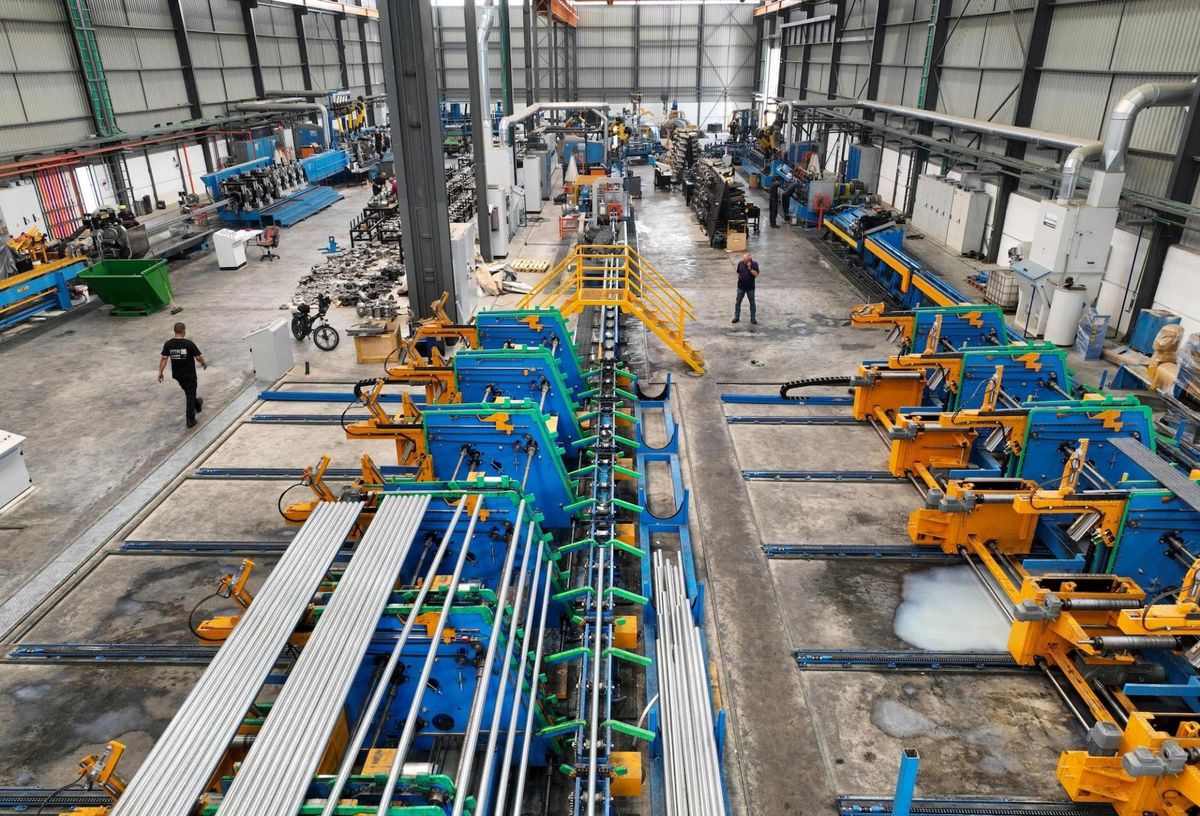
The artificial intelligence boom is creating ripple effects for commercial real estate far beyond the development of new data centers.
The explosion of digital infrastructure construction is also giving a substantial lift to the U.S. manufacturing and logistics sectors.
Last week, chipmaking giant Nvidia announced it is partnering with Corning, a manufacturer of optical connectivity equipment used in data centers, to develop three manufacturing facilities in North Carolina and Texas.
The firms framed the deal as an opportunity to leverage AI to “reinvigorate American manufacturing and supply chains,” as Nvidia CEO Jensen Huang stated in a press release. Corning CEO Wendell Weeks echoed the idea that the AI-driven infrastructure boom is giving a lift to the broader industrial landscape.
“This partnership is proof that AI is not just a technology story. It is a manufacturing story, and it is happening here in the United States,” Weeks said.
These planned factories are just the latest in a growing number of industrial development projects and leases across the U.S. specifically to meet the needs of the data center supply chain.
Siemens opened a $190M Fort Worth manufacturing hub last year to produce switchboards and other critical electrical gear for data centers. Electrical systems firm Eaton began work this year on a $30M Nebraska switchgear facility to meet data center demand. Data center cooling system manufacturers nVent and Aaon both opened new plants in the past six months in Minnesota and Tennessee, respectively.
Elon Musk, meanwhile, revealed this month he is considering a site near College Station, Texas, for his “Terafab” chipmaking facility — a massive proposed semiconductor fabrication plant that could become the largest business investment in the state’s history.
Known as chip fabs, projects from companies like Intel and TSMC that produce the silicon chips for GPUs and other processors are the largest and most expensive facilities being built to serve the data center supply chain, with price tags often nearing $100B.
The impact of the data center boom on industrial real estate is “completely validated” in quarterly leasing data, said CBRE Global Head of Industrial Research James Breeze.
Manufacturing leasing activity jumped 28% in the first three months of this year compared to Q1 2025, an increase Breeze said prompted his team to perform a deal-by-deal analysis to determine which kinds of manufacturers were leasing the most space.
They found that, by a significant margin, the largest share of tenants signing manufacturing deals — 27% of them — were from companies in the data center and tech supply chain.
The surge in industrial demand tied to data center development is unlikely to fade even if AI-related construction activity cools, Breeze said.
While some moderation is possible, CBRE’s data suggests that most of the data center-related manufacturers boosting leasing figures are tied not to one-time construction work but to the ongoing upkeep and replacement cycles for the equipment housed inside data centers.
Rather than construction materials, growth is being driven by IT gear and critical systems that must be continually upgraded or replaced over the life of a facility.
“It points to more stabilized long-term demand compared to companies that service just the construction of a data center, where if data center construction drops then you might see a drop in that correlating demand,” Breeze said. “However, most of the demand is actually coming from servers and cooling systems and other components that are going into the building.”
In addition to manufacturing, a growing network of warehouses and logistics facilities is emerging to support the sector as developers race to bring projects online.
The industry’s expansion beyond a handful of traditional hubs, combined with persistent supply chain constraints and the premium placed on construction speed, is driving the build-out of logistics infrastructure tailored specifically to the needs of data center development.
The past year has seen the emergence of companies like The Blev Group, a logistics real estate firm that launched this month with an explicit focus on acquiring “last-mile warehouses and outdoor storage sites positioned to benefit from data center expansion.”
Meanwhile, logistics real estate giant Prologis reported last month that data center suppliers have gone from accounting for 5% of its new industrial leases a year ago to 10% of new leases now.
Companies that support the data center industry are increasing their acquisitions of logistics space and creating “a new structural driver within logistics real estate demand,” Prologis Managing Director, Global Strategy and Analytics Chris Caton said during the firm’s earnings call in April.

Courtesy of CBRE Research
CBRE research shows tech/data center occupiers accounting for the largest share of manufacturing leasing in the first quarter of 2026, driving a significant jump in manufacturing leasing from the year prior.
The shift from Prologis and other logistics landlords to develop data center themselves has also contributed to the sector’s growing focus on serving the digital infrastructure ecosystem.
Data centers’ impact on logistics real estate demand is at least partially reflected in CBRE’s striking manufacturing numbers due to the increasingly blurred lines between the two subsegments, Breeze said. He said it is increasingly common for warehousing and manufacturing for data centers to occur on the same site.
This is the case for the networks of prefabrication hubs being created by big construction firms that work on data center projects.
While data centers have traditionally been built piece by piece on-site, companies like DPR Construction and Mortenson are increasingly turning the process into something closer to manufacturing. The firms are establishing regional prefab hubs where electrical skids, cooling systems and structural components are assembled off-site before being shipped to data center campuses for installation.
DPR alone has developed more than 1.5M SF of prefab facilities across the U.S., often in leased warehouse space but in some cases built from the ground up, said the company’s national prefab leader, Ray Boff.
“It’s a transformational shift from project delivery to product delivery,” Boff said.
In certain ways, data center-driven demand growth for both logistics and manufacturing has followed the geographic contours of the AI infrastructure boom.
Silicon Valley, where DPR recently built a new prefabrication facility, was the third-largest market for manufacturing leasing last year, according to CBRE. Breeze attributes this surprising ranking mainly to the need for certain manufacturers to have facilities close to AI’s research and development epicenter.
Avison Young’s data points to the hyperscale hub of Columbus, Ohio, as a market where data centers are reshaping local industrial markets. It found the city recorded 13M SF of net industrial absorption in 2025 — trailing only Dallas and Phoenix — as data center growth and a major chip fabrication project fueled demand for logistics space and supplier facilities.
What was once considered a secondary Midwestern market is now competing with the nation’s top industrial hubs as hyperscale campuses spawn an ecosystem of adjacent suppliers, said Peter Kroner, Avison Young’s director of national industrial market intelligence.
“There’s been larger industrial buildings that have been able to get demand from the servicers, the maintenance folks and the construction people that are all helping to get these things up and running — it’s a center of gravity,” Kroner said. “It’s like a planet: The bigger the planet, the more investment they have, the more moons they have orbiting.”
Still, industry observers say data centers aren’t only driving industrial demand in the major digital infrastructure markets. They are spurring manufacturing projects in places like Nebraska and Minnesota that aren’t fast-growing data center hubs.
Even contractors’ prefab operations are somewhat detached from the specific markets where data centers are actually being built.
DPR is involved in the construction of two of the largest data center projects in the country: Oracle and OpenAI’s Stargate campus in West Texas and Meta’s Hyperion megacampus in Louisiana. It is building modular components for both at a 330K SF facility in Houston.
DPR’s Boff described the strategy as a “hub-and-spoke” model, with regional prefab sites selected for the right mix of transportation infrastructure, labor availability and trucking regulations that allow components to be moved quickly and cheaply to project sites.
“Some of the old constraints where people would say you can’t ship more than 500 miles are just not true anymore. We’re finding projects that are even 1,000 miles away still make sense when you have a really well-integrated transportation system,” Boff said. “There’s some secret sauce in that.”