


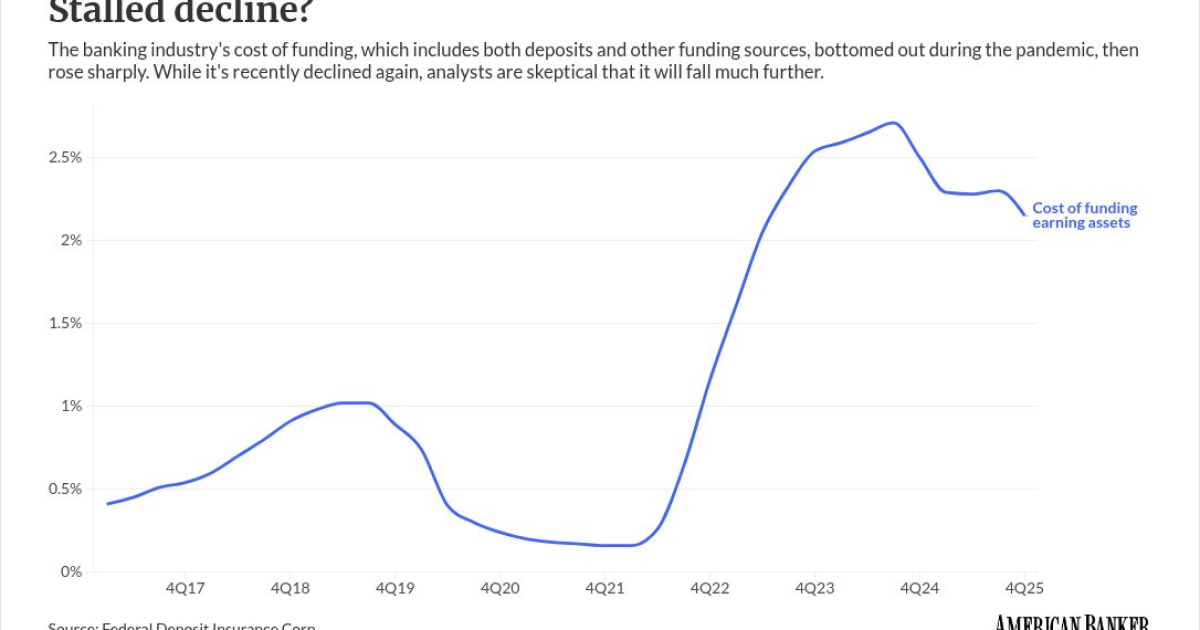
- Key insight: The banking industry’s cost of funding fell from 2.61% in 2024 to 2.26% last year, but analysts don’t expect much more improvement.
- What’s at stake: Renewed competition for deposits could dampen banks’ profit margins.
- Expert quote: “We’re seeing banks and credit unions maintaining their CD yields or even edging them higher.” —Mary Grace Roske, a spokesperson for CD Valet, which tracks annual percentage yields across thousands of lenders
Processing Content
The decline in deposit costs over the past year may have run its course, analysts say, as the Iran war’s inflationary effects hamper the Federal Reserve’s ability to cut interest rates again.
Renewed competition for deposits could dampen bank profit margins, since banks would be paying more interest to attract new depositors and retain existing ones.
Any such pressures today are tame compared with 2023, when a few high-profile bank failures
Since rate cuts have
“Banks have done a really strong job capturing the repricing tailwind — rates go down, they drop deposit costs pretty quickly,” said Christopher McGratty, head of U.S. bank research at Keefe, Bruyette and Woods. “But the incremental is hard, and you heard it from most every bank this quarter.”
There is a big bright side. Banks are competing for deposits partly so they can fund
“It’s a good lending environment,” McGratty said. “Banks can make a decent amount of money in this kind of yield curve.”
The Fed’s rate cuts have made funding cheaper for banks, with the industry’s cost of funding falling to 2.26% in 2025, down from 2.61% in 2024, according to data from
Deposit costs are likely “going to plateau” if the Fed keeps rates steady, said Rohan Shah, a partner at the consultancy Simon-Kucher who advises banks on deposit strategies. Larger banks may be more insulated, he said, since their vast branch networks and product sets give them many ways to attract customers beyond high interest rates.
The key for banks isn’t “winning the rate war,” Shah advised. Bankers should instead focus on making their relationships with customers sticky, he said, by engaging them with multiple products and ensuring the depositors they attract aren’t rate-chasers.
“It’s about using levers that are beyond just offering a better rate than the competition,” he said.
Pressure coming
Bankers are gearing up for more competition.
“An outlook with no cuts means that deposit pricing pressure is real and coming upon us,” Christopher Del Moral-Niles, chief financial officer at Pasadena, California-based East West Bancorp told analysts during the $82.9 billion-asset company’s earnings call last month.
Competition for low-cost deposits “is robust and growing,” said Brent Beardall, president and CEO at the Seattle-based bank WaFd, on the $27.6 billion-asset company’s earnings call.
Thus far, the pressures are manageable, said Tyler Wilcox, president and CEO of Marietta, Ohio-based Peoples Bancorp.
The $9.6 billion-asset bank is “competing largely against rational actors in the community bank and larger regional space,” he said on a recent earnings call, even if there are some smaller banks and credit unions offering above-average rates.
“We don’t chase stupid — it’s a technical banking term,” he said. “But we really value our margins.”
CD battles
More banks are already raising the rates they pay on certificates of deposit than reducing them, according to CD Valet, which tracks annual percentage yields across thousands of lenders.
Between April 3 and May 3, some 1,128 financial institutions hiked CD rates, while 969 lowered them, CD Valet found.
“We’re seeing banks and credit unions maintaining their CD yields or even edging them higher,” said Mary Grace Roske, a company spokesperson.
CD rates are still below last year’s levels. The median 12-month APY was 3.19% on May 5, down from 3.5% a year earlier, according to CD Valet data. But some lenders are still offering yields north of 3.5% — and a few are paying more than 4%.
More bank customers are realizing they can get paid more interest, rather than have their cash earn little or nothing in checking accounts or low-paying savings accounts, said Neil Stanley, founder of the deposit consultancy The CorePoint. It’s a trend that Stanley expects to continue as artificial intelligence tools make it easier for customers to track their finances.
“Who do you know that would responsibly say, in a 3.5% fed fund world, I don’t need to get paid interest on my money?” Stanley said.
Steady state
The shift back toward deposits that pay interest — rather than the cheaper checking accounts that banks treasure — has been pronounced.
Non-interest-bearing deposits were less prevalent before the 2008 financial crisis, making up 16% of bank deposits in 2007, according to a Mercer Capital analysis. But the low-rate era that followed the crisis helped banks gain the upper hand. The share of non-interest-bearing deposits rose to 28% by 2022.
The Fed’s post-pandemic rate hikes tipped the balance back, with non-interest-bearing deposits sliding and making up some 23% of deposits by September 2025, according to Mercer Capital.
The good news for banks is that the shift has slowed. “Most of the burn and the churn has been realized,” McGratty said.
The bad news is that the shift in mix of deposits is unlikely to reverse course anytime soon. KBW anticipates that the makeup will stay stable from here.
The industry may have reached a “new steady state” in its mix of deposits, said Theresa Paiz Fredel, senior director at Fitch Ratings. After all, consumers and businesses require some level of deposits to be on demand so they can pay bills and groceries or make payroll, rather than stashing away cash in harder-to-withdraw savings accounts.
“There’s a certain level of demand deposits that everyone’s going to need just for the day-to-day transactions, and that’s probably not going anywhere,” she said.
The shift to interest-bearing deposits has also had some positive benefits, argued Mark Narron, senior director at Fitch. Before 2023, some banks may not have given “enough rigor and thought” into which revenue-generating businesses were truly worth their time and effort, he said.
But now bankers have realized that they won’t be able to “run indefinitely on huge pools of non-interest-bearing deposits,” Narron said, forcing them to pick which business lines are the most profitable and leaving behind those that are lower-yielding.
“It’s created a lot more discipline,” he said.