


- Key insights: Banks partner with fintechs for a host of services, including processing payments, buy now/pay later, international payments, virtual accounts, stablecoins and other crypto services.
- What’s at stake: These connections have strengthened over time, but the need to control risk has grown as well.
- Forward look: Regulators are pressuring banks to improve operational resilience, third-party risk, data governance and AI transparency.
Many banks are battening down the hatches on fintech partnerships to mitigate risk more effectively.
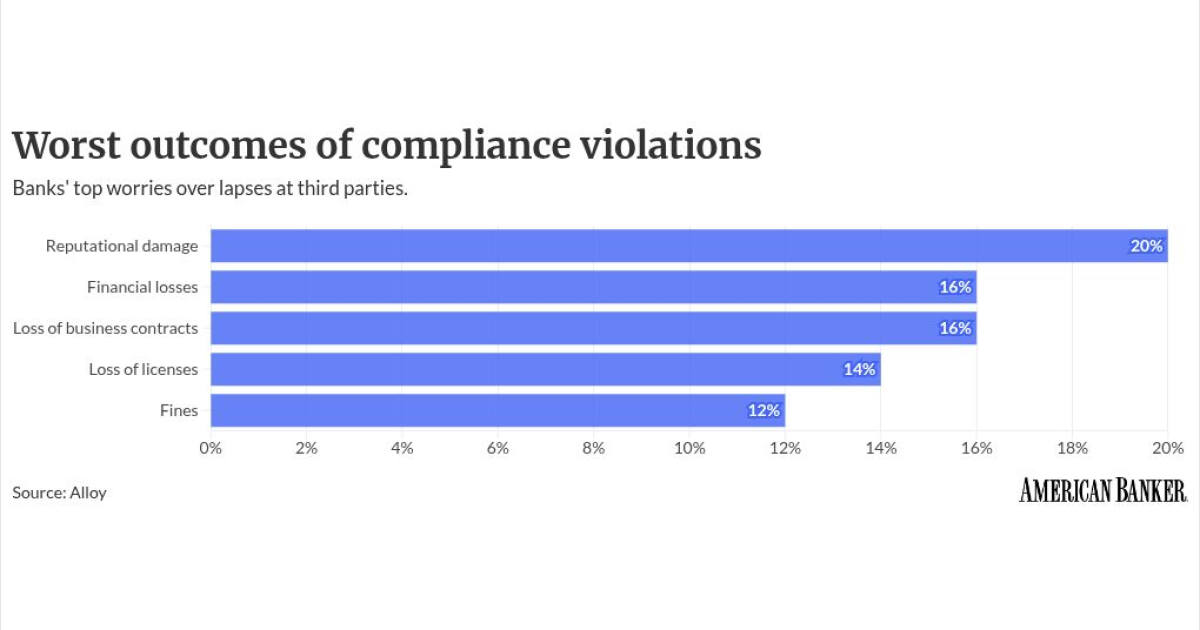
And with good reason, given that 80% of sponsor banks find meeting compliance requirements challenging, and 39% lost at least $250,000 due to compliance violations, according to a 2024
Processing Content
Banks
Banks that aren’t careful about policing their fintech partnerships can create “systemic risks,” Brian Shniderman, Accenture’s North American Payments lead, told American Banker. “Fintechs can destroy or nearly destroy a bank,” he added.
Here are five considerations for banks as they continue to navigate partnerships with payment fintechs:
Regulators have upped their expectations
Rules and regulations are changing rapidly, especially as artificial intelligence proliferates. As such, banks need to be more selective about their fintech partners and double down on efforts to ensure the bank is protected, Linda Lerner, partner at law firm Halloran Farkas + Kittila, told American Banker. “Regulatory and compliance is not the place to try to save money.”
Take a deeper dive into a partner or potential partner’s business model
A careful look under the hood is especially important as federal agencies, including the FDIC, OCC and Federal Reserve, have boosted
Banks also need to understand a fintech’s anti-money-laundering-related policies, business continuity plans, and cybersecurity policies and procedures, Lerner said. Good vendors will have a prepared description of the steps they take to safeguard the information they obtain, Lerner told American Banker. This can include physical security of their building and ensuring they have a hot site and a warm site for disaster recovery purposes. If a tornado rips through Virginia, a bank needs to know the fintech has a site in Oregon that’s immediately available, she said. It’s also important to ask how many intrusion events a fintech has had. “If they say none, you can’t believe them,” Lerner said.
Many banks now insist on more oversight of a fintech’s vendor relationships, whether that’s their cloud provider, the company offering know-your-customer solutions, the fraud prevention contractor, or the fintech’s AI model providers, Steve Schult, chief product officer at InvoiceCloud, a digital billing and payment platform, told American Banker. A bank may be comfortable approving a particular AI model, for example, but if the vendor moves from OpenAI to Anthropic or vice versa, the bank will want to approve that, Schult said.
Banks are asking that vendor names be written into contracts, and they’re requiring notice of a change and the option to agree or break the contract. Banks “want to be able to approve material changes,” Schult said.
Shift to ongoing assessments
Many banks review fintech partnerships annually. However, CGI’s Schmidt said banks should move from periodic assessments to continuous, risk-based oversight of fintech partners. “This means strengthening real-time monitoring, clear accountability frameworks, and end-to-end visibility across the ecosystem, while ensuring robust data governance and auditability — especially for AI-driven capabilities,” he wrote. “Banks should also actively manage concentration risk by diversifying partners and maintaining credible exit strategies.”
Watch for warning signs of a risky fintech relationship
Banks should watch for nonobvious red flags such as weak back-end integration behind strong UX, “fake” real-time capabilities, opaque data models, hidden concentration risk, limited scalability, and AI systems lacking transparency, Schmidt noted. Data protection and cybersecurity are other warning signs. How does the fintech authenticate? Does it encrypt data in transit and at rest? Who has access to client data? When was their last network penetration test, and what were the findings? And if the fintech is offering an app, when was their last application penetration test, and what were the findings?
“The issue that banks often encounter is that fintechs may prioritize functionality over security to get to market more quickly in an environment where the bank’s only asset is trust,” Schmidt wrote.
Smaller banks need to rely more heavily on core providers
Community banks can still get access to fintech payments products such as digital asset solutions, including stablecoin, and instant payment overlay services — value-added applications to enhance customer experience — but they should work with their core providers to vet potential partners, Accenture’s Shniderman told American Banker. For smaller banks, “I think it’s very risky to go down the path of partnering with fintechs directly. I think they need an intermediary behind them.”