


“I might be going away for twenty-five years,” a man in a gray D.O.C. jumpsuit told Richards, who stopped to talk to him.
“It’s not your life,” Richards told him. “Don’t you ever forget that.”
Selwyn Fergus, who serves as the senior adviser to the commissioner at the D.O.C., met Richards when they were third graders in the Bronx. “Back then, we were both part of the Baby Spades, a division of the Black Spades,” Fergus told me. He said that he’d been drawn to the gang out of a desire for belonging, after arriving as an immigrant from Trinidad. “There was this one guy that used to pick on me,” Fergus said. “One day, Stan beat the guy up. He never came back to school.” Richards’s mother died when he was ten, and he had a chaotic childhood; he became involved in drugs and was first arrested in 1976, at age fifteen. By the late eighties, he was serving time for armed robbery.
Today, Richards speaks about his four and a half years in prison, during which he completed an associate’s degree in social science and ran a pre-release center that helped others get ready for life outside, as a period when he first recognized the kind of work he wanted to do. When he was released, he applied for jobs at nonprofits that focussed on the transition to civilian life, only to be told that he lacked the requisite experience. “Lived experience” did not, at the time, have much currency. “Formerly incarcerated people were pariahs,” Vincent Schiraldi, a corrections commissioner under Bill de Blasio, told me. Schiraldi has been a longtime advocate for criminal-justice reform in his work both for government and at N.G.O.s. For much of his career, he said, people with Richards’s background “were not at the table,” even among reformers. “They were not running nonprofits. They were not a voice that you would want to testify on a bill.”
The Fortune Society was the only place to make Richards an offer. In 1991, the year of his release, he started there as a reëntry counselor. JoAnne Page, the organization’s president and C.E.O., had hired him; she remembers Richards talking about how, while in prison, “he had gone from being Big Stan of the Bronx to being a college student.” At the time, the group had around two dozen employees and was struggling for financial stability. Richards’s role grew as the organization did, and he eventually became Page’s successor as C.E.O. Today, the Fortune Society has about six hundred employees and a budget of more than ninety million dollars.
In the nineties, when someone was released from Rikers, the D.O.C.’s standard practice was to bus them to Queens Plaza, in Long Island City, where they would be dropped off, usually in the middle of the night. “And, at that time, Queens Plaza was a hot mess,” Richards told me. The area was rife with drugs and sex work. He and Page arranged to rent a table at a doughnut shop near the spot where the Rikers bus pulled up; there, starting in the early two-thousands, they greeted new arrivals, gave them food, and offered to help connect them with services. (“Feeding people builds trust,” Page said.)
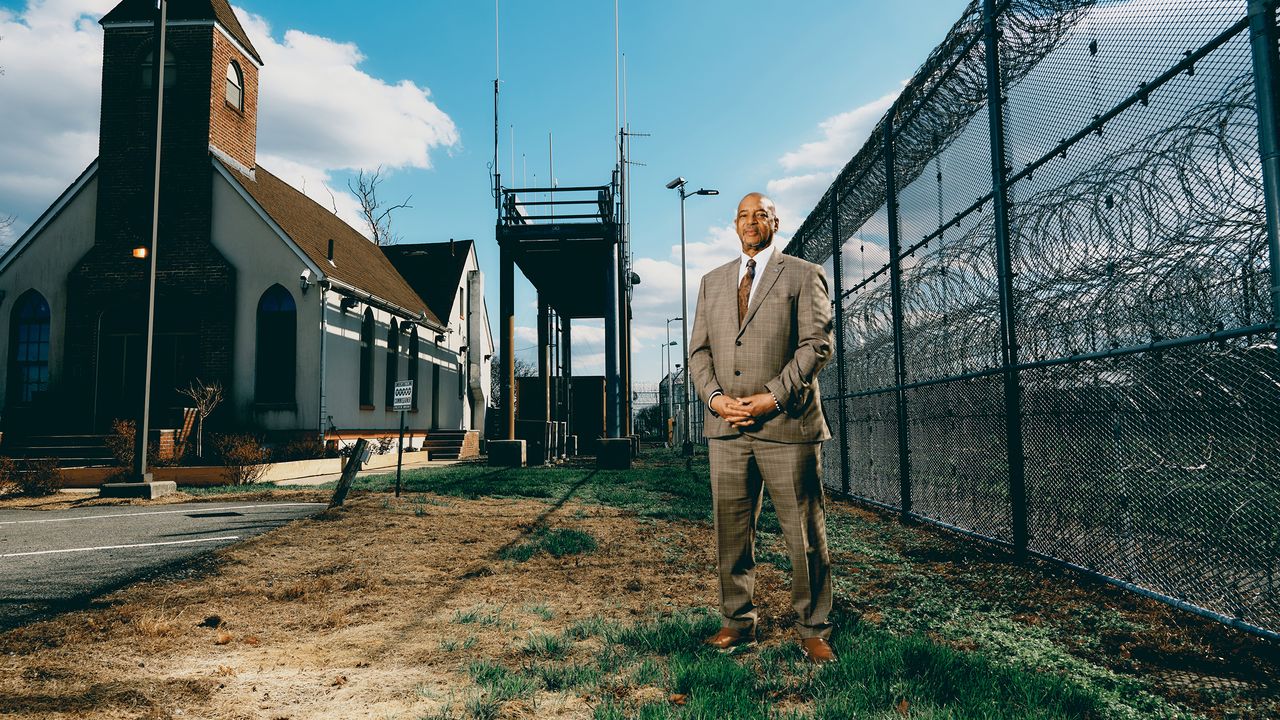
Today, Richards’s office on Rikers is situated in a small former chapel with a red brick steeple, across a stretch of lawn from the jail where he was once held in solitary. “It’s a reminder of what’s hopeful and what’s possible,” he said, of the view outside his office. “That a man from the South Bronx, who spent time on this island, could walk past this building as a five-star commissioner.”