


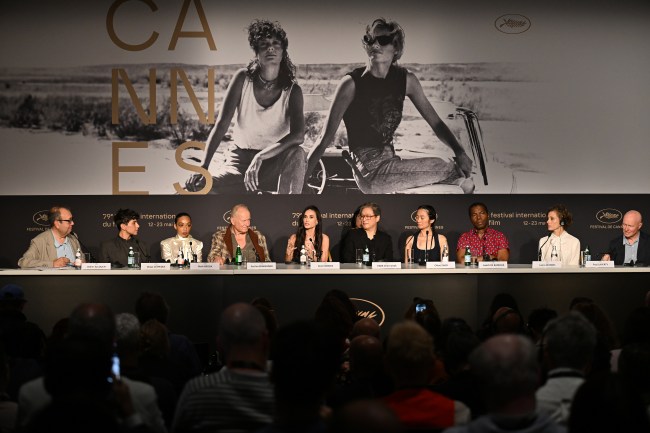
Amid the usual expressions of gratitude and cinephilia from this year’s Cannes jury, led by Park Chan-wook, the first Korean president in the festival’s history, politics were front and center.
Cannes screenplay winner Paul Laverty (“Sweet Sixteen”) started things off. He said that the root of the word politics, “the Greek polis, means about the city, the meanings of how human beings behave with each other … in the deeper sense of how we treat each other. Power values are encrusted in every type of script or any type of story.”
He went on to warn people about the control corporations have over artificial intelligence, and then finished forcefully by praising Cannes’ “wonderful” “Thelma and Louise” poster. “And isn’t it fascinating to see someone, like Susan Sarandon, Javier Bardem, and Mark Ruffalo, blacklisted because of their views and opposing the murder of women and children in Gaza?,” he said. “Shame on Hollywood people who do that and then my respect and total solidarity to them.”

Political issues have dogged festivals like Berlin, where artistic director Tricia Tuttle endured a firestorm of controversy. Cannes director Thierry Frémaux, at the pre-festival press conference Monday, defended Berlinale jury president Wim Wenders, saying he was misunderstood, and cited the political history of Cannes.

Demi Moore and Park deftly handled other political questions. “Part of art is about expression,” said Moore. “So if we start censoring ourselves, then we shut down the very core of our view. Which is where we can discover truth and answers.”
In answer to a question about AI, she said, “AI is here, and so to fight it is a battle that we will lose. So to find ways in which we can work with it is a more valuable path. … Truth is, there isn’t anything to fear, because what it can never replace is what true art comes from, which is not the physical. It comes from the soul. It comes from the spirit of each and every one of us sitting here, each and every one of us that creates every day, and that they can never recreate through something that’s technical.”
Chilean director Diego Céspedes, who made a splash with last year’s Un Certain Regard winner “The Mysterious Gaze of the Flamingo,” said, “I also am very political. We need to take a political position. I hope that the cinema gets diverse, and that not just rich people do cinema. I represent that and hope we can push that.”
But what really matters is how these jury members will lean when voting for the prize winners, including the pivotal Palme d’Or, which has moved the needle in the Oscar race in recent years, from Best Picture winners “Parasite” to “Anora.”
Iranian dissident Jafar Panahi’s “It Was Just an Accident” likely pushed the Academy Board of Governors to add Oscar eligibility to a handful of competition winners at key film festivals, including Berlin and Cannes. Now France wouldn’t have to submit an Iranian film.
Director Park reassured the press that just because Korea has grown in influence in recent years, with three films in the 2026 Cannes selection, including Neon pickup “Hope” in the Competition, “I am not going to be biased towards Korean works. I will judge very fairly.”

When figuring out the Cannes jury, it helps to ignore the Screen International critics’ grid and remember that most actors — on this year’s jury: Demi Moore, Stellan Skarsgård, Ruth Negga, Isaach de Bankole, and Laura Martel — are driven by emotion. Clearly Laverty and Céspedes have strong humanist leanings. And openly spiritual Chloé Zhao admitted to wearing her heart on her sleeve.
Which leaves director Park at the center of the debates that will follow in the coming week.
As for American representation at Cannes, the studios are conspicuously absent, perhaps remembering that for every success like “Top Gun: Maverick” or “Elvis” there are movies that miss the mark, from “Indiana Jones and the Dial of Destiny” and “Elemental” to Warner Bros’ “Furiosa” in 2024. Ira Sachs “The Man I Love” and James Grey’s “Paper Tiger” are the only American films in Competition.
Of the seeming lack of Hollywood attention this year? “I hope the studio films come back,” said Frémaux.