


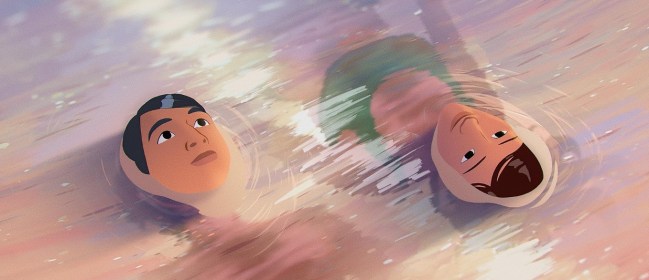
Based on the graphic memoir of the same name by illustrator AJ Dungo, the Cannes Critics’ Week selection “In Waves,” from director Phuong Mai Nguyen and screenwriters Fanny Burdino and Samuel Doux features beautiful, emotional animation, but is bogged down by its clichéd story of a man coming of age by falling in love with a dying (surfer) girl.
Ostensibly set in Los Angeles (although the local geography is wonky as hell), the film is largely told from the point of view of shy, artistic teenager AJ (voiced by Will Sharpe), who is coaxed out of his shell by his best friend Cisco (Alejandro Antionio Ruiz). The two attend a welcome week party at their high school where AJ meets cute with the impossibly cool Kristen (Stephanie Hsu) after literally jumping into her on the dance floor. Time nearly stops and the animation slows as her beautiful face and shiny hair fills the screen and AJ’s awestruck eyes.

For AJ, it is love at first sight. From this moment on, the film never gets out of his adoring gaze and into something deeper and more real.
After a rocky start to their courtship, Kristen teaches the skateboard-loving, aquaphobic young man the art — and colonial history — of surfing. She prays to statue of Duke Kahanamoku, a Native Hawaiian, Olympic swimmer, and the man she claims popularized the art of surfing after the colonizers banned it in Hawaii.
After wiping out at first, AJ feels the levitation and poetry of surfing. His ecstasy is beautifully represented through the magic of the animation. The scenes of AJ and Kristen together are sweet and filled with the awkward chemistry of youth, rendering in rich and vibrant color palettes. Their FaceTime chats and forbidden nighttime rendez-vous are so charming, they sweep you up in their fervor.
These scenes are cross-cut with silent, black-and-white retellings of the pre-colonial Hawaiian legacy of surfing, its mystical origins. and traditional practice. These are gorgeously drawn in the style of pen and ink, with AJ’s pen strokes taking on the slick curves of the ocean waves. In one breathtaking sequence, the waves of the ocean, of the bark lines of the tree, and of Kristen’s hair all swirl together through the harmony of a connected world.
A third timeline is slowly woven into the story. Here the world is nearly drained of all its color as AJ, living in a van on the beach, works on an art project that includes myriad sketches of surfing, of the ocean, and of Kristen herself. These scenes are meant to seem mysterious, to raise questions as to why AJ is now suddenly alone. However, the twist is telegraphed so early on that there is no air of mystery, just a foreboding sense that this material is about to enter the land of sick-girl-inspires-artist clichés.
These clichés come to fruition when Kristen is immobilized by pain in one of her legs which, of course, is diagnosed as cancer. Her illness brings her closer to AJ, and the two make their hidden relationship known to her parents. Nguyen’s striking direction in the scenes in which Kristen faces her future in the hospital elevates the maudlin material, especially after Kristen makes the choice to lose a leg in the hopes of snipping the cancer in the bud.
Hsu’s voice performance also gives Kristen spunk in these scenes, while Sharpe brings an unexpected vulnerability to AJ. However, the thematic and connective threads between the three timelines become more and more tenuous as the film’s focus shifts onto Kristen’s illness. Eventually, she becomes solely defined by her cancer and by her relationship with AJ. Her attempts to keep surfing become inspiration bait. The couple fight about their future, Kristen not wanting AJ to make any sacrifices for her. As Kristen gets sicker, the film hits other cancer movie beats like a trip up the coast to a snowy mountain, complete with Kristen, AJ, her brother, and their friend taking cheesy photos all along the way.
Most of this wouldn’t be so cringe-inducing, especially given the autobiographical nature of it all, if the film had ever established a better sense of who Kristen is outside of surfing and AJ. As she heads towards the great beyond, she asks AJ to tell their story, yet it seems AJ was only really capable of telling his story. His version of Kristen, without any of her interiority.
Worst of all, the film is an overly sanitized, almost idealized account of what it is like watching someone you love die from cancer. There is crying, sure, but everything is presented on a surface level. There is no nuance. No details. Nothing — aside from her love of surfing — that differentiates Kristen from any number of other dying girls in cinema.
As the film ends, the reason for its title becomes the worst cliche of all. Via voiceover narration, AJ shares what he learned from Kristen’s death: that grief comes in waves. Here the script attempts to wade out of these tropey waters and bring the surfing metaphor full circle by adding that because you can’t stop the waves of grief, “you’ve got to ride” them. Aiming for profundity, all this final sequence manages to achieve is the philosophical heft of a discount fortune cookie.
Grade: C
“In Waves” premiered at the 2026 Cannes Film Festival. It is currently seeking U.S. distribution.
Want to stay up to date on IndieWire’s film reviews and critical thoughts? Subscribe here to our newsletter In Review by David Ehrlich, in which our Chief Film Critic and Head Reviews Editor rounds up the best new reviews and streaming picks along with some exclusive musings — all only available to subscribers.