


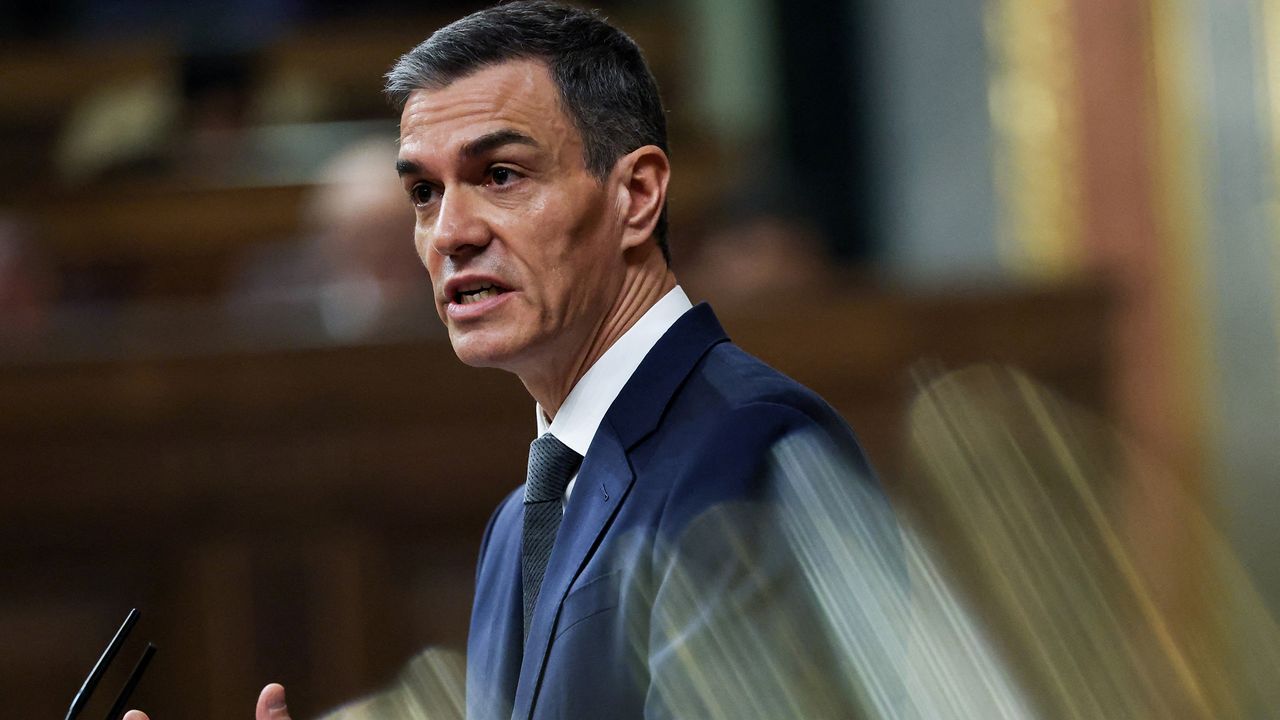
In the immediate hours after President Donald Trump, in conjunction with the Israeli Prime Minister, Benjamin Netanyahu, launched the war on Iran, one major European leader chose to speak out against it. “We reject the unilateral military action by the United States and Israel,” the Spanish Prime Minister, Pedro Sánchez, posted on X, warning against an “escalation” that could lead to a more “hostile international order.” The next day, Sánchez reiterated his opposition to Iran’s “hateful regime,” but still branded the campaign as “an unjustified and dangerous military intervention.” Even as other European officials shied away from criticizing Trump and offered limited assistance to the U.S. war effort, Spain denied the U.S. access to its military bases for operations linked to Iran. Trump, in return, threatened to “cut off all trade” with Spain, though it was far from clear how his Administration could go about selectively targeting a member of the European Union. Sánchez seemed to revel in the clash. “We are not going to be complicit in something that is bad for the world and is also contrary to our values and interests, just out of fear of reprisals from someone,” he insisted in a televised address. In early April, after the Administration agreed to a temporary ceasefire with Iran, the Prime Minister did not back down. “The government of Spain will not applaud those who set the world on fire just because they show up with a bucket,” he posted.
Sánchez’s criticism of the war has set him up as a conspicuous foil to Trump. On multiple fronts, Sánchez, a photogenic Socialist who has been in power since 2018, cuts a stark political contrast. Trump has rejected as a “scam” the Joe Biden-era pivot toward investment in renewable energy, whereas Sánchez has presided over the doubling of solar- and wind-energy production in Spain since 2019. Trump demonizes immigrants and has launched a sweeping mass-deportation campaign that was cheered by the far right across Europe; Sánchez resists such nativism, and his government is in the midst of a program to give legal status to some half a million undocumented migrants living in Spain. Trump has derided international institutions and sees the United Nations as an impediment to U.S. interests; Sánchez declined Trump’s invitation to join his “Board of Peace” initiative, while offering a spirited defense of the U.N. system and the multipolar world it helps shape.
Now, two and a half months after the start of the war, Sánchez’s frustrations are broadly shared by his peers in Europe. The government of the Italian Prime Minister, Giorgia Meloni, widely seen as Trump’s staunchest supporter among Western European leaders, thwarted U.S. bombers destined for the Middle East from using a strategically placed Sicilian airbase. Meloni also defended Pope Leo XIV, whom Trump has been attacking for his calls for peace, saying that the President’s remarks were “unacceptable.” (Trump, when asked whether he would then consider cutting the number of U.S. troops in Spain and Italy, said, “Probably.”) Meanwhile, President Emmanuel Macron, of France, bemoaned Trump’s “all over the place” approach to the war, which he suggested lacks seriousness and is a font of geopolitical instability. The German Chancellor, Friedrich Merz, cast it as a source of American humiliation, while his finance minister, Lars Klingbeil, blamed Trump’s “irresponsible war” and the ongoing blockade of the Strait of Hormuz for rising energy prices and for unleashing downstream economic chaos around the world. “This is a unilateral war” about which “no ally was even consulted or informed,” José Manuel Albares, Spain’s foreign minister, told me in an interview last week. “If you see what other European governments are saying, they are saying today what Spain has been saying since the very first day.”
In Albares’s telling, his government’s stand is a matter of principle, consistency, and adherence to the importance of international law. Its convictions predate Trump’s war-making in the Middle East. Spain has been critical of Russia’s war in Ukraine and of Israel’s wars in Gaza and Lebanon, and has backed the South African case at the International Court of Justice accusing Israel of genocide. It was among the first Western European countries to recognize Palestinian statehood, in 2024. This April, as Sánchez convened a gathering of progressive world leaders, including the Brazilian President, Luiz Inácio Lula da Silva, he called on the E.U. to suspend its association agreement with Israel. While the Trump Administration imposed sanctions on Francesca Albanese, a U.N. special rapporteur for Palestinian issues, because she had urged the International Criminal Court to investigate U.S. and Israeli companies and individuals for alleged complicity with human-rights violations and possible war crimes in Gaza, Sánchez awarded her the Order of Civil Merit, one of Spain’s highest honors, earlier this month. When Trump cajoled NATO member states last year to raise their defense spending to five per cent of G.D.P., Sánchez was the only leader to balk at the demand. “Sometimes I see people saying, ‘Well, there is an old order, and there is a new order,’ ” Albares said. “No, there is a rules-based order, or there is the chaos of war, and that’s a choice. There is a way of behaving in the world that is virtuous, in which everyone has their interests advanced, or there is the law of the jungle, and the stronger eats the weaker.”