


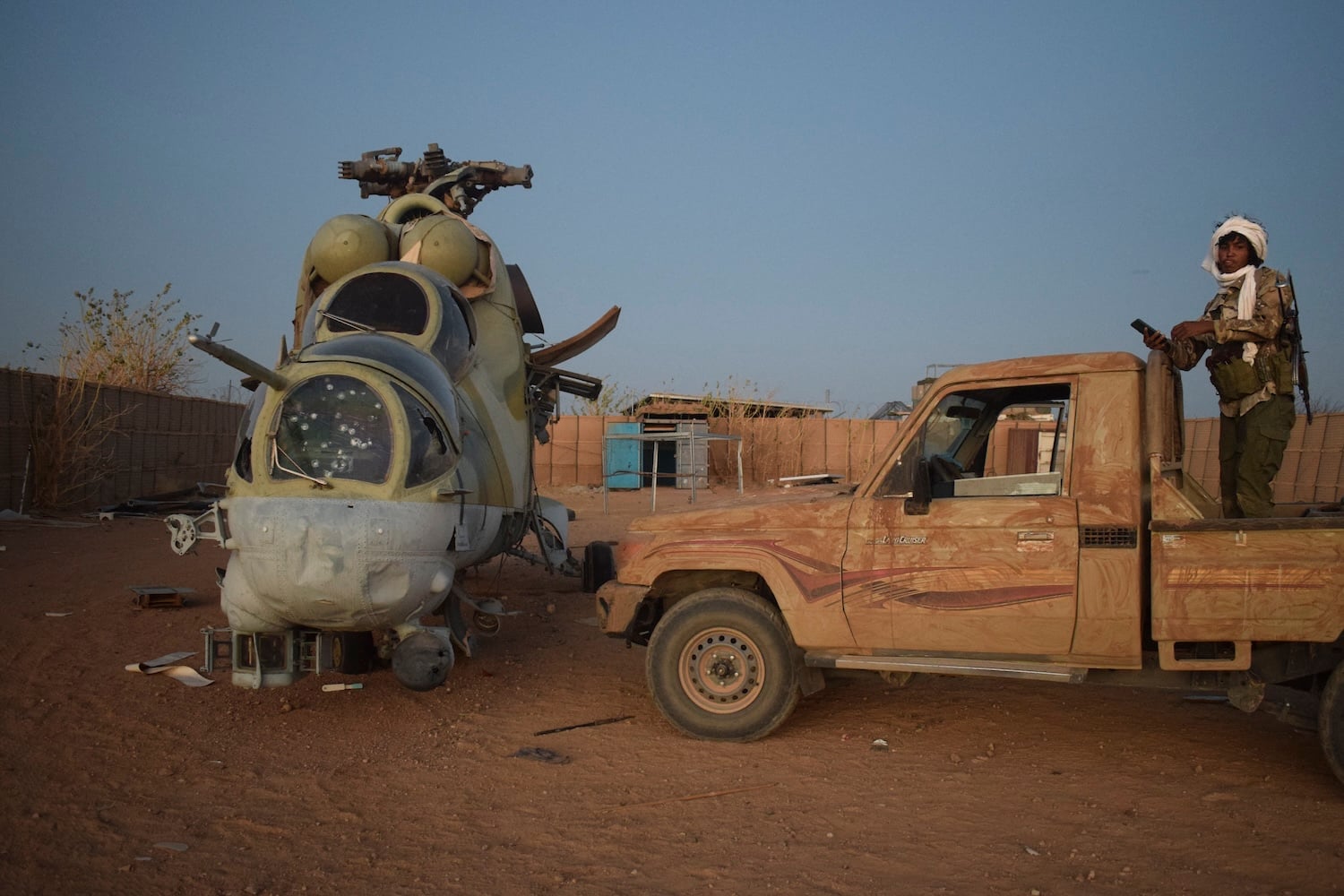
On April 25, a series of coordinated attacks shook military sites and cities across Mali, claiming the life of Defense Minister Sadio Camara, who had been considered a central player in the country’s security relationship with Russian forces. Jama’at Nusrat al-Islam wal-Muslimin (JNIM), an al Qaeda affiliate that has metastasized across the Sahel for years, and the Azawad Liberation Front (FLA), the Tuareg-led separatist movement operating primarily in Mali’s north, claimed responsibility for the attacks.
The scale and coordination of these operations by the two groups—one jihadi, one ethno-nationalist—was unprecedented, marking Mali’s most significant security crisis since the outbreak of civil war in 2012. Throughout the 2010s, French and United Nations counterterrorism forces struggled to contain rebel and jihadi violence. Frustration over deteriorating security and corruption helped bring Malian President Assimi Goita to power through coups in 2020 and 2021. Bamako then abandoned its long-standing security partnership with France and turned to Russia’s paramilitary Wagner Group—later rebranded as Africa Corps—for support.
On April 25, a series of coordinated attacks shook military sites and cities across Mali, claiming the life of Defense Minister Sadio Camara, who had been considered a central player in the country’s security relationship with Russian forces. Jama’at Nusrat al-Islam wal-Muslimin (JNIM), an al Qaeda affiliate that has metastasized across the Sahel for years, and the Azawad Liberation Front (FLA), the Tuareg-led separatist movement operating primarily in Mali’s north, claimed responsibility for the attacks.
The scale and coordination of these operations by the two groups—one jihadi, one ethno-nationalist—was unprecedented, marking Mali’s most significant security crisis since the outbreak of civil war in 2012. Throughout the 2010s, French and United Nations counterterrorism forces struggled to contain rebel and jihadi violence. Frustration over deteriorating security and corruption helped bring Malian President Assimi Goita to power through coups in 2020 and 2021. Bamako then abandoned its long-standing security partnership with France and turned to Russia’s paramilitary Wagner Group—later rebranded as Africa Corps—for support.
The recent attacks, along with JNIM’s continued blockade of Bamako, highlight the failure of Russia’s mercenary security model to stabilize the country. Instead, its coercive counterinsurgency operations have alienated civilians, undermined local intelligence collection efforts, and fueled jihadi recruitment.
Mali’s partners in the Alliance of Sahel states, Burkina Faso and Niger, have embraced the same model. Each state is led by a coup-installed regime. Each has expelled Western partners. Each now relies on Russia’s Africa Corps.
Mali did not turn to Russia in a vacuum. After gaining independence from France in 1960, Mali maintained a close relationship with its former colonizer that was often shaped by economic and military intervention.
In 2013, France’s Operation Serval halted a jihadi advance from the north at the Malian government’s request, but the broader counterterrorism mission that followed—Operation Barkhane—as well as a U.N. peacekeeping mission failed to resolve Mali’s enduring political and security crises. Yet years of foreign military involvement brought few security improvements.
When Mali’s military junta seized power in 2021, it adopted a particularly violent counterinsurgency strategy that has seen more civilians killed by government and allied forces than by jihadi groups, according to research by Human Rights Watch. The al Qaeda affiliate JNIM continued to expand, civilian casualties mounted, and tensions with Mali’s separatist groups in the north grew. When the junta expelled French and U.N. forces in 2022, it did so with at least partial popular support.
Russia’s Wagner Group offered an alternative to the Western security force assistance model, promising security without political conditionality, democratic benchmarks, or external scrutiny. Moscow was also free of the neocolonial baggage that many Malians associated with France, and it provided diplomatic backing when Western governments and regional organizations pressured Bamako over coups.
For a military regime seeking autonomy and survival, the appeal was obvious: a welcome shift that would enable the junta to invoke a renewed era of sovereignty—or what Foreign Policy columnist Howard French calls facile nationalism.
Although Wagner’s stint in Mali was brief, Russia’s presence endured. After Wagner leader Yevgeny Prigozhin launched a failed mutiny against the Kremlin in 2023, the group’s African operations were folded into the Africa Corps under Russia’s Defense Ministry. For Mali, little changed structurally, though the more bureaucratic, state-controlled force appears to be both less flexible and less risk-tolerant. The transition’s shift toward less kinetic operations and a more training-focused model has reportedly ruffled some feathers in the Malian army, since Russian military assistance was originally billed as an offensively oriented project.
As we argue in our forthcoming book, Wagner and its successor were designed for extraction and regime protection, not battlefield effectiveness, territorial stabilization, or civic trust. In practice, this meant protecting elites, securing resources, and controlling populations through coercive violence, resulting in a mission that is fundamentally distinct from counterinsurgency, even if it was marketed as such.
Mali’s security situation deteriorated by virtually every available metric following Wagner’s deployment in 2021. As JNIM adapted to the presence of Russian forces, it expanded and increased its operational sophistication. In response, Malian forces and Wagner personnel killed at least 500 civilians in the village of Moura in 2022. They billed the operation as a deterrent against civilian support for the jihadis. Instead, the mission deepened civilian grievances (particularly those of disproportionately targeted minority Muslim communities), accelerated insurgent recruitment, and further eroded the state’s perceived legitimacy.
Wagner-backed forces helped the Malian army seize Kidal, a long-contested rebel stronghold in the country’s east, a year later. But the recent JNIM-FLA attacks have completely reversed those gains, revealing Africa Corps’ lack of both the intelligence capacity and operational reach required for effective counterterrorism. Reports have also emerged of Africa Corps fighters abandoning positions and leaving Malian forces exposed, revealing a long-standing limitation of mercenary warfare: Contractors may not demonstrate the same degree of cohesion or commitment as national forces fighting for regime, territory, or national identity.
Africa Corps’ human rights violations continue to alienate local populations. In 2024, the group opened new fronts in Mali’s north, breaking an internationally recognized peace treaty that had granted Mali’s Tuareg minority a measure of self-rule in the region. The move deepened Tuareg grievances, driving greater tactical cooperation between the Tuareg FLA and JNIM.
The Sahel already accounts for more than half of all terrorism-related deaths worldwide. In addition to the growing strength of rebel and jihadi groups, the region’s Islamic State affiliate reportedly used the recent joint attack as an opportunity to initiate its own territorial grabs. There are also growing concerns that the Islamic State Sahel Province—which competes with and occasionally cooperates with JNIM across the tri-border region—may be on a trajectory to pose a legitimate transcontinental threat.
Further, violence in northern and central Mali has produced one of the most acute displacement crises on the continent. Civilian populations are caught between armed actors with few viable avenues for protection, which could fuel mass migration abroad.
Following April’s security fiasco, the Kremlin said it intends to keep Russian forces in Mali to support efforts against insurgents and extremists. Rather than acknowledging any failure in the recent attacks, Russian officials deflected, contending, without evidence, that Western security forces may have trained the attackers.
Such claims seem to be less aimed at explaining the crisis than preserving Moscow’s credibility, reflecting the increasingly blurred line between Africa Corps and the Russian state itself. Unlike the quasi-deniable Wagner Group, Africa Corps’ battlefield setbacks are harder for Moscow to distance itself from. The Kremlin’s muted response also reflects geopolitical priorities elsewhere—particularly its war in Ukraine—which have constrained the Malian project and consumed Moscow’s strategic attention.
Russia’s setbacks in Mali will not immediately translate into a loss of influence. If anything, Moscow has shown a tendency in the past to double down rather than disengage, a trend reinforced by reports that Russia is developing a new logistics hub in Guinea to serve as a gateway to operations in the Sahel.
This won’t be the end for the Malian state, either. JNIM and the FLA are operating under an alliance of convenience, and their long-term political goals have potential to lead to friction and conflict. Much like Mali’s army, these organizations lack the logistical power to maintain control over large swaths of territory, and JNIM’s attention is divided among other operational responsibilities in Burkina Faso and Niger. While more future attacks are possible (if not probable), the possibility of a Taliban-style march on Bamako appears unlikely.
If the Malian Armed Forces perceive Russia’s support as falling short of its core function, frustrations over battlefield losses or shifting operational priorities may begin to surface. These dynamics might not necessarily translate into immediate instability, but they can complicate the very value proposition that underpinned the partnership in the first place. Mali’s troubles reflect the tensions inherent in a flawed security assistance model: Wagner and Africa Corps were intended to be instruments of regime survival, not a genuine counterterrorism solution.
For regional governments, the question isn’t whether Russia remains a partner, but whether its model can address the threats that they face. Partnering with Russian mercenaries was always a risk; the absence of viable alternatives makes an immediate break with Moscow unlikely.
The implications extend well beyond Mali. A worsening security crisis in the Sahel risks accelerating transnational terrorism, deepening humanitarian crises, increasing migratory pressures toward Europe, and threatening West African states and Gulf of Guinea trade routes. More broadly, Mali’s experience raises deeper doubts about the durability of transactional security partnerships in fragile states. The gamble on Russian mercenaries looks increasingly like a bad bet.