


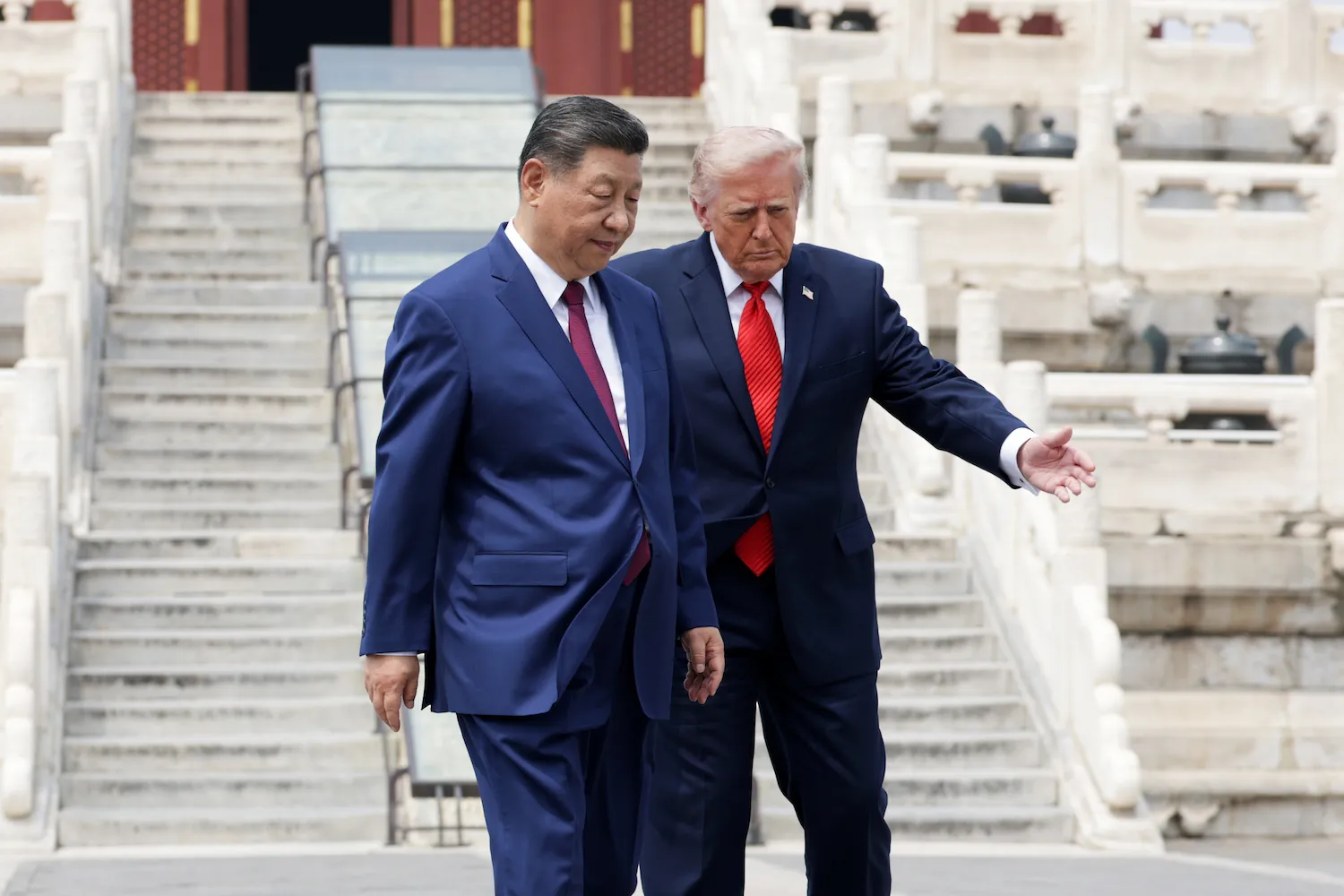
Welcome back to World Brief, where we’re looking at the biggest takeaways of the Trump-Xi summit, British Prime Minister Keir Starmer’s political fortunes, and the collapse of Latvia’s coalition government.
No Big Wins
“Partners, not adversaries” was the theme of high-stakes talks between U.S. President Donald Trump and Chinese President Xi Jinping on Thursday. Set against the backdrop of Beijing’s opulent Great Hall of the People, both leaders expressed the desire to bolster economic ties to create what Xi called a “new vision” for the U.S.-China relationship. However, thinly veiled threats about Taiwan alongside Trump’s weakened position at home overshadowed the summit’s veneer of cooperation.
Welcome back to World Brief, where we’re looking at the biggest takeaways of the Trump-Xi summit, British Prime Minister Keir Starmer’s political fortunes, and the collapse of Latvia’s coalition government.
No Big Wins
“Partners, not adversaries” was the theme of high-stakes talks between U.S. President Donald Trump and Chinese President Xi Jinping on Thursday. Set against the backdrop of Beijing’s opulent Great Hall of the People, both leaders expressed the desire to bolster economic ties to create what Xi called a “new vision” for the U.S.-China relationship. However, thinly veiled threats about Taiwan alongside Trump’s weakened position at home overshadowed the summit’s veneer of cooperation.
Xi warned Trump on Thursday that any disagreement over Taiwan could harm bilateral relations—and even lead to conflict. “If [the Taiwan question] is handled properly, the bilateral relationship will enjoy overall stability,” a Chinese readout of the meeting said. “Otherwise, the two countries will have clashes and even conflicts, putting the entire relationship in great jeopardy.”
China does not recognize Taiwan’s sovereignty and has repeatedly denounced Washington’s support for Taipei. Experts expected Xi to push Trump on Thursday to delay a promised $14 billion arms package for Taiwan. The deal, passed in January and awaiting the U.S. president’s approval, comes after Trump already signed off on another massive package worth $11.1 billion the month before.
Ahead of the summit, analysts suspected that Trump would try to downplay U.S. ties with Taiwan to secure favorable trade deals with China. High fuel prices due to the Iran war have tanked Trump’s approval ratings back home. Coupled with several U.S. court rulings against the president’s ability to impose sweeping tariffs on China and other countries, Trump faced extra pressure going into the summit to secure big economic wins.
But U.S. Secretary of State Marco Rubio dismissed these concerns on Thursday, stressing that the U.S. position on Taiwan had not changed. The Chinese “always raise it on their side, we always make clear our position, and we move on to the other topics,” Rubio told NBC News.
The White House readout of the meeting did not mention Taiwan at all and instead focused heavily on trade. “The two sides discussed ways to enhance economic cooperation between our two countries, including expanding market access for American businesses into China and increasing Chinese investment into our industries,” it said.
Yet no major trade deals were announced, including a potential deal on rare earths or investments in artificial intelligence. Trump did say Xi had agreed to buy 200 Boeing jets, and the White House readout said the two leaders pledged to work toward ending the flow of fentanyl precursors from China into the United States.
Chinese purchases of U.S. agricultural products were a key focus of the talks. In what was seen as a gesture of goodwill ahead of the Trump-Xi meeting, Beijing on Thursday restored beef trade with Washington, issuing new import licenses for hundreds of U.S. slaughterhouses to resume shipments to China. However, the licenses do not necessarily mean that China will actually purchase significant amounts of U.S. beef.
The Iran war also took priority during the summit. According to the White House, both Xi and Trump agreed that the Strait of Hormuz must remain open and demilitarized and that Tehran cannot be allowed to have a nuclear weapon. “President Xi also made clear China’s opposition to the militarization of the Strait and any effort to charge a toll for its use, and he expressed interest in purchasing more American oil to reduce China’s dependence on the Strait in the future,” the U.S. readout said.
Beijing has long supported the Iranian regime. Speaking to Fox News’s Sean Hannity after the meeting with Xi, Trump said the Chinese leader had told him that Beijing wouldn’t give Tehran military equipment. “But at the same time, he said, you know, they buy a lot of their oil there [in Iran], and he’d like to keep doing that,” Trump added.
Trump has one more day in China before he flies back to Washington, and he has already invited Xi to visit the White House on Sept. 24.
Today’s Most Read
What We’re Following
“Lost confidence.” This may be the beginning of the end for British Prime Minister Keir Starmer. Health Secretary Wes Streeting resigned from his position on Thursday, delivering a stinging rebuke of Starmer’s leadership but stopping short of formally challenging him for the top spot.
“[W]here we need vision, we have a vacuum. Where we need direction, we have drift,” Streeting wrote in a letter to Starmer, adding that he had “lost confidence” in the prime minister and felt that it would be “dishonourable and unprincipled” to remain in his cabinet. He warned of “dangerous English nationalism” by the far-right Reform UK party, arguing that it poses an “existential threat” to the United Kingdom’s integrity and values. And he pushed for a “bold vision and bigger solutions” to combat the country’s current crises.
Streeting’s resignation delivers a significant blow to Starmer’s government. To trigger a contest for the premiership, Streeting must secure the backing of one-fifth of Labour’s parliamentarians (or 81 lawmakers). Downing Street has yet to issue a comment on Streeting’s decision; however, Starmer has repeatedly said he will not resign, arguing that a change in leadership would only spark greater instability.
Coalition collapse. Latvian Prime Minister Evika Silina resigned on Thursday, triggering the collapse of her coalition government just months before the country was set to hold an election in October. Silina will stay on in a caretaker capacity until her replacement is chosen. In the meantime, Latvian President Edgars Rinkevics will meet all parliamentary parties on Friday to begin determining a successor.
Silina’s resignation is a direct result of her tiff with Defense Minister Andris Spruds. Last Thursday, several stray Ukrainian drones flew into Latvian territory from Russia, one of which accidentally exploded at an oil storage facility. Although no one was injured, locals reported that they only received a warning text after the incident had already occurred. Latvia’s army chief confirmed that the country’s military had not detected the drones upon entry.
“The drone incident that occurred this week clearly demonstrated that the political leadership of the defense sector has failed to fulfill its promise of safe skies over our country,” Silina wrote on X on Sunday. To address this, Silina fired Spruds, blaming him for not developing anti-drone systems fast enough. In response, Spruds’s left-leaning Progressives party pulled its support from Silina’s coalition government, leaving her without a majority.
Fragile cease-fire. Lebanon demanded that Israel adhere to its agreed-on cease-fire with Hezbollah during U.S.-mediated talks in Washington on Thursday. This was the third round of high-level dialogue focused on ending the Israel-Hezbollah conflict, which reignited on March 2 following the eruption of war in Iran. The two sides’ truce is set to expire on Sunday.
Since the cease-fire was declared on April 16, both Israeli and Hezbollah forces have continued to launch attacks. Lebanon’s health ministry accused Israeli strikes on Wednesday of killing at least 22 people, including eight children. Meanwhile, Israel’s military has blamed Hezbollah for firing an explosive drone that injured several Israeli civilians living near the Israel-Lebanon border.
Israel maintains that talks with Lebanon must result in a lasting peace that mandates Hezbollah’s full disarmament. However, the Iranian proxy group has refused to disarm or recognize the negotiations in Washington; no Hezbollah representatives were present at any of the U.S.-mediated talks, and Lebanon’s government does not control the group.
Odds and Ends
A small Dutch town is hoping that one sought-after relic may be the key to unlocking its tourism industry. This year, local volunteers searching for the lost remains of Charles de Batz de Castelmore, better known as d’Artagnan—the real-life inspiration behind the main character in Alexandre Dumas’s The Three Musketeers—found a skeleton buried beneath the floor of St. Peter and Paul’s Church in Wolder, Netherlands. The bones have since been sent to a Dutch university for verification, which could take weeks. Already, though, the village of just 1,500 people has begun preparing for a positive identification by brainstorming opportunities for bus tours, luxury hotels, and other attractions.