


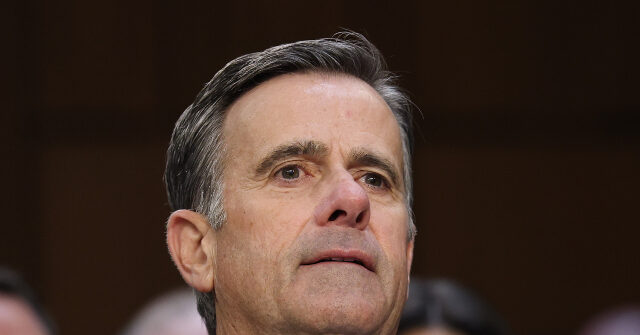
Central Intelligence Agency (CIA) Director John Ratcliffe met with officials of the ailing communist Castro regime in Havana on Thursday.
Details of the visit have not been publicly disclosed at press time. An unnamed CIA source claimed to the Associated Press that Director Ratcliffe visited Cuba “to personally deliver President Donald Trump’s message that the United States is prepared to seriously engage on economic and security issues, but only if Cuba makes fundamental changes.”
CBS News reports that Ratcliffe met with Interior Minister Lázaro Álvarez Casas, the head of Cuban intelligence services, and Raúl Guillermo “The Crab” Rodríguez Castro, the grandson of Cuba’s nonagenarian communist dictator Raúl Castro.
CBS News, citing an unnamed CIA source, reported that Ratcliffe and the Cuban officials “‘discussed intelligence cooperation, economic stability, and security issues,’ all against the backdrop that Cuba can no longer be a safe haven for adversaries in the Western Hemisphere.”
Ratcliffe reportedly told the communist regime representatives that the Trump administration was offering “a genuine opportunity for collaboration and a chance to stabilize Cuba’s struggling economy,” CBS said. Such an offer from the United States, the source pointed out, would “not remain open indefinitely” and, if necessary, the U.S. would enforce “red lines.”
The CIA published photos of Director Ratcliffe’s Thursday visit to Havana.
President Trump has insisted over the past months that the United States would no longer tolerate the national security threat posed by the Cuban regime and has hinted at a friendly “takeover” of the island nation. Cuban regime officials have confirmed that they met with U.S. government representatives in Cuba in recent months. This month, President Trump increased pressure on the authoritarian communist regime by imposing sanctions on GAESA, the Cuban military’s mega-conglomerate that allows the communist regime to fund its repression of the Cuban people. GAESA exerts control over as much as 40 percent of the entire Cuban economy.
“Cuba is asking for help, and we are going to talk!!! In the meantime, I’m off to China! President DJT,” President Trump wrote on a Truth Social post before departing to China.
The Castro regime, which for decades has accused the United States of plotting against the ruling communists through the CIA, claimed that it authorized Ratcliffe’s visit at the request of the U.S. government. The regime published a statement in Granma, the official newspaper of the Communist Party, saying that the encounter occurred against a backdrop of “complex bilateral relations.” According to the Cuban regime, the communist representatives provided information to Ratcliffe’s delegation that allegedly demonstrates that Cuba “does not pose a threat to U.S. national security” and that, thus, there is “no reason” to have the country included on the U.S. list of state sponsors of terrorism (SST). In reality, Cuba is on the SST list due to its deep ties and extensive track record of supporting international terrorist organizations such as Hamas and Hezbollah.
The Cuban regime’s statement read in part:
During the meeting, it was confirmed that there is consistency and coherence between our country’s historic position and the actions of the Cuban government and its competent authorities in unequivocally confronting and condemning terrorism in all its forms and manifestations.
Once again, it was made clear that the island does not harbor, support, finance, or permit terrorist or extremist organizations; nor are there any foreign military or intelligence bases on its territory, and it has never supported any hostile activity against the U.S. nor will it allow actions against another nation to be carried out from Cuba.
The authoritarian Cuban regime — which in 67 years has pushed the country to the brink of complete ruin — has found itself in an extremely complex situation throughout 2026.
Speaking to NBC News on Thursday during President Trump’s official visit to China, U.S. Secretary of State Marco Rubio emphasized that it is in America’s interest for Cuba to become a prosperous nation instead of a failed state 90 miles away. He pointed out that because of the Castro regime Cubans are successful everywhere in the world except in one place: Cuba.
“We want Cubans not to have to leave that island in order to be successful. But they can’t because the current model they have is – it’s not just – it’s broken. It doesn’t work and it’ll never change as long as the people that are there now are running it,” Sec. Rubio said. “They are closed-minded, unfortunately. I hope I’m wrong. I would love for them to come to their senses and say okay, we recognize this really has to change and it has to change big. But right now, they don’t seem to be indicating that. They seem to be digging in.”
This week, Sec. Rubio confirmed that the Castro regime rejected a $100-million U.S. humanitarian assistance package for the Cuban people to be delivered with the assistance of the Catholic Church. The U.S. State Department reiterated the offer, as the humanitarian aid package would provide significant assistance to the Cuban people. On Thursday, Cuban figurehead “President” Miguel Díaz-Canel claimed on social media that the Castro regime is willing to accept the help and that it would find “no obstacle nor ingratitude” from Cuba.
Díaz-Canel’s statements echo similar remarks issued by Cuban Foreign Minister Bruno Rodríguez Parrilla on Thursday, who claimed that Wednesday marked the “first time” that the U.S. had offered the aid package. Both Cuban officials availed themselves of their respective social media posts to once again demand the end of the U.S. “embargo” on the Cuban regime.
Christian K. Caruzo is a Venezuelan writer and documents life under socialism. You can follow him on Twitter here.