


The Securities and Exchange Commission can “fill in the gaps” of cryptocurrency regulation along with the Commodity Futures Trading Commission if Congress doesn’t pass the crypto legislation it’s been weighing for the past year, according to Chair Paul Atkins.
But Atkins worried that the lack of federal legislation would make “future proofing” crypto regulation difficult, and he encouraged legislators to move forward on the CLARITY Act, which may face a Senate committee vote on Thursday.
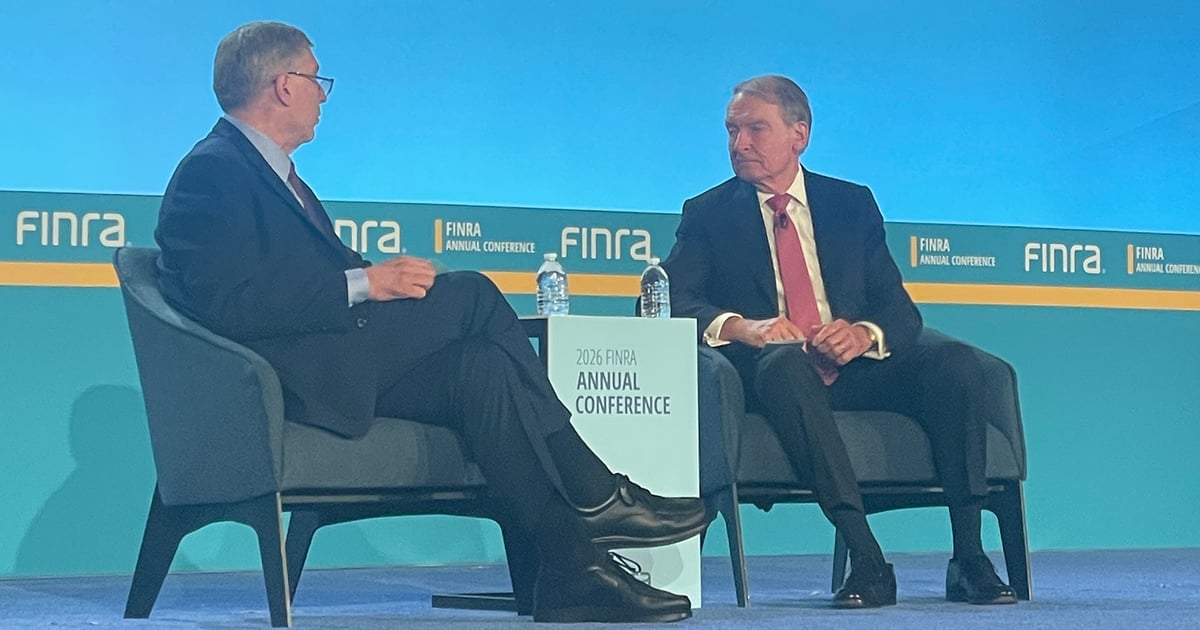
Atkins spoke about the agency’s role in crypto regulation (and other topics) during a conversation with Financial Industry Regulatory Authority CEO Robert Cook at the organization’s annual conference in Washington, D.C., on Tuesday.
Atkins made his comments the same day the Senate Banking Committee released the full 309-page draft of the CLARITY Act ahead of a committee markup of the bill scheduled for Thursday. The bill would attempt to legislate a comprehensive regulatory framework for digital assets, including which assets would fall under which regulators’ purview.
The bill follows a version passed by the House of Representatives last July, as well as a separate one OK’d by the Senate’s Agriculture Committee, which would have to be reconciled with the Banking Committee iteration before final passage. The Banking Committee’s version was previously set for a markup in January, but the markup hearing was postponed after Coinbase CEO Brian Armstrong pulled his support, writing on social media that he’d rather have “no bill than a bad bill.”
However, the bill’s critics span the ideological spectrum, with banking lobbyists, labor unions, consumer protection advocates and state securities regulators all opposing it in its current form.
Supporters of the bill are pushing for quick passage, citing concerns that the legislation will be dead on arrival in its current form should Democrats win the House or the Senate in this year’s midterm elections. It’s unclear how many Democratic votes the bill will receive when it goes to the full Senate.
In his conversation with Cook, Atkins floated the idea of an “investment contract safe harbor,” which would allow some latitude in determining how the so-called “Howey” Test is applied in practice. (The test comes from a Supreme Court ruling and guides regulators in determining when transactions qualify as investment contracts under U.S. securities laws.)
In a speech earlier this week at the Special Competitive Studies Project AI+ Expo in Washington, D.C., Atkins offered more detail on other actions the commission could take while waiting for Congress, including revisiting how the agency’s rules apply to on-chain trading systems, as well as the agency’s broker and dealer definitions (and the “associated regulatory framework to these activities”).
Atkins also suggested to Cook that the agency will be “exploring” changes to the accredited investor definition in response to ongoing interest in the private markets. Changing the definition has been a topic of interest spanning multiple SEC chair tenures and has been at the center of several bills that passed in the House of Representatives last year.
Accredited investors can access some private market investments. Under current laws, accredited investors must have a net worth of at least $1 million (excluding a primary residence), annual income of at least $200,000, or hold certain financial licenses. Qualified purchasers (individuals with $5 million or more in net worth) and institutional investors are permitted to operate fully in the private markets.
One piece of legislation would allow individuals with “certain licenses, education or job experience” beyond wealth and income thresholds to be considered accredited, while another bill would direct the SEC to create a FINRA-administered test retail investors could take to qualify (a point Atkins raised in speaking with Cook, saying a test was “one thing that a self-regulatory organization could take up”).
Atkins noted that any rule (including the Labor Department’s recent proposal encouraging more 401(k) private market exposure) would need “proper guardrails,” illustrated by “the private credit issues that are filling the newspapers these days” (following the collapse of several private credit-backed companies last fall, the industry has faced increased turmoil, with increased redemptions and scrutiny about lending practices).
“It just outlines some of the potential issues that the private markets have: valuation, liquidity and where one falls in the capital stack as far as the type of instrument that one is buying and fees, of course,” he said. “So all that needs to be taken into account, but again, if you’re an accredited investor and you can show knowledge and signs of other attributes, then maybe that’s a thing we should explore.”