


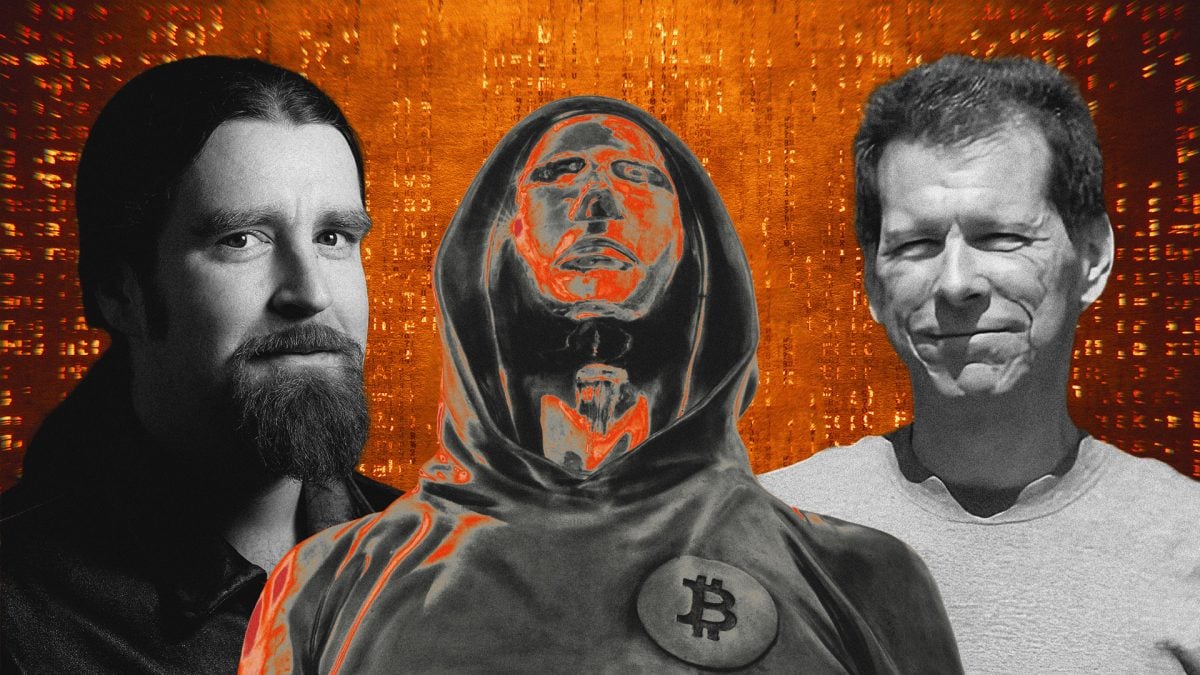
For most of the 18 years since the nine-page Bitcoin (BTC) whitepaper was published on Oct. 31, 2008, amid the turmoil of the great financial crisis, many have rightly or wrongly speculated about the identity of its pseudonymous creator, Satoshi Nakamoto.
Attempts to unveil Satoshi have continued ever since, spurred on by the pseudonymous creator’s disappearance from public view in 2011. A Newsweek story in 2014 focused on Japanese American systems engineer Dorian Prentice Satoshi Nakamoto, while others theorized that Bitcoin could be a CIA-controlled project, to which one expert in the documentary quipped, “I don’t think our government is competent enough to do something that smart.”
While the ideas put forth in many similar documentaries were ultimately dismissed, “Finding Satoshi,” directed by Tucker Tooley and Matthew Miele, attempts to avoid rehashing existing theories with a character-driven investigation that, while surfacing many familiar names, reaches an interesting conclusion.
The film, viewed in advance of its release by The Block, depicts a four-year investigation led by New York Times author, financial journalist, and former M&A investment banker William D. Cohan alongside Quest Research and Investigations’ team of private investigators led by Tyler Maroney, drawing on experts across cryptography, programming, and linguistics.
Cohan had originally set out on the documentary interviewing various figureheads from within the industry, including Katie Haun, the former DOJ prosecutor who led investigations tied to Silk Road and Mt. Gox and later founder and CEO of Haun Ventures; Brian Brookes, the former CLO at Coinbase, CEO at BinanceUS, CEO at Bitfury and Acting Comptroller of the Currency; and Joseph Lubin, co-founder of Ethereum and CEO of Consensys. However, he found little willingness to engage directly on the question of Satoshi’s identity.
Cohan told The Block he is not entirely sure why they were so reluctant. “Part of it was, I think, that it was just irrelevant more than a decade after Satoshi wrote his whitepaper and Bitcoin was born,” he said. “So, why bother? Part of it, too, might have been that what if we discovered that Satoshi was an evil person… that news could destroy the wealth that they had built up in their bitcoin ownership. In any event, it spurred us all on to try to uncover Satoshi’s identity — and I think we did.”
So instead, Cohan turned to Maroney and the broader QRI team. QRI’s focus is on investigations in the public interest that are very difficult to crack, according to Maroney, and sought to approach the task with empirical evidence and expert testimony from people that Cohan and many earlier documentaries had not spoken to.
The candidates
QRI outlined six of the most credible, yet usual suspects: Adam Back, cryptographer, CEO of Blockstream, and creator of the Bitcoin whitepaper-referenced Hashcash; Nick Szabo, computer scientist, and creator of Bitcoin precursor Bit Gold; Hal Finney, software developer, creator of Hashcash successor RPOW (Reusable Proof of Work), and the first recipient of bitcoin from Satoshi Nakamoto; Len Sassaman, systems engineer and academic; Paul Le Roux, encryption programmer, and convicted criminal; and Wei Dai, computer engineer and creator of Bitcoin precursor B-money, also referenced in the whitepaper.
One of the first people QRI spoke to was Bjarne Stroustrup, creator of C++, the programming language used for Bitcoin, who said, looking at the Bitcoin code, that Satoshi Nakamoto was a “reasonably good C++ programmer for the time,” that would have been proficient in C++, not just C — with Back, Dai, and Le Roux all fitting the bill. Szabo and Sassaman were not known to write in C++, and Finney was less known to use it.
Another link the investigators highlighted was that all of the candidates, except Le Roux, were very active in a 1990s group of coders called the cypherpunks, who had a very libertarian-leaning philosophy.
Phil Zimmerman, who founded PGP (Pretty Good Privacy), which created true email encryption, is seen by many as the “OG cypherpunk,” with both Finney and Sassaman having previously worked at PGP for Zimmerman.
Asked by Maroney whether anyone he worked with at PGP could have been part of the formative team that put together Bitcoin, Zimmerman was visibly reluctant to answer. While focusing on email encryption, PGP also explored several other areas, including digital cash.
Finney and Sassaman
Maroney spoke to Alyssa Blackburn, a data scientist at the Baylor College of Medicine and specialist in early Bitcoin mining. She identified around 64 major players during the first two years of Bitcoin, including a lot of metadata on Satoshi Nakamoto’s mining and communications activities, which she said provides an idea of their “digital rhythms.”
Her analysis of Satoshi Nakamoto’s activity shows they were predominantly active between 6 a.m. PST and 10 p.m. PST, suggesting North or South American time zones. Overlaying that with the remaining candidates and their known online activity, including the metzdowd cryptography mailing list that the Bitcoin whitepaper was distributed through, Blackburn surmised that only Finney and Sassaman matched Satoshi Nakamoto’s activity profile. She argued it was “inconceivable” that Back, Szabo, or Dai could be Satoshi Nakamoto based on that analysis.
The New York Times recently suggested Back as a leading candidate based on linguistic analysis and circumstantial evidence, including a 2015 email attributed to Satoshi Nakamoto, though its authenticity is widely disputed. Back also strongly denied the NYT’s claims.
QRI also looked into the same email. However, Maroney told The Block that multiple sources said it was inconsistent with Satoshi Nakamoto’s known writing style and focused on topics, such as bitcoin’s price, that Nakamoto did not typically discuss. The email was also not signed using Nakamoto’s cryptographic key, a standard method of verifying identity, and may have originated from a compromised account, he added.
From her research, Blackburn said that qualitatively, Finney and Sassaman looked like the most viable candidates.
One of Maroney’s concerns about Sassaman was his propensity to “bash” Bitcoin, referencing social media posts in 2010 and 2011 describing it as “bunk” and “overhyped,” with its success due to “irrational exuberance.”
Cohan and the investigators’ concerns over the case for Finney were that he was a coder, not an academic writer, and the Bitcoin whitepaper was an academic paper.
PGP Corp. co-founder Will Price said that, looking at the structure of RPOW, and having spent 15 years working with Finney, he could tell it was coded by Finney instantaneously. However, unlike Hashcash and B-Money, Price noted that RPOW was not credited in the Bitcoin whitepaper, questioning why that would be, as it was “as close to Bitcoin as anything could possibly be.”
However, when Maroney tried to make the case against Finney being Satoshi Nakamoto, Price laughed and wished him “good luck.” Maroney made the point that Finney was not known for coding in C++, and again Price laughed.
“To an engineer of Hal’s caliber, a different language is like chicken versus steak,” Price said. “It has no meaning and he can change languages in hours,” noting that he was already having to work on C++ tasks at PGP. “A lot of the Bitcoin code is very similar to what Hal does in his normal C++, but then he sticks in some things to throw you off the trail,” Price said.
Maroney suggested Price’s point seemed to be that Finney intentionally used C++, a language he was not known publicly for, to code in, because it provided “additional cover.”
By 2008, Price said the company was running out of things for Finney to do and suggested he just keep working on RPOW — and he thinks that’s exactly what happened.
Price explained that there was a two-month gap from Oct. 31, 2008 (the date Bitcoin’s whitepaper was published) to early January 2009 (Bitcoin’s genesis block), where Finney made no PGP commits. Price said they still knew what his tasks were, and Finney, a remote employee, would send weekly updates, confirming things like he was still working on his Windows fingerprint technology.
“So he’s working on C++ on Windows, which is what Bitcoin is written for and in,” Price said. “What was going on in those two months that the last two months before the release of the Bitcoin source code, Hal made no commits to the source code at work? What was he working on? I think it was Bitcoin.”
Finney passed away due to complications from Amyotrophic Lateral Sclerosis (ALS) in August 2014. Toward the end of Finney’s life, PGP Corp. co-founder Jon Callas and Zimmerman took a trip to visit him, where Callas said he asked him if he was Satoshi Nakamoto.
“His answer was, why would I deny being Satoshi if I were because I have a fatal disease. And you know, there’s no reason in the world for me to deny it because I’m not going to be around in two or three years, but no, I’m not,” Callas recalled. “At the time, I interpreted that as a non-denial and interpreted it as a yes,” he said.
But, of course, it would be reasonable to deny it.
“I don’t know why you would go through the effort of making everything anonymous, creating a pseudonym, going through all this effort, and then you just start randomly telling people,” Price said. “Right? I mean, you’re going to be consistent about that or not.”
“One of my big takeaways from this meeting is these people miss Hal. They respect Hal, they believe his story finally needs to be told,” Maroney reflected. “They want the truth out there. And yeah, maybe Satoshi can never actually move a bitcoin, but three eyewitnesses, experts in the field, friends of Hal’s confirming his identity, seem like good corroborating evidence.”
Though not noted in the documentary, following the original Newsweek story connecting Finney and Dorian Prentice Satoshi Nakamoto in 2014, Forbes and others also pointed out that the pair had both lived in Temple City, a small suburb of Los Angeles with a population of around 35,000, just a few blocks away from one another. While this doesn’t prove anything, many have speculated on the coincidence and suggested that Finney may have used local directories at the time for inspiration on the pseudonym.
“We were well aware of this, confirmed what others had previously found, worked to find any other connections between Nakamoto and Finney, and ultimately decided not to include it in the film,” Maroney told The Block. “I’ll note this point can be used to strengthen our case.”
A spanner in the works?
Just when he thought they were getting somewhere, Maroney was presented with an October 2023 article from “professional cypherpunk” Jameson Lopp, co-founder and chief security officer of Casa, titled “Hal Finney Was Not Satoshi Nakamoto.”
“Researching a lot of Hal’s and Satoshi’s early activity, I discovered several different conflicts that showed that they were both doing things at the exact same time when Hal could not have been at a computer on the internet,” Lopp said in an interview with Maroney.
For example, Lopp looked at back and forth emails and a Bitcoin transaction between Satoshi Nakamoto and early Bitcoin developer Mike Hearn with timestamps while Hal Finney was provably running a race.
“From the very simple fact that it’s not possible to be in two places at the same time, it’s highly unlikely that Satoshi and Hal were the same person,” Lopp said.
Maroney said he had a hard time squaring the conversations with the PGP team and Lopp, but went on to ask what other explanations Lopp may have.
“One possible explanation is that Satoshi was a group of people. Whether Hal was like ‘in on it’ will, I think, never really be able to prove,” Lopp said. “But Occam’s razor, it’s difficult to keep secrets amongst multiple people,” he added, echoing Puckett’s observations. “Unless they’re all dead” — which could also help explain why Satoshi Nakamoto’s funds were never moved.
‘Unless they’re all dead’
At first, Maroney thought Lopp was “blowing up” his theory. “But then I realized he gave me the answer because Hal Finney was not the only candidate who was no longer with us,” he said.
So the investigators sought the help of Meredith Patterson, a coder involved in computer security, linguistics, and civil rights. But the real reason they wanted to talk to her was that she is also the widow of Len Sassaman.
Maroney recalled a conversation with PGP’s Price about Sassaman’s life as an academic and a PhD student focused on anonymity.
“When you look through the whitepapers of Len Sassaman, he was really great at writing whitepapers,” Price said. “He would have really cared about checking every reference as they did, the precision and the correctness of every part of that whitepaper. He is the kind of person who would really have gone through that, gotten it right.”
“The whitepaper is written in a certain way, that is someone who writes whitepapers,” Price continued. “And that’s not Hal.”
Len lived in Europe during the time Satoshi Nakamoto was active, and despite being American, his writing often contained British spellings and phrases, just like Nakamoto. His PhD advisor was David Chaum, the inventor of DigiCash and widely recognized as the “godfather” of cryptocurrency.
Patterson and Sassaman met at CodeCon, a conference he ran in San Francisco with Bram Cohen, an American computer programmer, best known as the author of the peer-to-peer BitTorrent protocol.
Like Finney, Sassaman suffered from debilitating health conditions, dealing with Crohn’s disease and severe calcium depletion in his spine, using a cane by the time he was 30, Patterson said. Sadly, on July 3, 2011, around six months after Satoshi Nakamoto’s last public post, Sassaman took his own life.
Back in 2005, Finney had presented RPOW at CodeCon.
“I had read a couple of articles about Hashcash, which was basically the forerunner of RPOW,” Petterson told Maroney. “But it was fascinating to see that transformed into a system for actually using it as money.”
Petterson confirmed that Finney and Sassaman were friends, had worked together at PGP, and were “definitely” in touch in 2008. “They were certainly still interacting online,” she said.
Asked what she had thought about Bitcoin when she first heard of it, Patterson said she immediately went to read the whitepaper and saw it as a “neat way to get around the central operator.” Asked about the use of a pseudonym, she said that it did not surprise her. “Whoever was behind it had definitely been reading the cypherpunk’s mailing list. They were familiar with the kinds of problems that the cypherpunks were interested in solving,” she said.
Sassaman was also an expert in stylometric anonymization, small stylistic changes to writing that blur the fingerprints used to help identify who wrote it. Something that could explain the inconclusive analysis of the Bitcoin whitepaper.
Discussing the theory that Sassaman’s talents could have complemented Finney’s in the creation of Bitcoin, Patterson said she thinks it is plausible. “Is it possible that Len would have helped Hal and not told you?” Maroney asked. “Oh, yes, absolutely,” she said.
The skills and experience needed to create Bitcoin
BitTorrent’s Cohen, who had known both Finney and Sassaman, described Sassaman as his best friend, having been roommates for a long time. In a series of social media posts in 2021, Cohen said: “Len posted pseudonymously on the cypherpunks list constantly, including at least one fleshed-out and long-lived handle.”
“The implication with that one seemed to be that it was Hal or Len or some combination of the two, very unsure though,” Cohen added. “Len also tried to get me to publish BitTorrent pseudonymously, which seems indicative of something.”
Asked by Maroney why he personally saw Finney and Sassaman as Bitcoin’s creators, Cohen said they knew each other, and they both had a pattern of posting pseudonymously to cypherpunks. “What they liked doing exactly matched, you know, what we know about Satoshi Nakamoto, because Satoshi, first and foremost, was a cypherpunk,” he said.
In terms of the skills and experience needed to create Bitcoin, Cohen said Finney exhibited those especially, whereas Sassaman would be more of a fit for the human language element of it — hinting at the whitepaper and forum post contributions — which also explains how Finney could have been running a race while Sassaman was acting as Satoshi, Maroney suggested.
But one problem remained. Why would Sassaman publicly bash Bitcoin? “You don’t make all your pseudonyms agree with each other about everything or everyone’s going to know who your pseudonyms are,” Cohen said. “If you have some identity that you’re trying to hide, then your normal public persona has very little to gain by agreeing with a hidden identity, particularly if it’s some controversial topic like Bitcoin.”
Who is Satoshi?
For Maroney, the pieces were falling into place. Meeting with William D. Cohan, he said that, “For the entire investigation, we’ve been pursuing Satoshi as if he were one person. But all of our evidence is leading to the conclusion that it was two people collaborating.”
“If we take all of the circumstantial evidence, all of [the] empirical evidence, and all of the eyewitness testimony, the conclusion is that Hal Finney and Len Sassaman collaborated to create Bitcoin,” Maroney said. “That the two of them were Satoshi Nakamoto.”
Unlike the early interviewees, some crypto industry insiders were willing to comment on the documentary’s conclusions. In a press release accompanying the film’s official trailer last month, Coinbase CEO Brian Armstrong said: “It’s the most thoughtful take on this subject I’ve seen out there, and I suspect you got to the right answer.” Coinbase is also a supporter of the film.
After seeing the documentary, Lopp also reportedly told the filmmakers it was “easily the most expertly produced Bitcoin documentary” he had seen, adding that it is “a plausible take that may finally put an end to chasing ghosts.”
Many have criticized attempts to uncover Satoshi’s identity, fairly citing potential threats to their families and friends. Participants in the documentary, including Zimmerman, were also wary, describing it as “dangerous” and “people could get hurt.”
However, notably in this case, the widows of both Finney and Patterson were willing to take part in the documentary themselves and seemed to agree with the plausibility of the investigation’s ultimate conclusions.
“I liked your movie,” Fran Finney said. “The reason I [initially] declined to speak with you is because I misunderstood where your movie was going. I had been approached by a number of different projects, and I assumed this project was similar. And most of those projects are just very exploitive. But after I saw the film and what you’ve done with it so far, I was really touched and impressed and blown away.”
Asked if she ever asked her husband if he was Satoshi Nakamoto, Fran Finney said she did, but that he just laughed and said no. “Is it possible he helped build it and didn’t tell you?” Maroney said. “Yes, I think he did help build it,” she said. “You also brought forth the possibility that I hadn’t considered that Hal might have collaborated in the writing of the code for Bitcoin. And I mean, he did. He was excited to write that. The whitepaper itself, I didn’t think he wrote. But he could have helped. Making edits for it. So what you present in the film makes sense to me.”
Reflecting on the interview with Fran Finney, Maroney said it reminded him of a Forbes interview with Hal Finney shortly before he died. “In the conclusions to the article, Hal was asked if given his contributions to open source cryptography, he could perhaps be considered one of the creators of Bitcoin,” Maroney said.
PGP’s Will Price also picked up on the same thing. “When he phrased it the final way, which was whether he’s one of the creators of Bitcoin, Hal raised his eyes and eyebrows, which in the article is identified as his way of saying yes,” Price said. “And he asked him if he was proud of that work. And Finney raised his eyes and he smiled.”
“I think, for Hal, it was always true to say that he didn’t create Bitcoin. He didn’t create Bitcoin, it was a team. But if you ask him, are you one of the creators of Bitcoin? Yes,” Price said. “At this point, I think it’s better that people understand that these people who are long past did create it. They had all of the best intentions and didn’t do it for the money.”
“Hal’s influence on the world in a number of behind the scenes but extraordinarily important things ought to be valued,” PGP’s Callas said. “He is the person who is not like what you see out there in the cryptocurrency world and that is why he deserves the accolades because he is proof positive that you don’t have to be a horrible person to make a big impact on the world.”
“That’s his big legacy. He left his footprint. And I’m so proud of him,” Fran Finney said.
It’s important to note that the documentary emphasized that “based on an extensive investigative review, the filmmakers affirm that there is no evidence or reasonable inference that Fran Finney or Meredith Patterson have any access, direct or indirect, to Satoshi Nakamoto’s private keys.”
“I admire Hal and Len almost more than anyone I’ve ever investigated because their motives I learned were so much more beautiful and pure than the motives of most people who want to hide behind something,” Maroney concluded. “Usually I’m looking for people who’ve done something wrong and are hiding behind a mask. But in this case, I was looking for somebody or a few people who did something really creative and innovative. These were guys who felt that the average person was losing power and that the way to regain some of that power was not to launch an actual revolution, but to launch a revolution with ones and zeros.”
While Satoshi Nakamoto’s identity remains uncertain, perhaps never to be provably confirmed, the investigation arguably makes one of the most compelling cases to date that Finney and Sassaman jointly collaborated to launch Bitcoin.
Finding Satoshi was released globally on April 22 via FindingSatoshi.com.
Disclaimer: The Block is an independent media outlet that delivers news, research, and data. As of November 2023, Foresight Ventures is a majority investor of The Block. Foresight Ventures invests in other companies in the crypto space. Crypto exchange Bitget is an anchor LP for Foresight Ventures. The Block continues to operate independently to deliver objective, impactful, and timely information about the crypto industry. Here are our current financial disclosures.
© 2026 The Block. All Rights Reserved. This article is provided for informational purposes only. It is not offered or intended to be used as legal, tax, investment, financial, or other advice.