


Welcome back to Foreign Policy’s Latin America Brief.
The highlights this week: Colombia hosts a climate summit, acting Venezuelan President Delcy Rodríguez takes an international trip, and researchers estimate the cost of U.S. boat strikes.
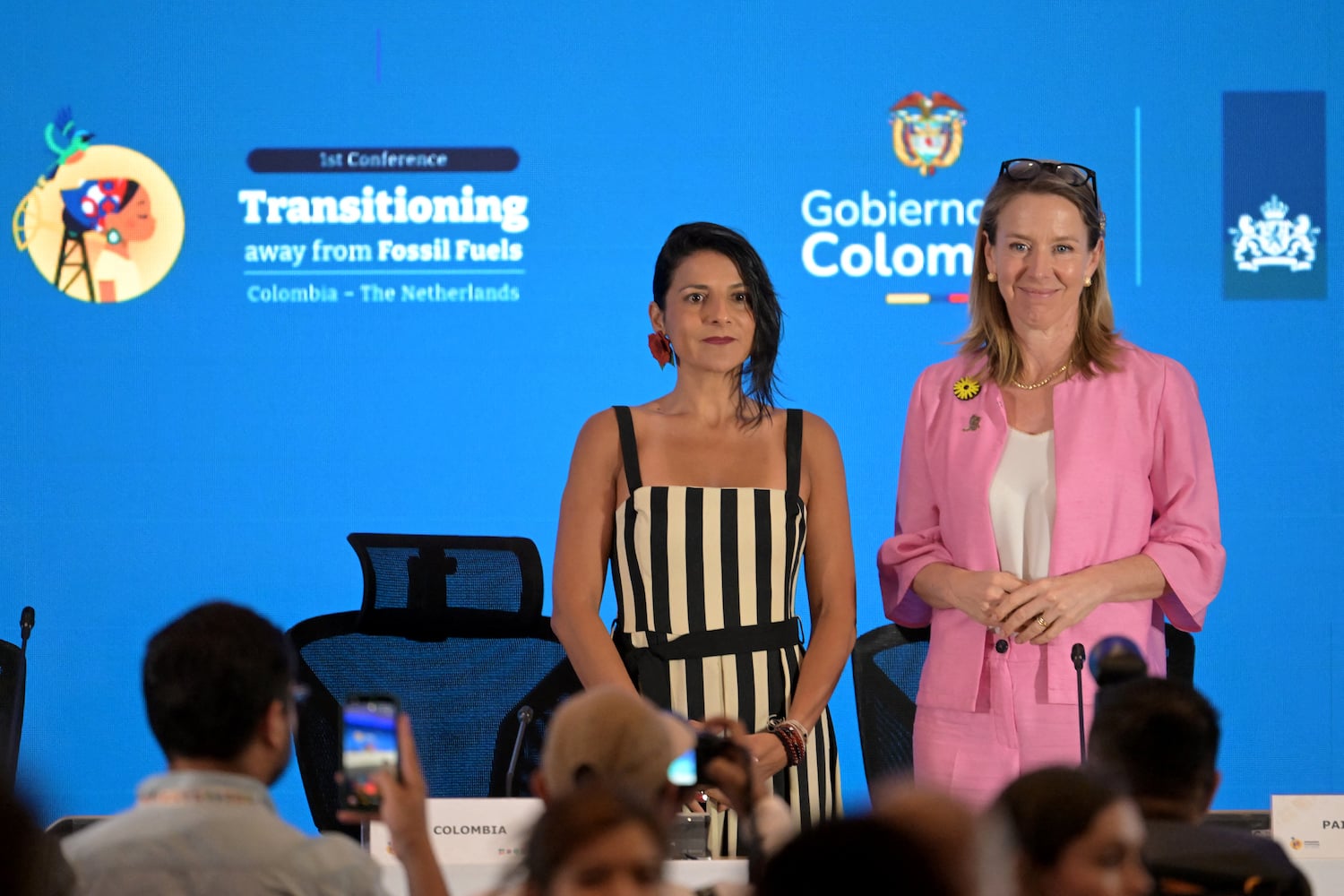
Envoys from dozens of countries, including major oil producers such as Canada and Norway, attended a first-of-its-kind climate summit in Santa Marta, Colombia, this week. The event focused on a topic that environmentalists have long struggled to advance in United Nations climate negotiations: the economic transition away from fossil fuels.
U.N. climate talks have long haggled over greenhouse gas emissions levels rather than targeting fossil fuel use itself. But at its conference in Brazil in November, known as COP30, more than 80 governments backed the idea of national plans to move away from fossil fuels.
The motion was quashed in the full plenary of around 190 countries, where decisions require unanimity. Key detractors included Russia and Saudi Arabia. That failure triggered this week’s summit in Santa Marta, which took place outside the U.N. framework. Colombia co-hosted the event with the Netherlands.
Rather than hammering out a joint text, participants spent their time brainstorming in a series of workshops. “We can do better than what we’re currently doing at the COP,” European Union climate chief Wopke Hoekstra told journalists this week at the summit. “Part of the future of international climate diplomacy will be about plurilateral initiatives.”
Participants at the Santa Marta conference discussed the nuts and bolts of creating national transition road maps. France presented a plan for phasing out energy sourced from coal by 2030, oil by 2045, and gas by 2050 through regulations and funding programs.
A draft plan for Colombia created in partnership with Colombian officials and U.K. government advisors as well as researchers from the University of Leeds envisioned cutting fossil fuel use by 90 percent by 2050 and drawing mostly on private investment, with some loans from public banks.
A key idea underpinning the Santa Marta conference was that a broad international shift toward renewable energy is inevitable due to its falling prices—and that countries will suffer financially if they don’t plan for this transition.
Some countries, including Colombia, are economically dependent on fossil fuel exports. “As oil and gas use declines worldwide, we are going to be in a very vulnerable position,” former Colombian energy official Adrián Correa said in an interview. At the Santa Marta summit, oil-exporting countries attended workshops on how to build up revenue from nonfossil fuel sources.
Meanwhile, oil-importing countries are suffering from the energy shock of the Iran war. Conference attendees discussed how speeding up their switch to renewables could shield them from similar shocks in the future. Moving away from fossil fuels “is vital for energy security and energy sovereignty,” Ana Toni, a co-director of COP30, said at the event.
Toni and her Brazilian colleagues still hold the rotating presidency of U.N. climate talks until COP31 takes place in Antalya, Turkey, in November. They have pledged to compile suggestions for national climate road maps this year and present them as an input for COP31.
Governments from some of the world’s largest fossil fuel producers did not participate in the Santa Marta summit: China, Russia, Saudi Arabia, and the United States were all absent. Washington has actively worked to spoil climate diplomacy under the Trump administration.
Still, many participants nevertheless left Colombia with a sense of hope. “We see this as a complementary space” to U.N. climate negotiations—one that is distinct because it lacks “the outsized influence of fossil fuel lobbyists, executives, and representatives who attend COP,” said Mara Dolan of the Women’s Environment and Development Organization.
Conference attendees agreed to schedule a second edition of the event, which Ireland and Tuvalu will co-host next year in the small Pacific island nation.
Friday, May 1: The European Union-Mercosur trade deal takes provisional effect.
Tuesday, May 5, to Friday, May 8: The Office of the U.S. Trade Representative holds a hearing regarding trade practices of countries including Mexico.
Friday, May 8: Laura Fernández is inaugurated as president of Costa Rica.
Delcy’s diplomacy. Acting Venezuelan President Delcy Rodríguez met with both Colombian President Gustavo Petro and Barbados Prime Minister Mia Mottley in the past week, stepping into regional diplomacy. The opening weeks of Rodríguez’s tenure focused mostly on rapprochement with the United States after the ouster of Venezuelan President Nicolás Maduro.
With Petro, Rodríguez discussed cross-border security concerns and trade issues. Organized crime groups in Colombia have for years also operated across the border in Venezuela. Under Petro, the Colombian government’s efforts to strike cease-fire deals with some of those groups have collapsed; a guerrilla group carried out a highway attack in southwestern Colombia last Saturday that killed at least 21 people.
With Mottley, Rodríguez talked potential oil and gas deals. It was her second recent trip to the Caribbean. Her visit to Grenada in early April triggered pushback from fellow Caribbean Community nation Guyana because she wore a pin of a map depicting the disputed Essequibo region as part of Venezuela.
Electoral changes in Ecuador. Ecuador’s election authority called an unusual Sunday board meeting last weekend to dissolve two opposition political parties. It said that the parties failed to present evidence that they had enough members to be viable. Party representatives said the move was illegal and that they planned to appeal.
One of the two parties had fielded anti-corruption presidential candidate Fernando Villavicencio in the 2023 election, but he was killed ahead of the vote. A third opposition group, the leftist party of former President Rafael Correa, was also suspended in recent months for campaign finance violations that the party said it did not commit.
Ruth Hidalgo, the head of Ecuadorian nongovernmental research organization Citizen Participation, called the latest bans “a pretty risky play on the part of the government party.” The electoral authority denied that it was working in favor of President Daniel Noboa’s party. Ecuador’s local elections are set for November.
Kalshi co-founder Luana Lopes Lara speaks during an Inc. Founders House event Los Angeles in Santa Monica, California, United States, on April 16. Anna Webber/Getty Images for Inc. at Inc. Founders House Los Angeles
Brazil’s partial betting ban. Prediction market betting site Kalshi is one of the fastest-growing tech companies in the United States. Though its co-founder Luana Lopes Lara is Brazilian, Kalshi’s attempts to move into Brazil were set back last week due to a government move to crack down on what it called unregulated “bet-like” products.
The webpages for Kalshi, Polymarket, and several other such sites are now blocked in the country. Brazilian Finance Minister Dario Durigan cast the measure as an effort to protect households from spending too much money on gambling and said the blocked sites were circumventing rules that took effect in January 2025.
Those rules still allow for trading on the outcomes of sporting events and economic statistics such as the interest rate, as long as platforms register with regulators and pay a fee—suggesting that it’s not impossible that Kalshi and its competitors could be permitted in the future. The website suspensions come as Brazil prepares for elections in October.
Despite Brazil’s restrictions on online betting, in the past two years, Brazilians’ total annual spending on online betting was equivalent to what the nation spent on Christmas shopping each year, according to a study by national business association CNC.
Venezuela’s Rodríguez has mended ties not only with foreign leaders, but also foreign oil companies. Which of the following firms has her government not signed deals with this year?
BP
Eni
Repsol
Exxon
Exxon is embroiled in a legal dispute to try to recover confiscated assets in Venezuela. One of its executives earlier this year voiced skepticism that it was worth investing in the country.

A Boeing C-17 Globemaster departs from José Aponte de la Torre Airport in Ceiba, Puerto Rico, on Sept. 12, 2025.Miguel J. Rodríguez Carrillo/Getty Images
The U.S. military has not published an estimate for how much it has spent on boat strikes in Latin America and the Caribbean, which have killed more than 180 alleged drug traffickers since September, along with the capture of Maduro. But last week, experts at the Brown University Costs of War project released what they called a conservative estimate: $4.7 billion.
Congress has not authorized the “armed conflict” that the Trump administration says it is carrying out against drug traffickers, and the U.S. government has not publicly provided information about who it has killed or the evidence against them. Legal experts have broadly said that the strikes appear to be unlawful.
In March, the U.S. military commander for Latin America, Francis L. Donovan, told a congressional hearing that the boat strikes are “probably not the most effective” tool against drug trafficking in the region. But the strikes have continued, with the New York Times reporting this week that the United States had increased the number of aircraft used in the operations.
Donovan assumed his post in February after his predecessor stepped down. He told the Times that he has tried to explore anti-drug tactics that are alternatives to boat strikes, and the months since his appointment have seen the United States announce new intelligence cooperation with some Latin American law enforcement services.
The latest U.S. boat strike, on April 26, killed three people.