


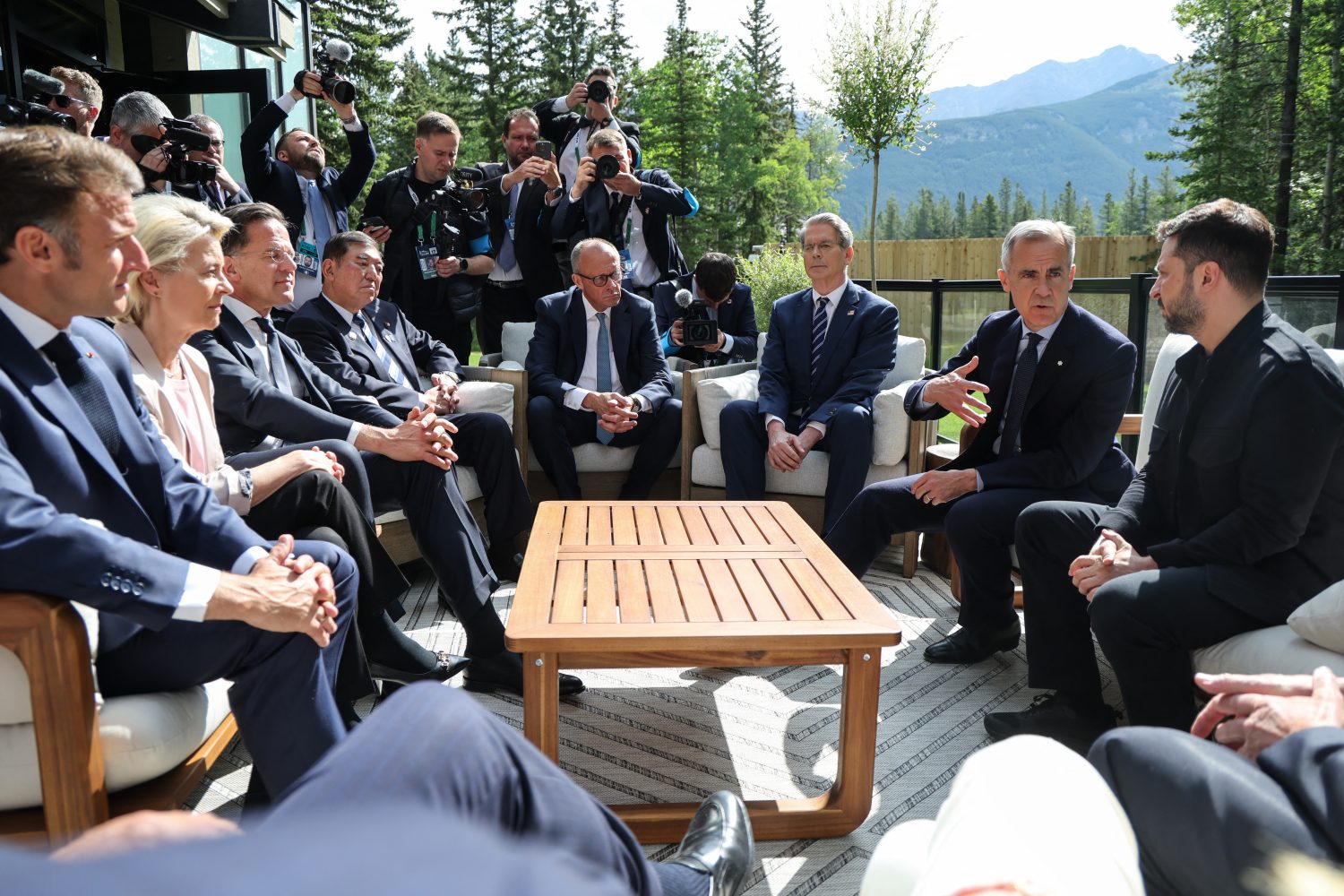
As middle powers flail around for ways of dealing with the current chaos in the international system, soaring hopes for collective action are not matched by the realities on the ground. Middle powers can certainly de-risk their ties with the great powers by increasing cooperation among themselves. Such cooperation, however, does not lead to much influence on a global order dominated by the United States and China.
The current wave of interest in middle powers was set off by Canadian Prime Minister Mark Carney’s address at the World Economic Forum in Davos, Switzerland, in January. In his speech, he called on middle powers to unite against bullying by the great powers. “Intermediate powers like Canada are not powerless,” Carney said. “They have the capacity to build a new order that encompasses our values, such as respect for human rights, sustainable development, solidarity, sovereignty, and territorial integrity.” But these ideas aren’t new. Canadian scholars were among the first in the post-World War II era to develop the idea of middle powers seeking agency in the international system, and Carney was consciously harking back to that tradition. He was also reacting to the immediate challenge presented by U.S. President Donald Trump—his condescension toward America’s closest allies and scant regard for their dignity, let alone interests.
As middle powers flail around for ways of dealing with the current chaos in the international system, soaring hopes for collective action are not matched by the realities on the ground. Middle powers can certainly de-risk their ties with the great powers by increasing cooperation among themselves. Such cooperation, however, does not lead to much influence on a global order dominated by the United States and China.
The current wave of interest in middle powers was set off by Canadian Prime Minister Mark Carney’s address at the World Economic Forum in Davos, Switzerland, in January. In his speech, he called on middle powers to unite against bullying by the great powers. “Intermediate powers like Canada are not powerless,” Carney said. “They have the capacity to build a new order that encompasses our values, such as respect for human rights, sustainable development, solidarity, sovereignty, and territorial integrity.” But these ideas aren’t new. Canadian scholars were among the first in the post-World War II era to develop the idea of middle powers seeking agency in the international system, and Carney was consciously harking back to that tradition. He was also reacting to the immediate challenge presented by U.S. President Donald Trump—his condescension toward America’s closest allies and scant regard for their dignity, let alone interests.
But the rupture Carney proclaimed did not translate into solidarity for long. When the United States and Israel struck Iran at the end of February, Carney declined to condemn the attacks, directing his criticism instead at Tehran’s conduct on nuclear proliferation. German Chancellor Friedrich Merz voiced a similar position, but many other European states called Trump’s war on Iran illegal and refused to support it. This early divergence was telling. Carney’s central proposition—that middle powers must act together because “if we’re not at the table, we’re on the menu”—gave way almost immediately to the centrifugal pull of individual nations’ views and interests. What the war has demonstrated is not the consolidation of a middle power bloc but its fragmentation.
Carney’s position on Iran illuminated the foundational incoherence of the middle power project: These states do not share a common adversary, threat perception, or vision of the order they wish to build. Middle power agency reaches its peak when the hegemon maintains a broad international order within which countries such as Canada can contribute to stability and the observance of certain norms. When the great powers are themselves seeking an overhaul, there is not much the middle powers can do except protect their own interests as best as they can.
Nowhere is this incoherence more visible than in the diplomatic scramble around the Hormuz crisis. Anne-Marie Slaughter, writing in the Financial Times, describes it as an “armadillo order”—overlapping clusters of states taking tentative, uncoordinated action while the great drama plays out elsewhere.
Slaughter’s description is more damning than she perhaps intended. One of the armadillo’s distinguishing features, as she acknowledges, is to curl into a defensive ball and play dead. That, rather than any triumphalist narrative of middle power emergence, is perhaps a more accurate description of what the world is witnessing today.
Slaughter identifies several distinct middle power formations in response to the war—Pakistan and China’s joint proposal, the Turkey-Egypt-Saudi-Pakistan consultations, the International Crisis Group’s civil society initiative, and Britain’s virtual summit of some 40 nations—and treats their multiplicity as evidence of vitality.
But the opposite inference seems more apt. The overlapping groupings do not reinforce one another; they reflect divergent interests dressed in the common language of de-escalation. Pakistan’s mediatory effort is inseparable from its determined bid to cultivate close ties with Trump. Egypt, Pakistan, Turkey, and Saudi Arabia—the four countries most visibly engaged in mediation—are the same nations that helped hand the Gaza peace process to Trump in late 2025. The direction of the Iran effort similarly aims to make life easier for Washington rather than produce some durable order around the Persian Gulf. Far from constraining U.S. unilateralism, the involved middle powers are providing it with a multilateral veneer.
The conduct of the rival great powers confirms that the strategic contest is being settled on terms set by Washington. At the United Nations Security Council, Russia and China simply abstained rather than vetoed the one-sided Gaza resolution of late 2025 that ceded considerable authority to Trump and laid the basis for his Board of Peace. On the Security Council resolution recently initiated by Bahrain seeking to authorize the opening of the Strait of Hormuz, Moscow and Beijing did submit vetoes—but that has not stopped Trump from pursuing a unilateral blockade to compel Iran to reopen the strait. What the rival great powers do, in other words, has had no material effect on U.S. policy choices. At least for now.
This brings us to the question of military power, which remains the ultimate arbiter. The current crises have not revealed the emergence of a middle power order; they have confirmed the persistence of unipolarity. The United States and Israel conducted strikes that reshaped the Gulf’s strategic landscape in ways that no middle power combination could have prevented, deterred, or credibly threatened to deter. When Slaughter observes that middle power coalitions lack “the ability or the will to make the kind of side payments required” to function as effective hegemons, she is identifying not a contingent political failure but a structural incapacity.
The Gaza precedent had already made this plain. For more than two years, an entire architecture of middle power diplomacy—South African legal challenges at the International Court of Justice, Arab League resolutions, Turkish rhetorical escalation, and the usual European statements of concern—failed to alter U.S. conduct or Israeli military operations in any material way. The diplomatic activity was real; its strategic consequences were negligible.
Washington drew a clear lesson: Middle power noise generates little friction. The same logic was applied in Venezuela. And in the Hormuz crisis, the diplomatic clearinghouse has been organized around Washington’s preferences—not despite middle power activity but partly because of it. By providing a legitimate-looking multilateral scaffolding around the cease-fire, middle powers have made it easier, not harder, for Washington to pursue unilateral outcomes while distributing the burden of diplomatic legitimization.
A further complication, consistently underestimated by middle power enthusiasts, is that several of the states being recruited to this putative coalition face direct strategic conflicts with the very powers they are being asked to collectively manage. Australia, Japan, and South Korea—frequently cited as anchor members of any Indo-Pacific middle power grouping—maintain deep security dependencies on the United States while facing existential concerns about China that drive them toward Washington, not away from it. India, which has the scale and aspiration to function as a genuine pole, is engaged in a live territorial dispute with China along its Himalayan frontier. For New Delhi, any middle power framework that treats Beijing as a co-architect of global order rather than a strategic challenger is not a coalition to join but a trap to avoid.
The European situation is no cleaner. Britain’s convening to discuss Hormuz was the act of a country that retains the diplomatic habits of a great power without the military sinew that once gave those habits effect. France and Germany remain bound to Washington through NATO dependencies that they have spent decades failing to transcend. The much-discussed European project on “strategic autonomy” has yielded only limited results—more defense spending, some industrial coordination—but nothing approaching the capacity to shape a major crisis against U.S. preferences.
The Hormuz standoff will eventually resolve, as crises usually do. When it does, the settlement will reflect U.S. interests—and how the internal debate over their definition plays out within the Trump administration and between it and the broader U.S. national security establishment. Middle powers will claim some credit for whatever diplomatic architecture emerges, and they might even deserve some. But credit for decorating a structure is not the same as credit for shaping its foundations.
Middle powers are structurally dependent on the great-power order that they can critique but not shape. A liberal and internationalist United States was willing to pay them some attention, offer coalition membership, and allow a measure of shared norm-setting in exchange for diplomatic support. Trump has no such inclination or compulsion. He is acutely aware that the middle powers are dependent on the great powers—most notably the United States—for their prosperity and security, and he is content to let that dependence do its work. He may tolerate middle power agency and autonomy at the margins. But he will not entertain middle power claims to shape the core of the international system, particularly when Washington is actively trying to redesign the operating system of the global order.
There may come a time when Trump’s current strategies run aground, the internationalists return to dominance in Washington, and the United States once again finds it useful to build coalitions and offer middle powers a degree of genuine gratification. But as long as the power balance continues to shift in the United States’ favor, the incentives for such a policy will remain low. The armadillos will keep moving—busily, visibly, and largely without consequence.