


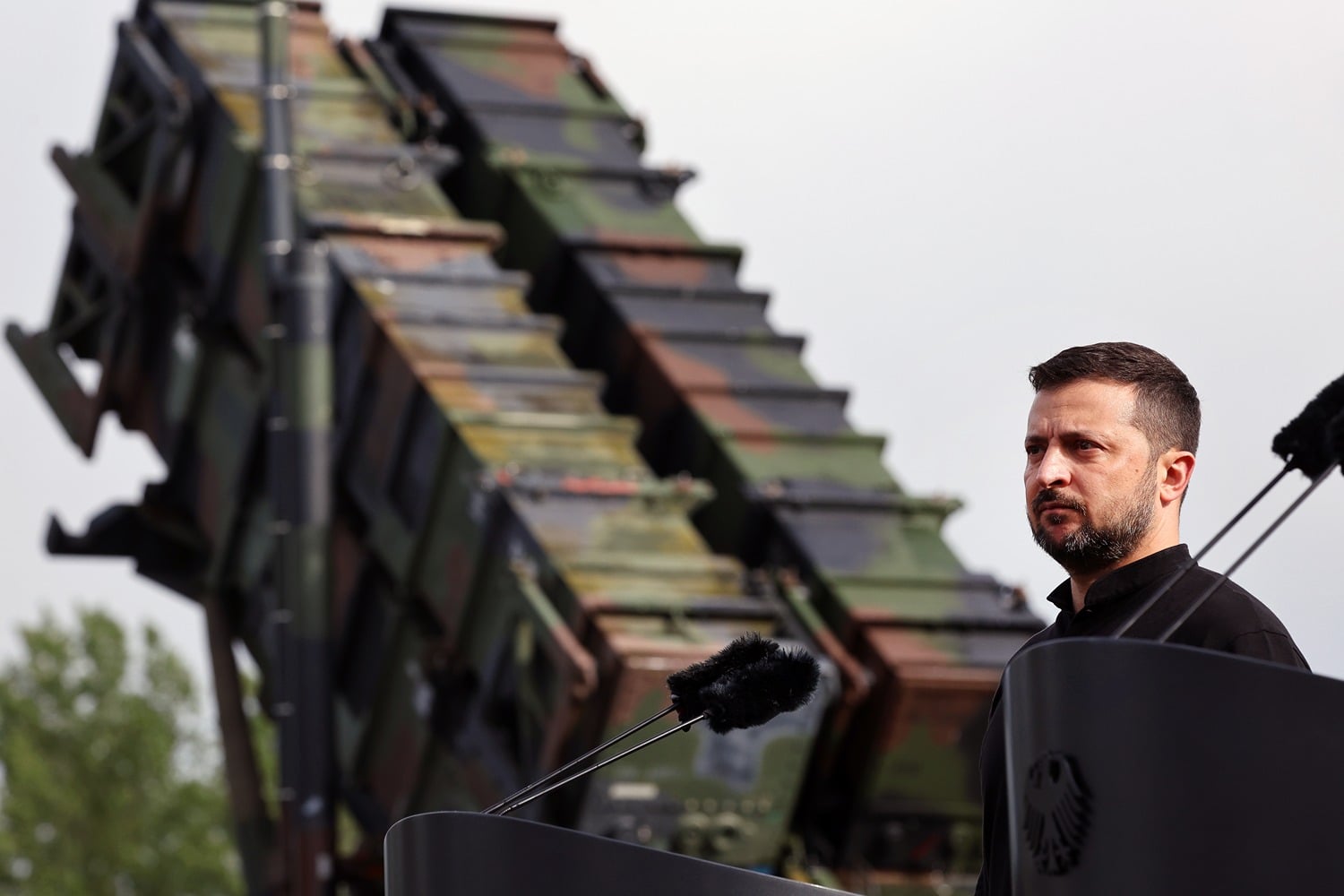
Ukraine and its partners in Europe are holding their breath and waiting to learn just how the war in Iran may affect U.S. military aid—and especially the delivery of the powerful Patriot air defense missiles that Kyiv has relied on to blunt the devastating impact of Russian ballistic missiles.
“Everything will depend on the situation around Iran,” said one European diplomat, who—like others quoted for this story—was not authorized to speak publicly.
Ukraine and its partners in Europe are holding their breath and waiting to learn just how the war in Iran may affect U.S. military aid—and especially the delivery of the powerful Patriot air defense missiles that Kyiv has relied on to blunt the devastating impact of Russian ballistic missiles.
“Everything will depend on the situation around Iran,” said one European diplomat, who—like others quoted for this story—was not authorized to speak publicly.
Russia has long sought to crush Ukrainian resistance with ballistic missiles, in particular by using them to go after Ukrainian critical infrastructure, according to Yasir Atalan, a deputy director at the Center for Strategic and International Studies (CSIS), a Washington-based think tank. Russian attacks on Ukrainian energy sites using drones, cruise missiles, and ballistic missiles hit a peak this winter, leaving many Ukrainians regularly without power or heat.
Since April 2023, the United States has donated to Ukraine Patriot anti-air missiles, which are designed to handle the complicated task of intercepting a ballistic missile. Ballistic missiles work by rocketing into the air and then plunging down on their target. European nations have also donated Patriot missiles to Ukraine.
In July 2025, though, the Trump administration stopped outright donating the missiles and instead began selling them to NATO countries, which then give them to Ukraine. The system is called the Prioritized Ukraine Requirements List, or PURL, program. Weapons sold under PURL are delivered either directly from U.S. stocks or are newly made, a U.S. Defense Department spokesperson told Foreign Policy.
The system has never been perfect. Ukrainian President Volodymyr Zelensky has regularly complained of a shortage of the interceptors. European Commissioner for Defense and Space Andrius Kubilius said in March that Ukraine needs as many as 2,000 Patriot missiles per year, yet Kyiv received just 600 interceptors over four years, an advisor to Zelensky told the New York Times in March.
The missiles’ effectiveness has also fallen to only a 25 percent intercept rate, according to Atalan—in part because of Russian adaptations.
But that rate could fall even further if Washington stops supplying the missiles at all.
Read More
-
A Greek-flagged crude oil tanker seen off the coast of the Syrian Baniyas port refinery, along the Mediterranean Sea. A Greek-flagged crude oil tanker seen off the coast of the Syrian Baniyas port refinery, along the Mediterranean Sea. Why Iran Isn’t Blinking Yet
Trump’s blockade aims to force damaging shutdowns at Iranian oil fields. But Tehran has been through this before.

-

A Ukrainian serviceman controls an unmanned ground vehicle in eastern Ukraine, Aug. 11, 2025. A Ukrainian serviceman controls an unmanned ground vehicle in eastern Ukraine, Aug. 11, 2025. Pressed by Russian Drones, Ukraine Turns to Ground Robots
While mostly used for logistics, Ukraine is increasingly using them for combat operations.
-

Missiles produced by Iran’s armed forces are displayed near a row of Iranian flags during commemorations to mark the anniversary of the 1979 Iranian Revolution on Feb. 11 in Tehran. Missiles produced by Iran’s armed forces are displayed near a row of Iranian flags during commemorations to mark the anniversary of the 1979 Iranian Revolution on Feb. 11 in Tehran. Iran’s Strait of Hormuz Toolkit: Drones, Missiles, and Mines
A breakdown of the tools Iran has to maintain pressure on Trump.
The United States has now used as much as half of its inventory of an estimated 2,330 Patriot missiles in defending against Iranian ballistic missiles since the start of the Iran war on Feb. 28. And it may end up using even more. While the war has seemingly entered a stalemate, Tehran reportedly retains at least half of its missile launchers, meaning that more Patriot missiles could be required if fighting resumed.
To make matters worse for Kyiv, the missiles are also in high demand for the U.S. military’s needs elsewhere, particularly to defend against a potential Chinese invasion of Taiwan. In fact, the United States is already likely short of what it requires, said Tom Karako, the director of CSIS’s Missile Defense Project. “We’re hitting dangerous territory,” he said.
Nor is cranking up production an easy way out the conundrum. Current delivery time for the newest Patriot missile variant, the PAC-3 MSE, is about 42 months from contracting to delivery, and the United States makes less than 200 a year, according to CSIS.
A diplomat from a PURL-contributing nation as well as a second senior European diplomat said that the United States had assured partners that weapons already paid for under PURL would be delivered.
After that, however, it’s unclear. There is “still not a great deal of certainty,” on future PURL packages, said the diplomat from the PURL-contributing nation. The senior European diplomat expressed doubts regarding further packages given U.S. needs.
And Trump administration officials have sent signals that are hardly encouraging for Ukraine.
U.S. Vice President J.D. Vance said on April 14 that ending military aid for Ukraine was one of the White House actions of which he was “proudest.” The next day, speaking at a meeting of Ukraine’s military supporters, Pentagon policy chief Elbridge Colby said that Washington is “prepared to continue helping through initiatives like PURL, but this support must not rely on significant U.S. contributions.”
The United States briefly paused its aid to Ukraine in March 2025, then again in July, reportedly on the initiative of Colby due to concerns about the impact on U.S. munitions stockpiles.
Trump may also see PURL as a form of leverage over Ukraine. He has regularly discussed a reduction of support to Ukraine over Kyiv being “difficult” and reportedly threatened to stop the PURL program unless Europeans joined the United States in opposing Iranian control of the Strait of Hormuz.
Kyiv’s options without the United States are limited. Ukraine is developing a counter-ballistic missile that it hopes to field by the end of 2027, but the technology is challenging to produce.
The most comparable European-produced anti-ballistic missile system is the SAMP/T. However, the production rate for its missiles is estimated at 300 interceptors or less per year—far fewer than the 2,000 that Kubilius said are needed. Zelensky has previously noted a lack of interceptors for the SAMP/T systems that Ukraine already has, and he has said that the Patriots were more effective.
Germany is also producing Patriot missiles, which could potentially supply Ukraine. This month, U.S. defense contractor Raytheon announced a $3.7 billion contract to start production in Germany of the older PAC-2 Patriot missile variant for delivery to Ukraine, with several hundred missiles to be eventually delivered. Those deliveries will take time, though, occurring over the next three years. The Patriots produced in Germany are also subject to the United States’ International Traffic in Arms Regulations and therefore require Washington’s approval for export.
Still, there’s at least some room for optimism on Ukraine’s part.
Trump himself appears to revel in the notion that the Europeans are paying the United States for the weapons that Ukraine needs and has mentioned the topic frequently in press appearances.
Europe also has plenty of money to buy the weapons, following the approval on April 23 of a $106 billion support package for Ukraine. The package encourages weapon acquisition within Europe but makes exceptions for items that are only available outside the continent, such as the Patriot missile.
That has at least some Europeans believing that Trump is unlikely to jettison the program. “I think that President Trump likes PURL,” a third senior European diplomat said. “He came up with this brilliant idea for how to make Europeans pay for American weapons to be delivered to Ukraine.”
Trump also appears to be particularly aware of Russian missile strikes on Ukrainian civilian targets, telling Russian President Vladimir Putin to “STOP” on April 24, 2025, and calling a Russian missile strike on Kyiv a “terrible thing” on Dec. 8 of that year.
If Patriot missile deliveries do end, Russia may lean even more on ballistic missile attacks to capitalize on Ukraine’s lack of defenses, said Atalan of CSIS. Such strikes “could have a much more [bigger] effect against the electricity supply,” he added.
Still, he cautioned that it was unlikely to be a “game-changer.” As mentioned, Ukraine’s Patriot missiles already only intercept around 25 percent of incoming Russian missiles, and Ukraine has managed to fight on, in part by focusing on repairing its energy grid quickly. And in contrast to at times wavering U.S. support to Ukraine’s military sector, Kyiv has had success drawing in U.S. government and business interest in its energy sector.
Ukraine’s resilience may be a feature that some in the U.S. administration may not be counting on.
“Sometimes, when I speak to [U.S.] officials, they see Ukraine as a state that would not be able to survive a day or two without international support,” said the diplomat from a country participating in PURL. “But I think Ukraine has proven over and over again—on the battlefield, politically, socially … that this is a force to be reckoned with.”