


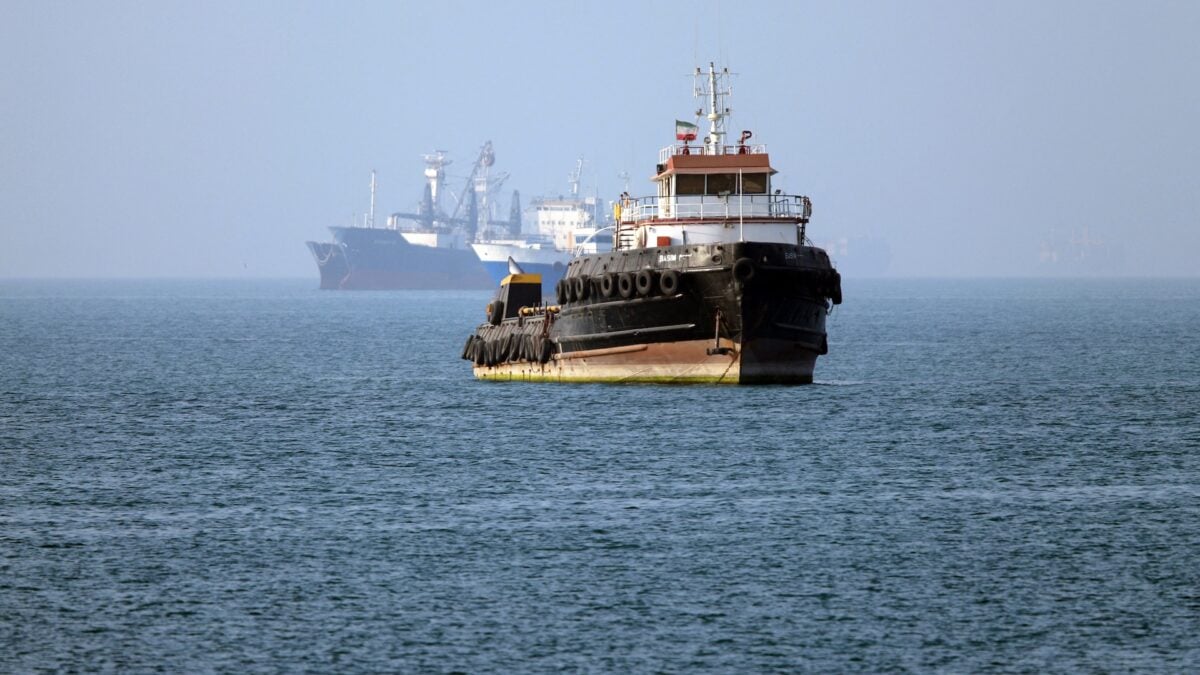
Oil prices climbed Monday after the U.S. and Iran resumed fighting, disrupting a ceasefire that had largely held since April 8. And that’s bad news for anyone nervous about the days and weeks ahead after President Donald Trump decided to start a war that has managed to jack up energy prices around the globe.
President Donald Trump kicked things off Sunday by declaring that the U.S. would escort ships from “neutral” countries through the Strait of Hormuz starting Monday morning in what he dubbed Project Freedom. The U.S. military claimed Monday that two U.S.-flagged merchant vessels had been protected as they transited the Strait, though the U.S. is obviously not a neutral country in this conflict.
Iran responded by launching missiles and drones against U.S.-aligned targets on Monday, according to the Wall Street Journal, with one drone hitting the important oil hub of Fujairah in the United Arab Emirates and starting a fire. At least three ships have been hit by Iran, all off the coast of the UAE, including the Marshall Islands-flagged JV Innovation, which was struck by a drone, and the Panama-flagged Korean cargo ship HMM Namu, which was hit by an explosive, according to the Journal.
The UAE described the missile and drone attacks as “renewed treacherous Iranian aggression,” according to the Associated Press. But the country’s military has suggested most of the attacks have been successfully defended against.
“Four cruise missiles coming from Iran toward the country were detected,” the UAE defense ministry said in a statement to CNN. “Three missiles were successfully intercepted over the country’s territorial waters, while another fell into the sea.”
For its part, the U.S. military has taken credit for destroying six small boats operated by Iran used to attack other vessels. Trump posted Monday afternoon that it was actually seven boats and urged South Korea to “come and join the mission” since their cargo ship had been hit. Trump also promoted a news conference that will be held by Defense Secretary Pete Hegseth on Tuesday morning.
CENTCOM commander Brad Cooper suggested on a call with reporters Monday that Iran’s ability to strike with small boats was degraded in a significant way.
“I’ve transited through the Strait of Hormuz probably 100 times in my career. You typically see between 20 and 40 small boats in the pack coming out. Today we saw six, and eliminated them quickly,” Cooper said, according to a portion of the call played on Fox News.
“I think this is an example of the degradation of their capability,” Cooper continued. “It doesn’t mean it’s all gone, but it’s highly degraded.”
But Iran still has plenty of missiles and drones, which have done significant damage to oil infrastructure in the past. Roughly 20% of the world’s supply of oil and liquid natural gas travels through the Strait of Hormuz, which has been effectively shut down by Iranian forces.
Cooper said on the call with journalists that the American military didn’t physically escort the two U.S.-flagged ships through the Strait of Hormuz on Monday. The path was cleared and “validated,” though details about what that entailed were scarce.
“We used our own military technology in a unique way to clear a free lane that’s not obstructed in any way, shape or form through the strait,” said Cooper, according to the Wall Street Journal.
The renewed fighting has caused Brent crude, the global benchmark for oil, to surge over 5% Monday, topping $113 a barrel. The Dow Jones Industrial Average was down a relatively modest 450 points on Monday as of the time of this writing.
The U.S. wants to encourage ships to travel through the Strait of Hormuz with Project Freedom, though it’s unclear whether any will try. UN spokesman Stephane Dujarric told the AP on Monday that the global body is “still trying to fully understand” what the U.S. means when it says the Strait is open for passage.
“There’s not much clarity at this point, but what we do not want to see is a return to outright kinetic activity in this area,” said Dujarric.
It’s clear that Trump is trying to bluff his way into opening the Strait of Hormuz, but as long as Iran has missiles, drones, and small boats that can still pose a threat to ships, that seems like a recipe for failure.
The current national average for a gallon of gas in the U.S. is $4.45, according to AAA, just from $2.98 just before President Trump and Israel launched their war against Iran on Feb. 28. Airfares have also climbed, especially for international travel, according to a trends dashboard maintained by Kayak.
For example, a flight from the U.S. to Hong Kong averaged about $1,005 shortly before the start of the war. That same flight was averaging $1,534 as of April 20, the latest date with data available. A flight to Rome, Italy, was averaging $847 before the war. By April 20, that had climbed to $1,266.