


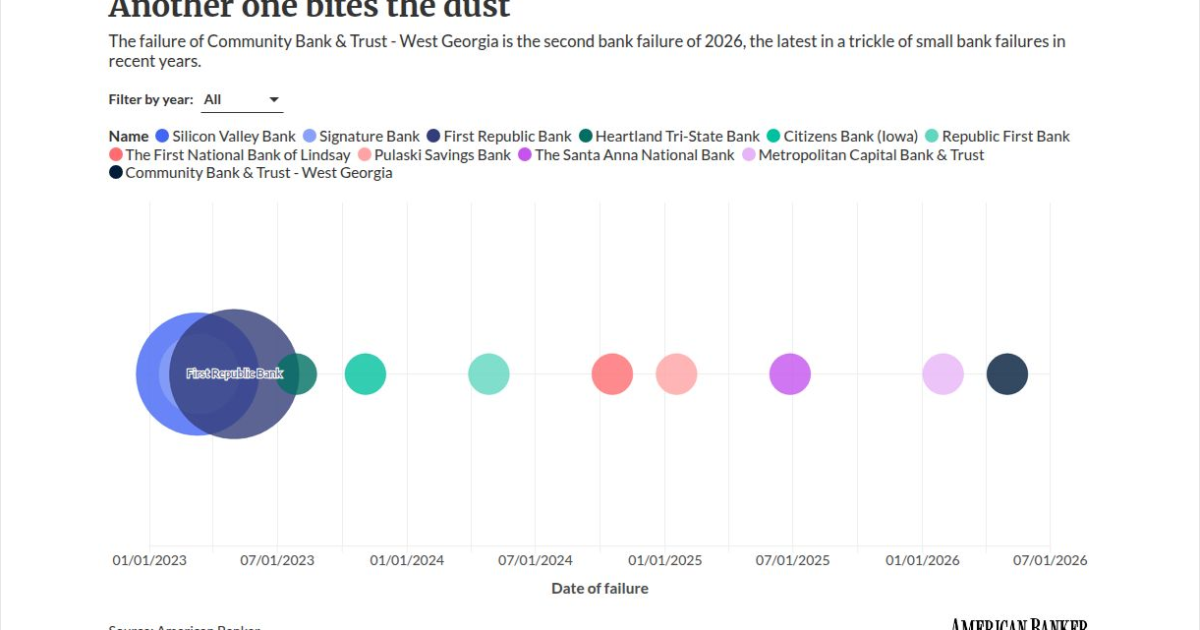
Two U.S. banks have failed so far in 2026, continuing the recent pattern of smaller lenders collapsing abruptly due to firm-specific issues. January’s
Processing Content
At the time of its failure, Community Bank held $288 million in assets and $268 million in deposits. Roughly $27 million of those deposits exceeded the FDIC’s $250,000 limit for insurance coverage meaning funds are not guaranteed, though the agency said it would provide advance dividends to affected depositors.
Regulators had already flagged issues at the Georgia lender earlier in the year. An April 14 cease-and-desist
Both Metropolitan Capital Bank, with $261 million in assets, and Community Bank were larger than either of the 2025 failures.
Another Chicago-based firm, Pulaski Savings Bank,
Still, all of those firms were relatively small, and certainly much smaller than the 2023 failures of Silicon Valley Bank – $209 billion in assets – and First Republic Bank – $233 billion in assets. Since then, only one bank that failed had more than $1 billion in assets. Republic First Bank, with $6 billion in assets, failed in April 2024.
The FDIC’s move this month to sell the Georgia bank the same day of the failure’s announcement — as it did with Metropolitan — fits into Chair Travis Hill’s focus on swift transactions of failed banks, something
Hill has
Still, the last decade has been very steady for banks. There have not been more than five bank failures in any year since 2017, according to the FDIC, and some years – such as 2021 and 2022 – have not seen any failures at all. Moreover, apart from Silicon Valley Bank and First Republic Bank, none of the failed banks have had substantial assets.