


FBI Director Kash Patel is at the center of a fierce political storm. In February, a video of him chugging alcohol in the U.S. men’s hockey team’s locker room following their Olympic victory went viral. In the New York Times, Emily Bazelon and Rachel Posner have fueled concerns about his suitability to lead the FBI with a new installment of their ongoing interview series about key agencies, sharing accounts from former agents who discussed the FBI’s dysfunction. Most damaging was Sarah Fitzpatrick’s recent article in the Atlantic which detailed allegations of heavy drinking and highly erratic behavior.
Patel is fighting back. In Trumpian fashion, he has sued the Atlantic for defamation. The New York Times also broke a chilling story: The FBI reportedly investigated one of the paper’s reporters, Elizabeth Williamson, after she began looking into the full-time FBI security detail that accompanies Patel’s girlfriend to various engagements. The FBI dropped the case, but the revelation was “alarming,” New York Times Executive Editor Joe Kahn warned, since it was a brazen attempt to “criminalize routine reporting.”
Patel’s fate remains uncertain. There have been reports that President Donald Trump, who doesn’t drink and whose brother was an alcoholic, is unhappy with the stories. As with the rest of the Department of Justice, the president is also said to be frustrated that investigations into his political opponents are not moving fast enough.
Patel may soon be pushed out of the administration, replaced by a loyalist who is more disciplined and less erratic. In that sense, he has become a test case of which scandals the president won’t tolerate—distinct from the many he shrugs off.
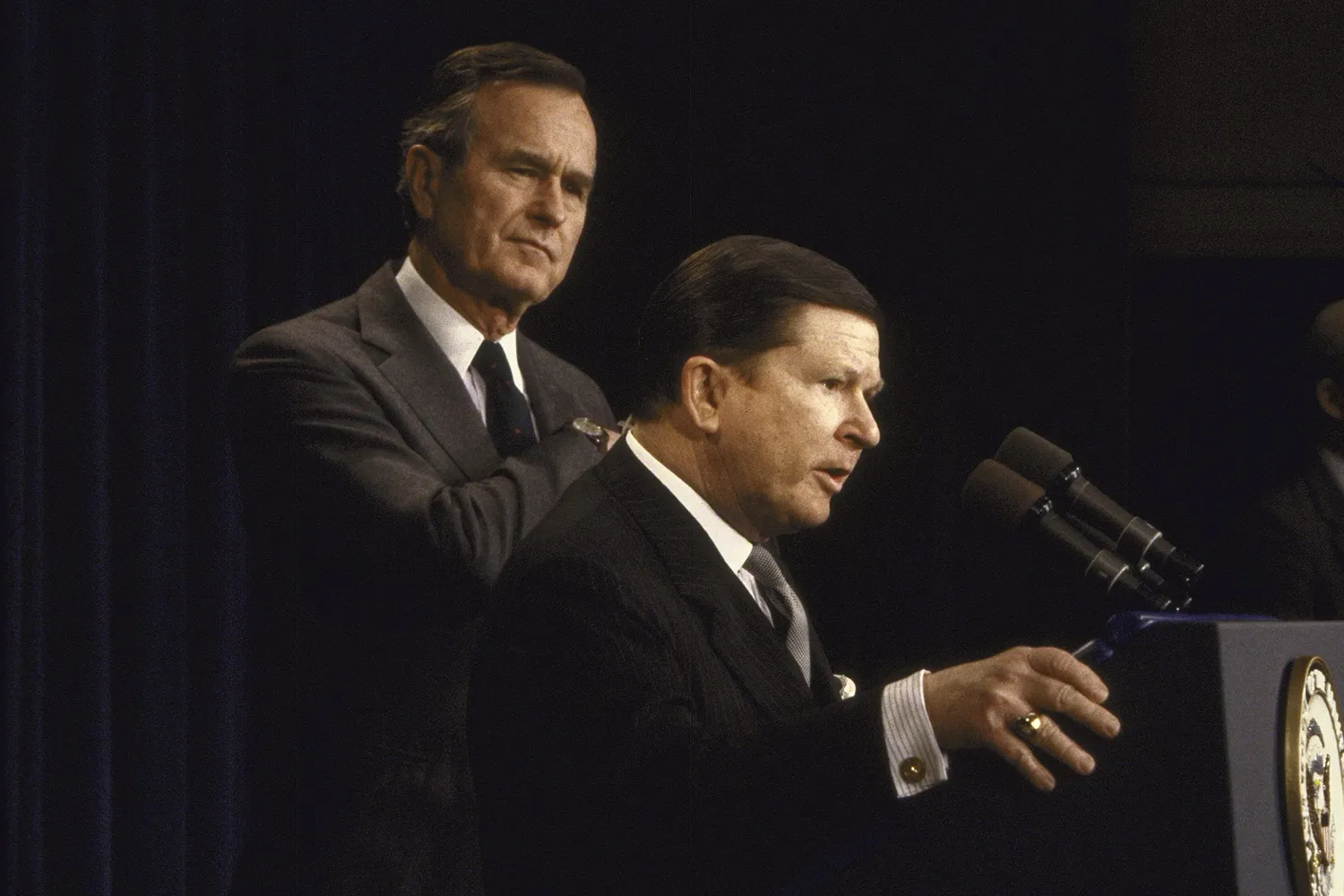
The uncertainty over what kinds of personal behavior are no longer disqualifying reveals how profoundly the political environment has been transformed in the MAGA era. Back in 1989, President George H.W. Bush’s nominee for secretary of defense, former Texas Sen. John Tower, was rejected following revelations of financial impropriety, womanizing, and excessive drinking. While Senate Republicans defended Tower on the grounds that the allegations were unsubstantiated innuendo, they did not dispute that the charges themselves were problematic. He was the first nominee rejected by the Senate in 30 years; the last had been President Dwight Eisenhower’s pick for commerce secretary, Lewis Strauss, who went down in 1959.
George H.W. Bush was elected at a critical moment for U.S. foreign policy. His predecessor, Ronald Reagan, had negotiated a historic agreement with the Soviet Union, the Intermediate-Range Nuclear Forces Treaty. Bush, who had served as Reagan’s vice president, was eager to guide the United States and the Western world through what appeared to be the imminent collapse of the Soviet Union.
At first, Tower seemed a perfect choice for Bush. He had been one of the first Republicans to break through in then-solidly Democratic Texas, where Bush had been working to build the GOP since the 1960s. Tower won Lyndon Johnson’s Senate seat in 1961. He went on to chair the Armed Services Committee after Republicans took control of the Senate in 1981—for the first time since 1955—where he supported Reagan’s massive buildup in defense spending. After leaving the Senate in 1985, Tower led Reagan’s arms negotiation with Soviet leader Mikhail Gorbachev in Geneva and then headed a high-level commission that Reagan established in December 1986 to investigate the Iran-Contra scandal, which broke after the midterms. Meanwhile, he built a lucrative second career consulting for defense contractors, part of Washington’s revolving door that enabled public servants to capitalize from their time in office.
When hearings opened on Jan. 25, 1989, Tower promised to maintain the strong military posture that had taken shape under Reagan but also vowed to streamline Pentagon operations, cutting waste and unnecessary spending as the Cold War wound down. Even the liberal Massachusetts Sen. Ted Kennedy, who had been the focus of multiple personal scandals in his career, expressed support for Tower’s work record.
Democrats, who had reclaimed control of the Senate in the midterms with a 55-45 majority, were in no mood to compromise, though. Armed Services Committee Chairman Sam Nunn of Georgia, a centrist hawk, insisted that he would not rubber stamp his former colleague. “We’re not going to play the ‘old-boy-go-around’ with him this time,” Nunn warned.
Questions instantly emerged about Tower’s consulting work. Indeed, Bush had held up his nomination in December so that the FBI could conduct an extensive background check, giving the appearance that Tower had been thoroughly vetted. Several Democratic committee members argued that Tower had worked for the very companies who would be doing business with the Defense Department. His promise to not participate in certain decisions involving those firms satisfied most members, though not all.
Then all hell broke loose. Nunn had decided to move forward with the confirmation process despite rumors that Tower drank too much and had a reputation for womanizing. But the political atmosphere changed after Paul Weyrich—one of the most influential activists in the conservative movement and a co-founder of the right-wing think tank, the Heritage Foundation—appeared before Nunn’s committee to announce his opposition to the nomination on the grounds of Tower’s “moral character.” Weyrich testified that he had seen Tower inebriated and in the company of women he wasn’t married to. “The smoke surrounding the nominee’s personal life seems rather intense,” Weyrich said. “I have made enough personal observations of this man here in Washington to have serious reservations about his moral character.”
Additional FBI background investigations into the nominee produced further allegations of the same kind, including a “pattern” of alcohol abuse before 1983.
None of this came as a big surprise. Despite the fact that Secretary of State James Baker had strongly backed the choice of Tower for his position, there were many people within the administration who had warned Bush that he would be trouble. His reputation was well known. As Elizabeth Drew wrote in The New Yorker, “It was no secret in Washington that Tower had lived life fully and indiscreetly; the cumulus of stories over the years, from disparate sources, referring to disparate times and places, lent substantial credence to the idea that this was a man who indulged his pleasure in booze and women.”
Tower denied that he had a drinking problem, but witnesses told senators of seeing him drunk and even groping a female member of the Air Force in the 1970s. One unnamed woman reported seeing Tower chase a secretary around a desk. Tower, twice divorced, denied the allegations.
While the multiple allegations could not be substantiated, the drumbeat of unfavorable news coverage eroded confidence among many senators, particularly given that the position would empower him to make decisions about the use of force. There were also more stories that surfaced about financial conflicts of interest, including campaign contributions from defense contractors doing business with the government during his time in the Senate.
His problems were compounded by the fact that not many people liked Tower personally. “He was not a back-slapper,” recalled the reporter Fred Kaplan, “in fact, he was mean, which probably helped propel his downfall.”
In late February, Nunn decided that he could not support the nomination. Without his backing, Tower was doomed. On Feb. 23, the committee voted against him along a party-line vote of 11 to 9.
In his floor speech, Nunn focused on the boozing and the consulting work, setting aside the allegations of womanizing. Republican supporters condemned Nunn for sinking the nomination on the basis of unsubstantiated rumors and inuendo. Nonetheless, the outlook for final vote on the floor looked grim.
Tower tried to fight back. On television, he denounced Democrats’ attacks as untrue. In an interview with ABC’s David Brinkley, Tower admitted that he used to be a “pretty good Scotch drinker” but for the last 12 years had not drunk much: “I don’t drink wine even unless I’m eating.”
Though his own advisors were privately urging the president to cut his losses, Bush kept lobbying senators on Capitol Hill. After a contentious floor debate, the Senate rejected the nomination on March 9 by a vote of 53 to 47. Only one Republican voted against him, Nancy Kassebaum of Kansas, and three Democrats voted in favor: Christopher Dodd of Connecticut, Howell Heflin of Alabama, and Lloyd Bentsen of Texas. Tower joined a small group in the history textbooks: Only eight cabinet nominations in U.S. history had been defeated before him. The cover of Time magazine featured a photograph of Tower along with the headline: “The Tower Fiasco.”
Republicans were furious with Democrats.
“Instead of the recompense of a grateful nation,” Bush said, “John Tower’s lot in the past weeks has been a cruel ordeal. … I am also concerned by the way in which perceptions based on groundless rumor seemed to be the basis on which at least some made up their minds in judging a man well-qualified to be my secretary of defense. Now, however, we owe it to the American people to come together and move forward.”
Writing in his memoir, Consequences, published in February 1991, Tower lashed out at those who brought him down. That April, a 65-year-old Tower, along with one of his daughters, died in plane crash in Georgia.
The battle had unanticipated effects on the future of Republican leadership that were very significant. The Senate quickly confirmed Bush’s next nominee, Wyoming Rep. Dick Cheney, who was replaced as House minority whip by Newt Gingrich. Cheney would receive high praise during Operation Desert Storm, when U.S. forces repelled Iraq from Kuwait; he went on to become one of the most consequential vice presidents, under President George W. Bush. After Republicans won control of Congress in 1994, the House GOP chose Gingrich to be their speaker.
The politics of 2026 are dramatically different from those of 1989, when the feminist and conservative movements had together reshaped public expectations, demanding that the personal was political. The behavior of elected officials mattered. After Watergate, moreover, Congress had enacted laws that elevated the standards for what constituted a financial conflict of interest for government officials.
The MAGA era has rapidly eroded those norms, though some would argue the changes began in 1998, when the public backed President Bill Clinton despite his sexual relationship with White House intern Monica Lewinsky. From top to bottom, the Trump administration has been filled with figures who have been at the center of well-sourced stories about scandalous personal and financial behavior without negative political repercussions. The same is true on Capitol Hill.
U.S. public culture has grown less interested in holding officials accountable for personal conduct when partisan loyalty is at stake. A deepening cynicism about politicians across the board has lowered expectations for everyone in government. Revelations of drug or alcohol abuse, unacceptable personal behavior, and sexual harassment can still end careers, but that outcome now depends on whether the individual remains politically valuable to the party leadership. That basic calculation is what will determine Patel’s fate in the days ahead.