


Worried about China’s powerful trade leverage, U.S. President Donald Trump wants to rally a coalition of countries to break Beijing’s grip on many of the world’s mineral supply chains.
Yet for much of the world, the United States isn’t exactly a reliable partner, either.
Worried about China’s powerful trade leverage, U.S. President Donald Trump wants to rally a coalition of countries to break Beijing’s grip on many of the world’s mineral supply chains.
Yet for much of the world, the United States isn’t exactly a reliable partner, either.
It’s no secret that China has wielded its supply chain grip against others in trade spats, particularly when it comes to rare earths. But after the Trump administration has spent months wreaking havoc on global trade and imposing on-again, off-again tariffs on key trade partners, world leaders have grown wary of becoming too dependent on Washington, too.
Many of those countries are now looking to each other. Even as the Trump administration goes all-in on critical minerals, there has been a flurry of trade deals that exclude both Beijing and Washington—underscoring just how unreliable of a reputation the United States has developed in the global marketplace.
“Because of the political risk associated with aligning with China or with the United States, there’s developing this patchwork of critical minerals agreements that have nothing to do with either” country, said Cullen Hendrix, a senior fellow at the Peterson Institute for International Economics.
Critical minerals—which in the United States are a set of 60 raw materials deemed essential to U.S. economic and national security by U.S. agencies, and which include rare earth elements—have emerged as a major geopolitical focal point as recent trade spats make countries keenly aware of their own supply chain vulnerabilities.
If the Trump administration has been racing to diversify away from China, the rest of the world also appears to be diversifying away from Washington.
Take Australia and Japan, for example, which just this week agreed to strengthen cooperation in the critical minerals sector—the latest in a drumbeat of moves by both countries to secure alternative supply chains. “Australia and Japan are taking action to protect our economies from future economic shocks and uncertainty,” Australian Prime Minister Anthony Albanese said in a statement.
Japan has also deepened ties in critical minerals security with both Britain and France, the latter of which has also pledged to strengthen ties with Canada. Ottawa, which famously faced Trump’s annexation threats, has also made critical minerals deals with Australia as well as signed a joint declaration that aims to strengthen critical minerals and energy cooperation with Greenland—another target of Trump’s threats.
“You’re seeing a lot of these … countries do one-off deals with each other,” said Chris Berry, the president of House Mountain Partners, an independent metals analysis consultancy. “They don’t involve China, but they also don’t involve the United States.”
“I’m not sure if there’s a lot of trust in the United States out there at this point in time,” Berry said.
With trust running low, Reuters reported in March that G-7 members Japan, France, and Canada are working on creating an alternative to a U.S.-led critical minerals trade bloc, after the Trump administration pitched more than 50 countries on a global critical minerals trading bloc.
And it’s not just G-7 countries, either. Outside of the grouping, Botswana and Oman also drew closer together on critical minerals, securing a raft of deals involving mineral exploration and energy infrastructure. So too have India and Brazil, which signed a mining pact in February to boost reciprocal investment across the sector.
“We will not repeat the role of mere exporters of mineral commodities,” Brazilian President Luiz Inácio Lula da Silva said in a post on X in April. “We are open to international partnerships that include stages of higher value added and technology transfer.”
That web of deals has emerged as the Trump administration chases its own global partnerships, making critical minerals one of the rare areas in which the U.S. leader has sought cooperation. Countries, in turn, have learned to harness the materials to curry favor with the U.S. president, but without putting all of their eggs in Washington’s basket.
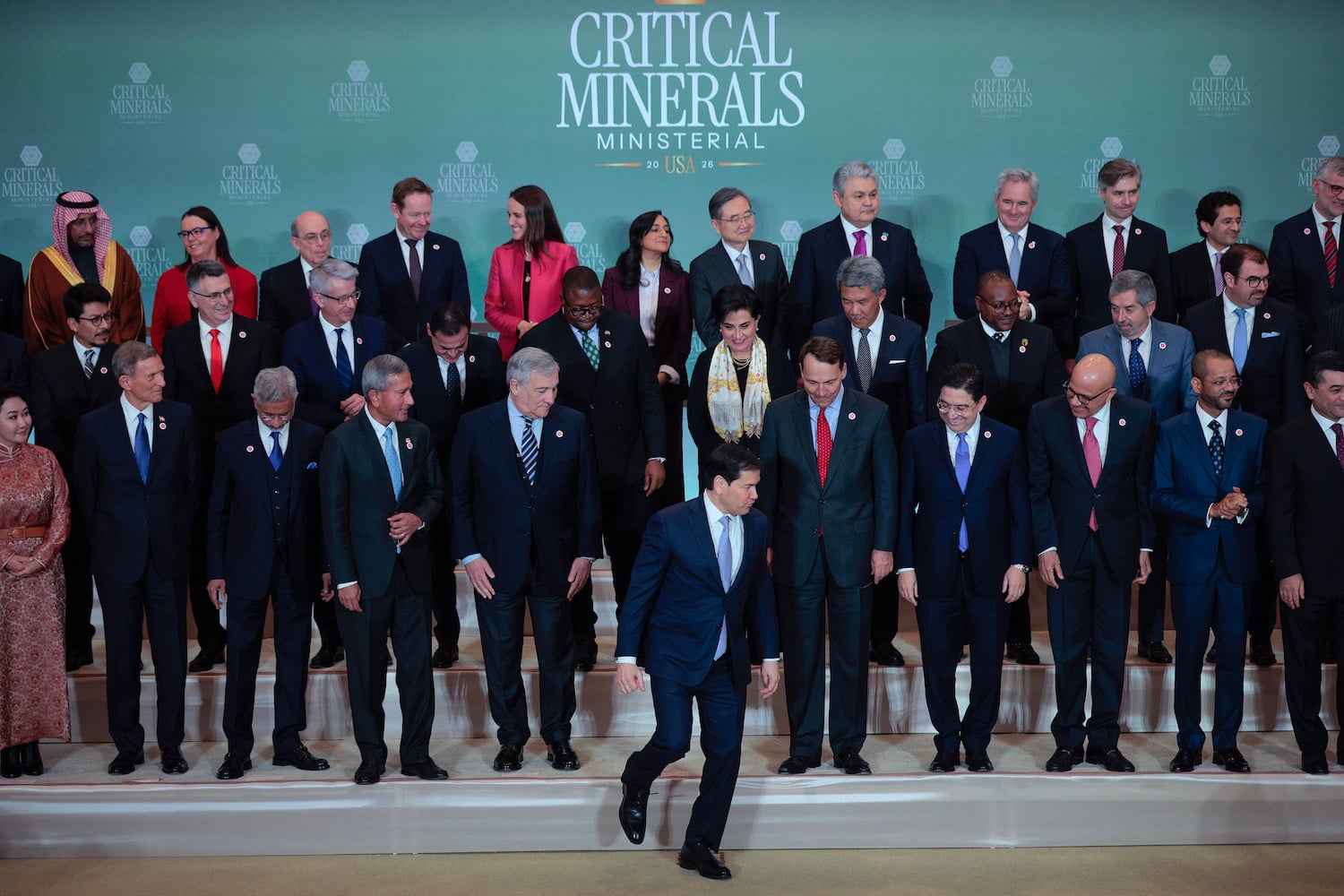
The White House convened dozens of countries in February for the first-ever Critical Minerals Ministerial, where U.S. officials pitched delegations from dozens of countries on a global critical minerals trading bloc.
Ultimately, 27 deals emerged from that ministerial, Caleb Orr, the U.S. assistant secretary of state for economic, energy, and business affairs, said at an event in Washington last week. The Trump administration has taken a primarily bilateral approach, while leveraging multilateral forums to sign deals, Orr added.
“The most impactful component of the ministerial was the sheer size of it,” Orr said. “You had 55 countries … who all signed up and said, ‘We recognize that there is a problem in the world with one country having a monopoly on the minerals that will power the 21st century, and we want to work with the United States to come up with a solution.”
Gracelin Baskaran, the director of the Critical Minerals Security Program at the Center for Strategic and International Studies, a Washington-based think tank, said that countries are walking a “precarious” line between strengthening collaboration with the Trump administration and risking angering Beijing.
“Countries want to create a coalition whereby they can work together to build supply chain security,” she said. “However, every country is also cautious of Chinese retaliation.”
In one of the most recent agreements, the European Union and United States last month inked an agreement to coordinate efforts to strengthen critical mineral supply chains, including by establishing potential price floors and offtake agreements.
“Now comes the real test—execution, by turning shared ambition into concrete, high-impact projects,” European Commissioner for Trade and Economic Security Maros Sefcovic told reporters in a press conference last month. “That is what will define our success.”
But with other critical mineral agreements with Australia, South Africa, and more, European officials aren’t relying solely on Washington, either.