


- Key insights: Banks face challenges in serving digital wallets, which are generally operated by third parties.
- What’s at stake: Digital wallets have rapidly become mainstream globally.
- Expert quote: “The bank is the plumbing,” Barclays’ Anuj Arora said. “If you do a bad job there, you are going to lose the customer. How easy are you making it for the customer?”
SAN FRANCISCO — For Anuj Arora, the stakes and the benefits of getting digital wallets right is clear.
“We have realized that the customers that use [our card] in a digital wallet spend four to five times more than non-wallet users,” Arora, director and executive product manager at Barclays, said Tuesday at American Banker’s Payments Forum in San Francisco. “These are your highest engaged customers.”
Processing Content
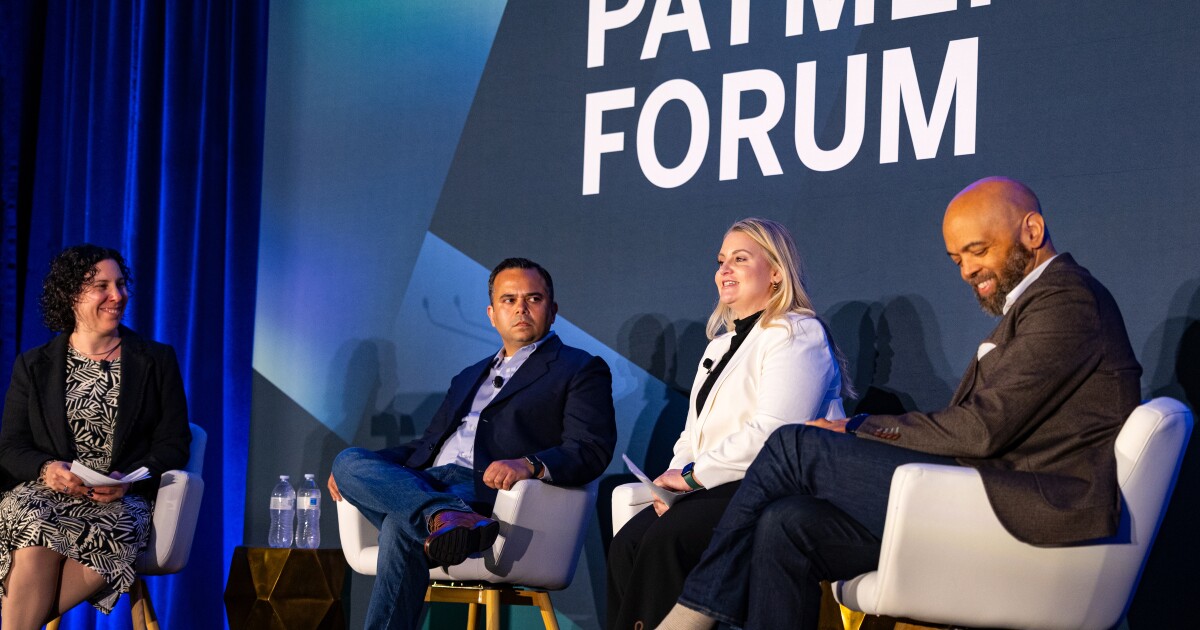
Arora joined Tim Mills, head of enterprise and open banking at Regions Bank, and Jennifer Smith Brittain, senior director of experience strategy and digital experience at Pinnacle Financial Partners, in discussing what banks need to know about earning the “top status” as consumers increasingly use non-bank digital wallets as a primary point of contact.
To help incentivize customers to use the bank’s payment cards first in a digital wallet, Pinnacle includes a
It’s crucial that the card work, and not stop working, once the customer loads it into the wallet, the panelists said.
“People are automatically expecting that transaction is going to happen,” Mills said, noting the importance of building habits since a consumer using a card in a digital wallet will generally keep using that card.
“My goal is to make sure that when they get their Regions card, it shows up in their digital wallet, as long as that first transaction goes through with no problem,” Mills said.
The executives stressed that banks need to make it easy to use these wallets, even if the consumer’s initial contact is with a third party that has its own recognizable brand, such as Starbucks or Apple.
“If it’s Apple Pay, Google Pay, Cash App, our role is to be able to be about trust. Is my payment secure?” Mills said.
Usage statistics show digital wallets have become mainstream. payments passing $15 trillion in yearly volume, according to
Since companies like Apple and Starbucks aren’t payment processors, traditional bank-led rails execute the payments on behalf of these wallets.
That makes banks responsible for service reliability and issues such as customer queries about payment failures and fraud.
“The bank is the plumbing,” Arora said. “If you do a bad job there, you are going to lose the customer. How easy are you making it for the customer?”
If these questions can’t be answered, consumers will quickly move another card to the top of the digital wallet.
“People are automatically expecting that transaction is going to happen,” Mills said. “My goal is to make sure that when they get their Regions card it shows up in their digital wallet, as long as that first transaction goes through with no problem.”
The shift to digital wallets is also happening in brick and mortar stores. Contactless payments, which link to a digital wallet, now account for 70% of all in-person Mastercard transactions, suggesting that the habit of using mobile wallets has successfully migrated from e-commerce to brick-and-mortar stores, according to Mastercard, which added.
Digital wallets are also evolving into “full-stack financial operating systems” that integrate investing, lending, and global transfers into a single interface. “Top of wallet strategies are really important. It really comes down to who they trust,” Brittain said, noting her institution provides advice on spending, fraud alerts and other services: “These are things we’re doing to put clients more in control.”