


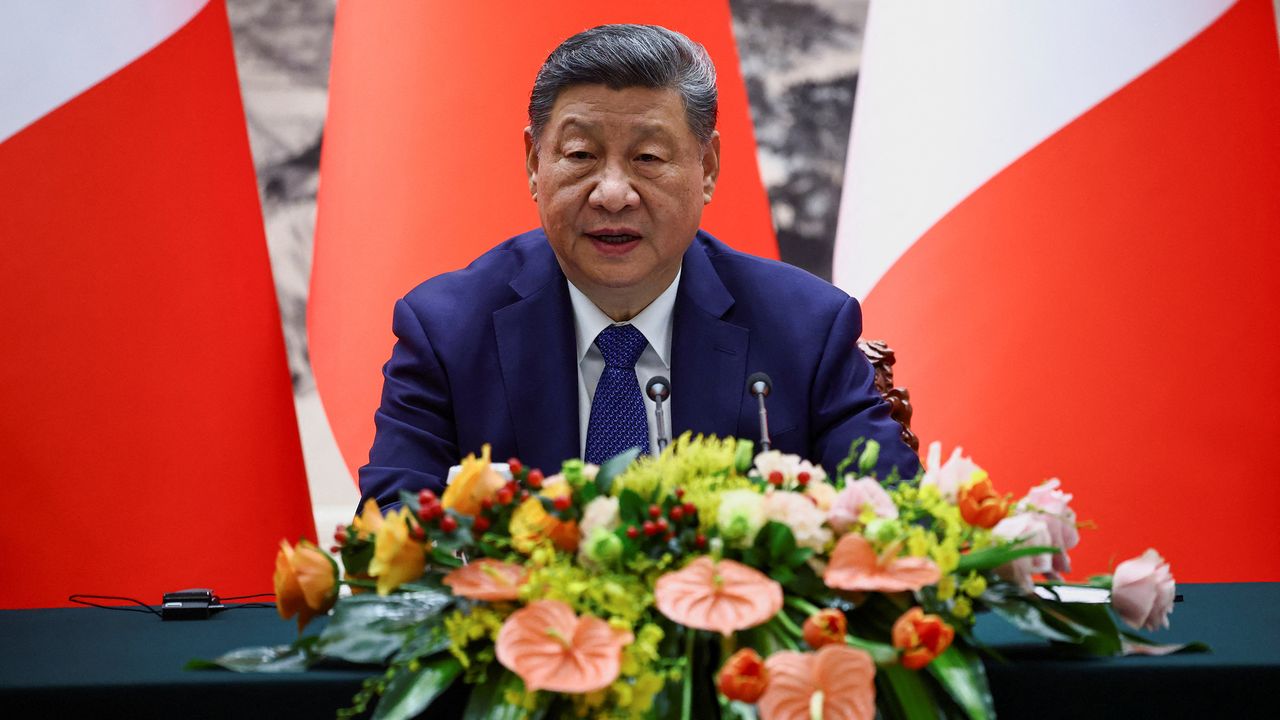
For China, this rhetoric isn’t just posturing. The country is at the heart of twenty-first-century trade networks, so Beijing’s strategists prioritize geopolitical calm and market predictability. The tumult of Trump’s tenure provides a foil for Xi’s greater ambitions. “For decades we thought of Chinese foreign policy as mainly seeking stability to facilitate economic development, but Xi is projecting confidence in the face of the more volatile, violent world of the second Trump term,” Julian Gewirtz, a senior researcher on China at Columbia University and a former official in the Biden Administration, told me. China, despite its immense strategic oil reserve, isn’t immune to the economic disruptions created by the ongoing impasse over the Strait of Hormuz. Still, Gewirtz argued, Xi “believes that China is better able than the United States to ‘eat bitterness’—that is, to endure hardship and emerge stronger from periods of struggle.”
China’s economy was already sluggish before the war, and new bottlenecks in global logistics are raising costs for the country’s vast manufacturing and export sectors. But the war has offered an upside: Asian countries, which are far more dependent than the U.S. on the fossil fuels coming across the Strait of Hormuz, now have fresh urgency to insulate themselves from future oil shocks and expand their renewable-energy capacity. China already dominates green-energy supply chains, and its exporters of solar systems, batteries, and electric vehicles all posted record sales in March, Ember, a global-energy think tank, reported. There is evidence of a wider reckoning in motion, too: “As we face the second fossil-fuel shock in less than five years, the lesson for our country is clear. The era of fossil-fuel security is over, and the era of clean-energy security must come of age,” the British secretary of state for energy, Ed Miliband, said, calling on the U.K. to wean itself off gas-generated electricity. The Trump Administration, sitting atop its fossil-fuel bounty and contemptuous of investment in renewable energy, seems content to let China steer this global transition.
China has also benefitted from the Iran war simply by sitting on the sidelines. It has watched the Trump Administration relocate major military assets from Asia to the Middle East—redeploying air-defense systems over the objection of South Korea’s President. In just weeks, the United States burned through an arsenal of critical munitions, including stockpiles of Patriot, Tomahawk, and stealth cruise missiles, and of THAAD interceptors. For U.S. partners in the Pacific, these moves deepen the sense of a waning Pax Americana and could reshape their long-term calculations on how to hedge against China.
The war has exposed other vulnerabilities, too. U.S. struggles against Iran, a weaker opponent—and its inability to neutralize Iran’s cheap drone campaign in the Gulf—have cast doubt on any prospect of sustained U.S. military dominance in Asia. Beijing has also gained a front-row seat to new U.S. methods of warfighting, specifically its widespread use of unmanned and autonomous weapon systems. Chen Yixin, China’s Minister of State Security and a prominent adviser to Xi, recently published an article mentioning the deep applications of A.I. in intelligence fusion, decision-making, target recognition, combat support, and cognitive shaping on display in the conflict. As it did when the U.S. rallied to Ukraine’s defense after the 2022 Russian invasion, China is watching and taking notes.
The war with Iran—or its uneasy aftermath, should there somehow be a diplomatic breakthrough in the coming days—will loom over Trump’s upcoming summit with Xi, in Beijing. The meeting, initially planned for March, was delayed by the war. The situation has only intensified since: in a bid to put more pressure on both Tehran and Beijing, the Trump Administration placed sanctions on several Chinese oil refineries and forty Chinese-linked shipping firms and vessels involved in trade with Iran. China, meanwhile, laid out new rules that could penalize foreign companies trying to shift from China-based supply chains. The project of “de-risking” from China—encouraged by both President Joe Biden and Trump—had been embraced by various countries in the West, but seems more complicated in Trump’s second term, as those same countries now feel the need to hedge against the U.S., too. It’s another tacit victory for Beijing, whose own soft power is growing just by existing in contrast to Trump’s wrecking-ball politics. “The more that U.S. allies and partners undertake to de-risk from Washington, the less diplomatic capital Beijing has to expend on assuaging their misgivings about its own conduct,” Ali Wyne, a researcher on U.S.-China relations at the International Crisis Group, told me.