


- Key insights: AI is growing quickly, but banks still face challenges in building interoperable agentic commerce payments.
- What’s at stake: Consumers and businesses are slowly embracing new forms of AI, creating competitive pressure on banks.
- Expert quote: “It’s very hard to put agents in control,” said Eynat Guez, CEO and cofounder of Pagaya Global.
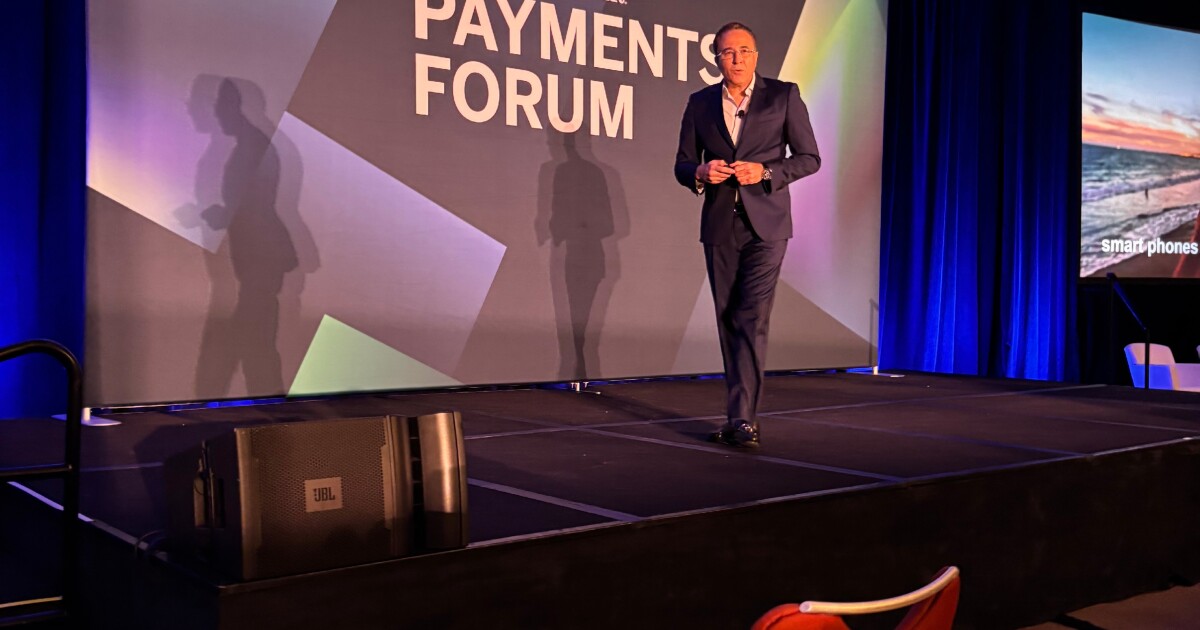
San Francisco—Driss Temsamani says artificial intelligence has evolved so much that there are already robots that can make decisions in factories, but the prevailing technology isn’t designed to support sophisticated artificial intelligence end-to-end.
“This is not about process automation, it’s about something completely different,” Temsamani,
Processing Content
Temsamani discussed what he calls the “agentic bank,” which includes people and AI agents working in concert to orchestrate payments, manage liquidity, detect risk and deliver financial services at “machine speed.” But, the internet has shortcomings in this environment, since the web is designed to move information, not value, he said, adding that this leads to silos in payments data, which hinders interoperability between databases.
There are also complications due to compliance and risk that create challenges in using AI to quickly move funds globally, according to Eynat Guez, CEO and cofounder of Pagaya Global.
“AI is taking over all of the infrastructures, such as compliance. Over time it will get to user experience,” Guez said at Payments Forum. “It’s very hard to put agents in control,” Guez said. Even as AI and digital payments advance, there is still a need to support traditional processes because support for agentic payments is not assured on both sides of a transaction, even for a relatively clean payment such as payroll.
“Bank infrastructure is behind because they can’t change and innovate quickly,” Guez said.
While Temsamani said it’s hard to predict the future, work is ongoing to help AI agents and similar tools communicate and standardize actions, which will encourage interoperability.
Mastercard and Visa recently launched separate agentic payment technology that for the first time promises to bring AI together with payments outside of well-known use cases.
Mastercard’s Agent Pay, an agentic payments program, is part of agentic suite at Mastercard that includes Agentic Tokens, a security protocol that leans on Mastercard’s established tokenization capabilities to secure mobile contactless payments, secure card-on-file, Mastercard Payment Passkeys and programmable payments such as recurring expenses and subscriptions.
Visa has a similar program, Visa Intelligence Commerce, that enables AI agents to make purchases on users’ behalf.
And
The benefits of advanced AI are apparent, Temsamani said, noting that
But only 3% of banks have scaled AI in their organization, Temsamani said, noting the “execution gap” is real.
“Today all of us are figuring out how to use AI,” Temsamani said.