


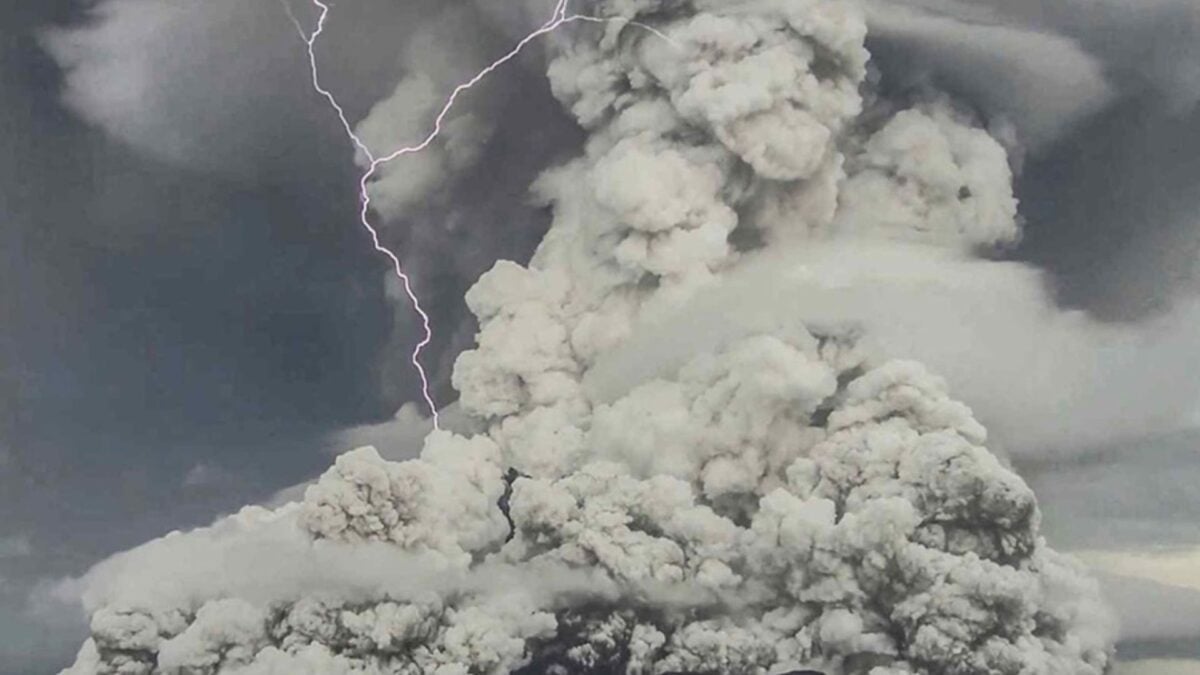
When the Hunga Tonga–Hunga Ha’apa submarine volcano erupted in 2022, it spewed roughly 2.9 billion tons of ash and gas into the air above the South Pacific. According to a new study, the eruption also cleaned up some of its own mess.
The researchers estimate that the eruption released about 330 gigagrams of methane, which is roughly equivalent to the annual emissions produced by more than 2 million cows. But their findings, published in Nature Communications on Thursday, show that chemical reactions within the eruption plume destroyed about 900 megagrams of methane per day—roughly equivalent to the daily emissions from 2 million cows. As if that wasn’t surprising enough, they also found that the cloud kept removing its own methane pollution for 10 days as it drifted toward South America.
“It is known that volcanoes emit methane during eruptions, but until now it was not known that volcanic ash is also capable of partially cleaning up this pollution,” first author Maarten van Herpen of the Dutch organization Acacia Impact Innovation BV said in a statement.
How volcanic eruptions emit and destroy methane
Methane is a potent greenhouse gas that traps about 80 times more heat than CO2 over a 20-year period. Scientists believe it currently drives about 30% of global warming. Fortunately, methane breaks down in the atmosphere relatively quickly, typically within 10 years.
Reducing methane emissions from industrial processes and agriculture will be essential to mitigating climate change, but not all methane emissions can be reduced. Some stem from natural processes such as microbial decomposition or, of course, volcanic eruptions. To address methane pollution from those sources and slow global warming in the near term, researchers are exploring ways to accelerate the natural breakdown of atmospheric methane.
This study uncovered a mechanism that could help them do just that. Using the TROPOMI imaging spectrometer aboard the European Space Agency’s Sentinel-5P satellite, the researchers determined that the eruption plume contained unusually high concentrations of formaldehyde, a short-lived intermediate that forms when methane breaks down. Formaldehyde only exists for a few hours before it decomposes into CO2 and water, but it remained present within the plume at high concentrations for more than a week, suggesting methane was continuously breaking down.
Previous research led by van Herpen showed that when dust from the Sahara Desert blows over the Atlantic Ocean, it mixes with sea spray to form iron salt aerosols. When sunlight interacts with these particles, it produces chlorine atoms that accelerate the decomposition of methane. He and his colleagues believe a similar reaction mechanism took place within the volcanic cloud; seawater hurled into the atmosphere by the eruption mingled with ash, and the mixture reacted with sunlight to produce highly reactive chlorine atoms.
Turning this mechanism into a climate solution
The findings provide further evidence that this mechanism could help reduce atmospheric methane concentrations—if engineers can figure out a safe, effective, and economically viable way to replicate it.
Researchers have already proposed some strategies, such as building reactors that pull methane from the air and bubble it through a chlorine-saturated brine or spraying chlorine atoms directly into the atmosphere via a controlled release system, though the latter could have unintended environmental consequences.
A key hurdle to developing these interventions is accurately measuring how much methane they remove. “How do you prove that methane has been removed from the atmosphere? How do you know your method works? It’s very difficult,” co-author Jos de Laat, a senior scientist at the Royal Netherlands Meteorological Institute, said in the statement. “But here we address that problem by showing that methane breakdown can in fact be observed using satellites.”
The researchers hope their findings will inspire more engineers to leverage chlorine atoms as a methane-removing agent and validate their approaches using satellite spectroscopy. As global warming rapidly accelerates, finding innovative ways to reduce atmospheric methane concentrations will only become more critical.