

Some authors make such an impact they become adjectives. Without even reading their work most know what “Byronic,” “Dickensian,” and “Kafkaesque” suggest, but no term is as chilling as “Orwellian.” It connotes a dystopian society ruled by a ruthless and manipulative government that suspends its misinformed populace in fear while under constant surveillance. These themes of course permeate George Orwell’s final major work, 1984, but these dark seeds are also found in the “fairy story” (its original subtitle) that he published four years earlier: Animal Farm, a novella still taught to middle school kids.
Indeed, Andy Serkis, director of a new computer-animated movie version of the thinly veiled allegory of the Soviet Union, said in an interview that he first encountered the story at age 11 and that it spoke to him deeply. The 2026 version, which took Serkis 15 years to realize, is a bit of a headscratcher, but it is also, in its way, perfect for our current cultural climate. It moves the story from the United Kingdom to the United States, it’s got fart jokes, the distribution company is shilling merch riffing on the MAGA hat, and there’s a gloriously irrelevant rap song at the end. (You must listen to this. You absolutely must.)
Some authors make such an impact they become adjectives. Without even reading their work most know what “Byronic,” “Dickensian,” and “Kafkaesque” suggest, but no term is as chilling as “Orwellian.” It connotes a dystopian society ruled by a ruthless and manipulative government that suspends its misinformed populace in fear while under constant surveillance. These themes of course permeate George Orwell’s final major work, 1984, but these dark seeds are also found in the “fairy story” (its original subtitle) that he published four years earlier: Animal Farm, a novella still taught to middle school kids.
Indeed, Andy Serkis, director of a new computer-animated movie version of the thinly veiled allegory of the Soviet Union, said in an interview that he first encountered the story at age 11 and that it spoke to him deeply. The 2026 version, which took Serkis 15 years to realize, is a bit of a headscratcher, but it is also, in its way, perfect for our current cultural climate. It moves the story from the United Kingdom to the United States, it’s got fart jokes, the distribution company is shilling merch riffing on the MAGA hat, and there’s a gloriously irrelevant rap song at the end. (You must listen to this. You absolutely must.)
A still from Animal Farm.Angel Studios
Animal Farm is for many the first “smart person book” they read. And it’s no wonder why it continues to resonate with thoughtful kids. For starters, it’s a funny story about pigs and horses trying to run a farm on their own. It has broadly drawn characters representing clearly defined social attitudes. (One does not need to know specifics about the Great Purge or the Molotov-Ribbentrop Pact to follow along.) It’s got violence, it’s got mystery, and it’s got some easily understood distrust of authority culminating in the famous transformation of the phrase “All animals are equal” into “All animals are equal but some are more equal than others”—a paradoxical statement as perfect as 1984’s climactic assertion that “2+2=5.”
If it’s been a while since you’ve last picked it up, Orwell’s novella is set on small English farm run by the drunken Mr. Jones. An elderly prize boar, Old Major (representative of Karl Marx with a dash of Lenin), has a dream of a utopian farm free of humans, where there is equality, pride in hard work, and a fair reward of retirement, not slaughter. After a battle, the animals take over, but they soon discover that self-government is not simple.
There’s the wise and visionary pig Snowball, who symbolizes Trotsky. He is soon overrun by the duplicitous, totalitarian brute Napoleon, who symbolizes Stalin. You can continue through the book’s barns and stables looking for one-to-one representatives from Soviet history if you like— the windmill is the Five-Year Plan; the hens are the Ukrainians suffering the Holodomor; some have made the case that Boxer, the brave, hard-working cart-horse, is specifically Alexey Stakhanov, but I’ll leave that to the hardcore Russian historians to parse.
Orwell began work on Animal Farm in late 1943 and had great difficulty in getting it published. A man very much of the left and devoted to British Socialism, he broke ranks with Stalin and the Soviet Union after witnessing communist purges in Spain, where many of his friends were imprisoned, killed, or disappeared. (In the preface to the Ukrainian language version of Animal Farm, he wrote that he was “lucky to get out of Spain alive.”) But the thick of World War II was not the right time to sell a book criticizing the man Franklin Roosevelt was calling “Uncle Joe.” In a 1996 preface to Animal Farm, Russell Baker noted that Orwell began drafting the work just as the Red Army began to turn the tide of the war, and “even conservatives were pro-Soviet.”
In time, though, the book was published, and it hit shelves just a few days after the Hiroshima and Nagasaki bombings. The world and its attitudes had radically shifted. Animal Farm has since been adapted for film on three occasions, and each version is a fascinating window into the politics of its time.
In 1951 British animators John Halas and Joy Batchelor were hired by producer Louis de Rochement to adapt the story for a film released in 1954. But the financing and creative guidelines for the movie actually came from a branch of the CIA run by E. Howard Hunt, whose later hits would include the Bay of Pigs invasion and Nixon’s White House Plumbers unit. The rights were negotiated with Orwell’s widow using undercover agents. It is unclear to what extent she knew who was ultimately signing the checks, but it is fair to say that few would have predicted an Orwell-CIA collab at the time of Animal Farm’s publication.
Its unusual origins aside, it’s a damn good movie. The hand drawn animation, led by Walt Disney Company alum John F. Reed, is spectacular, and the seriousness of the subject matter is expressed skillfully and creatively. Kids can still watch it, but it stays true to the story. (Napoleon’s dogs definitely maul Snowball off-screen, the use of red paint makes clear.)
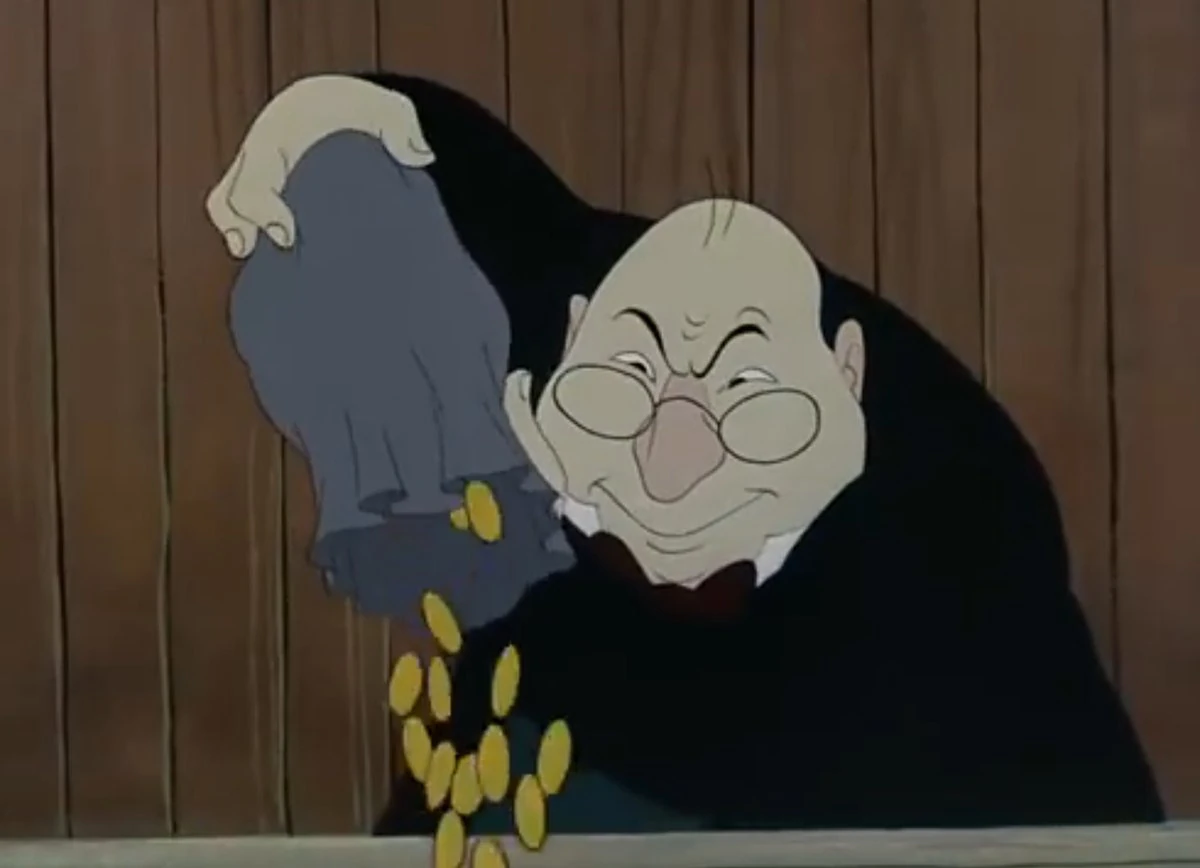
Changes were made to the text, as with any adaptation. Moses the Raven, the nuisance presence meant to represent religion, has been purged, and the capitalist go-between, Mr. Whymper, described merely as “a sly-looking little man with side whiskers” in the book, is presented as a fat, hook-nosed, coin-counting antisemitic caricature. The most notable change, however, comes at the end.
The book concludes with a colossal downer. Napoleon and his cabal of sinister pigs are now indistinguishable from the humans, and there is no hope on the horizon. (To quote 1984: “If you want a picture of the future, imagine a boot stamping on a human face—for ever.”) But the CIA-led production had something else in mind: a coda in which the rank and file of Animal Farm are joined by animals from other farms and are liberated from their totalitarian oppressors. After learning his pal Boxer has been turned to glue, Benjamin the donkey finally says enough and leads one last battle. Whether the reinforcement animals represent NATO or hordes from other Eastern Bloc countries stirred to action by Western propaganda is open for discussion.
Forty-five years later (and after 1977’s “Dude, I think this might be based on Orwell?” Pink Floyd album Animals), a new Animal Farm was released, again from U.S. producers deploying British writers and directors. The 1999 film is a mix of live action (real animals!) and a cagey use of animatronics created by Jim Henson’s Creature Shop. After the initial shock of seeing a group of barnyard quadrupeds speaking with British accents, you’ll find that this is actually a handsome and sharp production.
The voice cast is stunning. Patrick Stewart as the evil Napoleon is quite rightly the star of the show. He is aided by a murderer’s row of powerhouse British talent: Ian Holm as the propaganda minister, Squealer; Peter Ustinov as Old Major; and Paul Scofield as Boxer. From the Hollywood side, Kelsey Grammer voices Snowball and Julia Louis-Dreyfus is Mollie the mare. In the book, Mollie is presented as a vain turncoat who defects from Animal Farm to live with the humans, but that’s been excised here. There aren’t too many female characters in Orwell’s text, so one can see how, in 1999, adjusting Mollie would be a reasonable studio note. (It’s worth pointing out, however, that Ann Patchett’s 2003 preface to Animal Farm defends the character somewhat, writing that “the stupid, frivolous Mollie chose to be a slave on her own terms, and in doing so was spared the heartbreak of betrayal by her own kind.”)
Another nod to gender parity is taking one of the dogs, Jessie (voiced by Julia Ormond), and making her the narrator of the film. New to the story is how Napoleon takes her pups away, then trains them to be his enforcers without her knowledge. It’s a nice touch that makes Napoleon seem all the more cruel. (Not all adjustments to a classic are bad!)
But, as in 1954, a happy ending was needed. There’s no triumphant battle, however. Napoleon’s greed and debauchery eventually leads to entropy and a slow implosion. Wait long enough, the film suggests, and the righteous will persevere and the Berlin Wall will fall. (If you want to read the destruction of Animal Farm’s windmill as a retconned version of the Chernobyl disaster, I’m not going to stop you.) This “it’ll all work out in the end” summation isn’t exactly an accurate depiction of the Soviet Union’s final days, but it’s probably good enough for a movie with Henson animatronics that was initially broadcast on basic cable.

A still from Animal Farm.Angel Studios
If the book was an indictment of Stalin from the left, the first film was CIA agitprop, and the second film was a celebration of the new world order of the 1990s, it’s appropriate that the new one, designed with unimpressive 3D computer animation in the Shrek mold, is an incoherent hodgepodge going for cheap laughs—even if Serkis boasts he has the approval of the Orwell estate.
Serkis, a director and actor who first gained prominence as a motion capture artist in the Lord of the Rings and Planet of the Apes films, accurately points out that Orwell has been “claimed by both the political Left and Right,” then adds that “neither has a monopoly on his ideas.” Serkis has sanded down the historic specificity of the text for a generic lesson of how absolute power corrupts absolutely, and in doing so his message is convoluted and confusing.
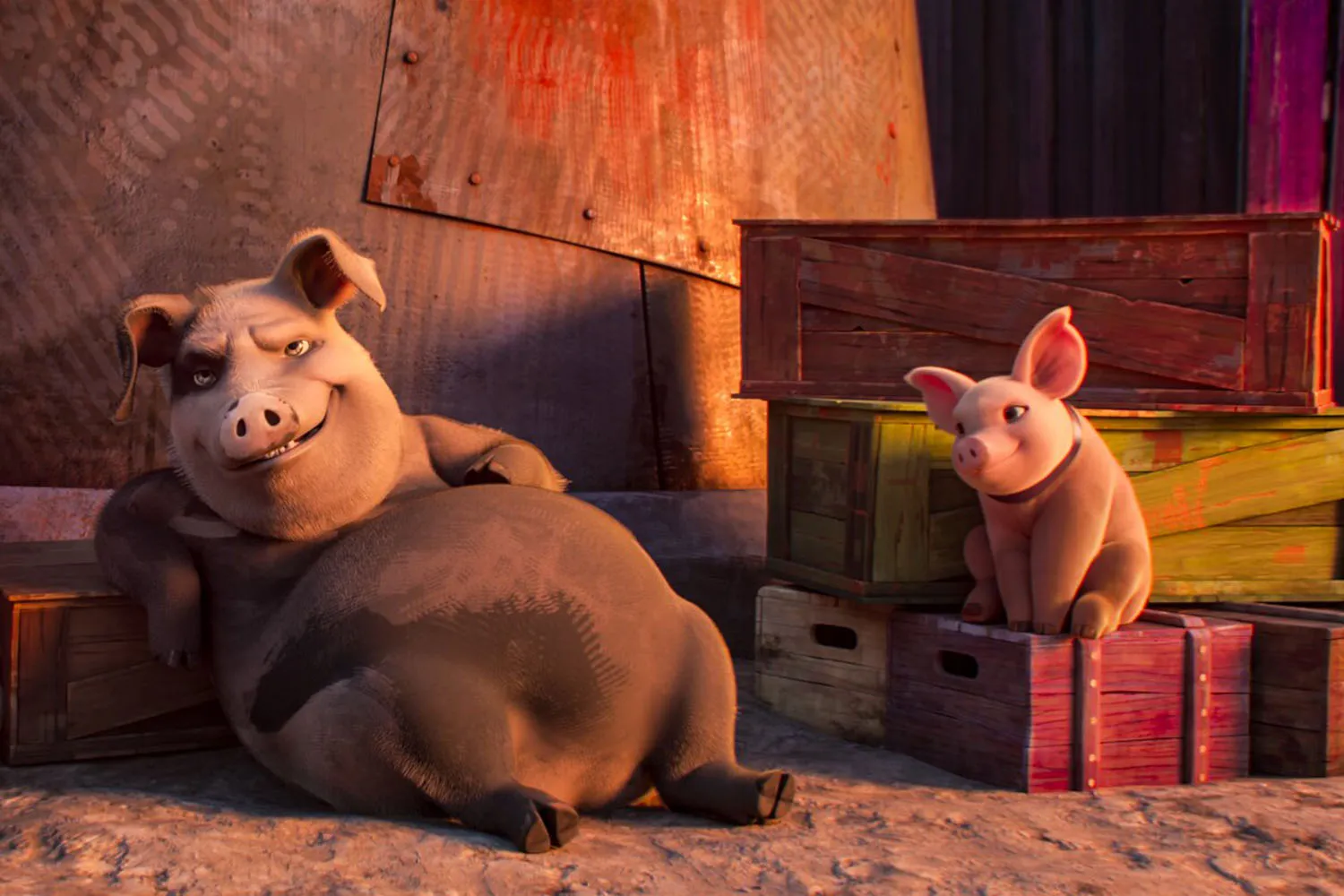
Though Serkis is British, the bulk of his voice cast is from the United States. Seth Rogen is Napoleon, and instead of a malignant schemer, he’s an arrogant (and flatulent) blockhead—less Stalin and more of a supercharged version of Family Guy’s Peter Griffin. You almost feel sorry for him when he plunges the farm into debt because he had to buy a flashy car, one of several vehicles that resemble a Cybertruck. There’s a moment when he dances on stage like Elon Musk campaigning with Trump, and then later he uses two Trumpian rhetorical flourishes: beginning a sentence with “many animals have been saying” and also flatly shouting “BORING!”
Beyond lampooning Trump, there is a more typical jaundiced view of modernity—the pigs get addicted to a Candy Crush-like game—and capitalism in general. Glenn Close voices a version of the neighboring farmer Mr. Pilkington, but this time she’s an agribusiness/tech disrupter in the Bezos-Musk mold who appeals to Napoleon’s vanity to screw over him and Animal Farm. Say what you will of Napoleon in the book, but he knew how to look after his own interests.
The weirdest part of all this is that while the film was produced independently, it is being distributed by Angel, a relatively new Utah-based company known for Christian films and hard-right projects like Sound of Freedom, a financially successful movie about Tim Ballard, the anti-trafficking activist later accused of sexual misconduct. (But yes, Animal Farm boasts the talent of Rogen, a liberal Canadian Jew who sells proprietary marijuana strains on the side.)
Seen from E. Howard Hunt’s perspective, you can see Angel’s interest in Animal Farm, but with all the Trumpist lampooning, it doesn’t really snap together. As far as the movie’s ending, well, there’s a big blown-out action sequence and a race against the clock, until the final, cringey dialogue: “We dreamed of freedom but looked for it in the wrong place,” a new character, Lucky, concludes. A leader like Napoleon isn’t the answer, and neither is Snowball, for that matter. (For the first time in the history of Animal Farm , Snowball catches a stray here.) The real way to find freedom is by “helping one another” and “work[ing] hard for our friends.”
Before you can say “huh?” just know this: Angel is offering a deal where you can purchase a digital ticket for Animal Farm and pre-order a bottle of “Boxer’s Workhorse Glue.” Benjamin the donkey torched houses for less.