


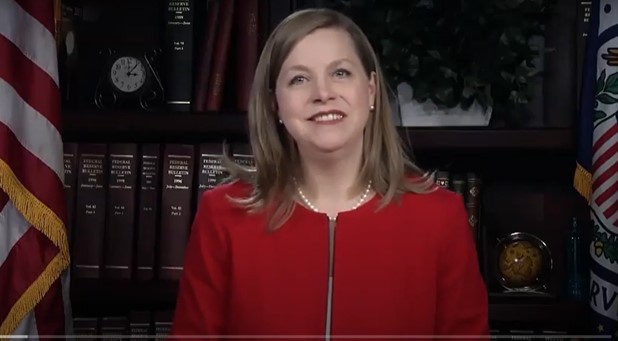
While addressing the 2026 Women in Housing and Finance Symposium today in Washington, D.C., Federal Reserve Vice Chair for Supervision Michelle W. Bowman told the audience that the Fed, along with the Treasury and the Federal Communications Commission will hold a public-private roundtable on ways to combat financial and consumer fraud.
Though consumer fraud “has been around as long as money itself,” today’s environment of rapid technological advances makes the risk “different in scale, sophistication and impact,” Bowman told the audience. To be effective, she said, the effort to respond to and prepare for fraud threats requires a “comprehensive, multifaceted response and no single agency or private-sector entity can address this threat alone. Effective solutions demand coordinated action.”
Bowman said Treasury Secretary Scott Bessent and FCC Chair Brendan Carr will build on their ongoing collaboration with the upcoming roundtable.
“This isn’t our first conversation. It is the next step in sustained engagement focused on actionable solutions,” Bowman said. “We’ll be asking participants to share what they are currently doing to combat payments fraud, what informal data-sharing practices have proven effective, what prevention mechanisms they have seen that work, and what additional cross-sector or government efforts would be most helpful in this fight.”
Among the goals will be to strengthen bank defenses and improve victim recovery, she said. “We must examine whether our regulations address modern fraud and are positioned for the threats consumers will face in the future,” she said. “The criminals are sophisticated, organized, and relentless. Our approach must be equally robust.”
Bowman cited the Fed’s 2025 Survey of Household Economics and Decision Making, which indicated that one in five American adults experienced financial fraud or scams in 2024 — 21% of the adult population. The total loss from non-credit card fraud across the financial system was $84 billion in 2024. Of this amount, only $21 billion was recovered, resulting in an estimated net loss of $63 billion in losses for individual consumers.
The median loss for victims was $500, before any recovery, she said, adding that even when victims were successfully able to recover funds, about half of those victims still lost money. In broader context, 13% of Americans cannot cover a $400 emergency expense using cash, Bowman said. “For financially vulnerable households, a fraud loss can quickly escalate from an inconvenience to a crisis affecting their ability to cover essential expenses.”
More than half of non-credit card fraud involved a bank account product, Bowman said, again citing Fed survey figures. Bank transfers and payments were the mechanism for almost 40% of aggregate reported losses from fraud in 2024, according to the Fed. Criminals are exploiting vulnerabilities in payment systems, authentication processes and the security measures designed to protect households.