


MIAMI — Florida’s politically influential Cuban American community is pressuring President Donald Trump to fully oust Cuba’s communist leadership as the Trump administration looks willing to settle for less.
Cuban opposition activists, especially in South Florida, have been taking their uncompromising message public for months. This includes everything from holding prayer sessions to caravaning in the streets of Miami to signing a road map document called the “Freedom Accord,” which set in stone their expectations for a transition to democracy. Working groups with members in South Florida and Cuba have been meeting for weeks to outline post-regime plans, like holding free and fair elections.
The moves point to growing tensions between the GOP-leaning Cuban diaspora in South Florida and the Trump administration, which has sent mixed signals about its true intentions for the island nation — fissures that could affect this year’s critical midterm elections.
The administration has imposed an energy blockade on Cuba and expanded sanctions pressure on the island, including through an executive order unveiled Friday, while simultaneously negotiating with the regime. But Trump and other administration officials have emphasized that some sort of deal for economic reforms could satisfy them for the time being. That includes Secretary of State Marco Rubio, a son of Cuban immigrants, who has long sought to topple the leadership in Havana.
While administration officials have also said some top Cuban officials would need to step down, the overall message they’ve sent is that all-out regime change may have to wait.
This approach is disturbing some in the Cuban diaspora, who argue that a U.S.-Cuba deal that puts economic change first would fail given rampant corruption in Cuba, fueled by the regime.
“The Cuban exile community, which is my community, what we’re saying is there won’t be any real economic change until you have real political change,” said Orlando Gutíerrez-Boronat, secretary general for the Assembly of the Cuban Resistance, a coalition of activist groups. He stressed that this is a widespread sentiment in the Cuban American business community.
GOP state Sen. Ileana Garcia warned that if the U.S. didn’t take military action or intervene in another way or have a plan that would “overthrow the regime” in Cuba, then Trump’s future presidential library, which is set to be built in downtown Miami, would be viewed as an “eyesore” next to the Freedom Tower that was once a processing center for Cuban refugees.
Inaction in Cuba, Garcia warned, would “definitely” affect the way people in South Florida vote, “especially after years of rhetoric and promises” to remove the communist regime.
Trump’s approach to foreign policy has generally prioritized U.S. economic interests ahead of human rights and democracy. His removal in January of Venezuela’s autocratic leader Nicolás Maduro left much of the Caracas regime in place in exchange for economic cooperation with the U.S. Trump also has backed off on earlier calls for total regime change in Iran, despite at first saying that he wanted to help Iranians rise up against their oppressive rulers.

Similar outcomes in Cuba are unlikely to satisfy the Cuban diaspora. An April poll for the Miami Herald of Cuban exiles found that 78 percent said they’d be dissatisfied with economic reforms alone. Another question found a significant majority would back military intervention, though that group was about evenly split between those who wanted the military to unseat the government in Cuba and those who wanted the military only to address humanitarian needs.
Cuban Americans are a politically powerful cohort in the Sunshine State and among Trump’s staunchest supporters. Their enthusiasm is a key reason Republicans have gained a foothold in South Florida, which, until recent election cycles, was a solidly blue part of the state.
Many Cuban Americans were thrilled that Trump named Rubio as his chief diplomat, and they trust him as a key player in the Cuba talks.

But the broader Cuban diaspora also has been swept up in Trump’s immigration crackdown. Cubans have long had a fast-track to green card status under the Cuban Adjustment Act, but the Trump administration has slowed down the processing of Cuban claims for legal immigration, while stepping up deportations and other enforcement actions against Cubans who have arrived in recent years.
A person familiar with the Trump administration’s thinking on Cuba described the Cuban diaspora activism as a mixed blessing.
“The exiles are mostly not helpful in a direct way, but they do put pressure on the regime, which is good,” said the person, who was granted anonymity to discuss a sensitive topic. “But look, the regime has survived pressure for 70 years. We need to be pragmatic about how this can go.”
Rubio, for one, isn’t going to forgo political reforms in Cuba, but Cuba and the U.S. “need to build the capacity for political change over time,” the person said.
Asked to comment on electoral implications and policies in Cuba, the White House said in a statement, “As the president stated, Cuba is a failing nation that has been horribly run for many years and whose rulers have had a major setback with the loss of support from Venezuela.”
The State Department did not respond to a request for comment.
Publicly, Rubio has sent a variety of signals about what exactly he would like to see in Cuba, speaking about the need for both economic and political change.
On “Fox and Friends” on Monday, Rubio said that “serious economic reforms” weren’t possible “with these people in charge.”
But that comment could be interpreted to mean swapping out a few Cuban officials, rather than wholesale regime change followed by democratic elections. That’d be in keeping with Trump’s occasional statements that he has achieved “regime change” in Iran despite only removing top leadership.
The economic changes the U.S. is pushing for in Cuba include privatizing state-run businesses, allowing more foreign investment, giving Cuban citizens better internet access and obligating Cubans to buy U.S. energy, according to the person familiar with the Trump team’s thinking.

Rubio doesn’t have the final say on what the U.S. will settle for — Trump does. The president is a mercurial figure who frequently changes his mind depending on the conditions of the moment. Trump also has to deal with the fallout of the ongoing war with Iran, which already has pushed Cuba down his priority list.
The Cuban diaspora is not monolithic, and the dominant voices in South Florida are often its most hard line — but they’re also the most fervent and important voting bloc.
Still, the U.S. also has to consider its national interests, not simply the views of Cubans.
That includes preventing a migration crisis that could result if the regime in Cuba, which is just 90 miles off the Florida coast, were to suddenly vanish, as well as managing the reactions of Cuba’s friends, like Russia and China, to whatever deal is struck with Washington.
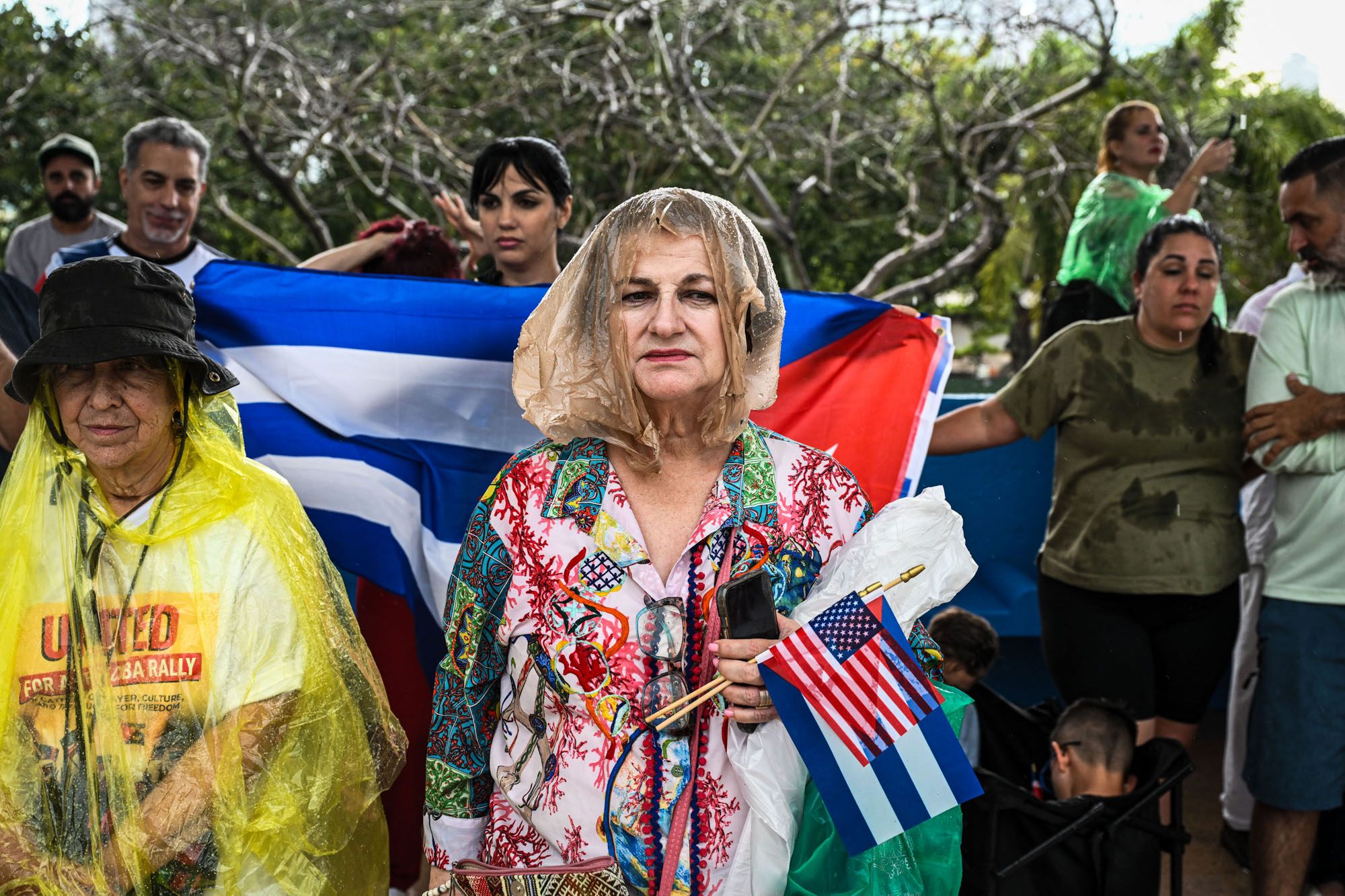
On the ground in Miami, Cuban liberation rally-goers routinely wear MAGA hats, T-shirts and capes featuring the president. But leaders also continually emphasize there’s a specific way they want Cuban liberation to play out.

Some, like Hialeah Mayor Bryan Calvo — whose city holds the largest concentration of Cuban Americans in the U.S. — have explicitly stressed that they don’t want a “half-measure” agreement akin to what the Trump administration did in Venezuela. That includes rejecting any deal that leaves in power the island’s President Miguel Díaz-Canel or the still-influential relatives of late Cuban dictator Fidel Castro.
“The people on the ground are very skeptical that Trump and Rubio can pull off something that’s acceptable to the community,” said a Florida-based political consultant with knowledge of the dynamics between Washington and South Florida, granted anonymity to speak candidly about internal concerns.
Last weekend, activist groups joined by Sen. Rick Scott (R-Fla.) met for a prayer event in downtown Miami to call for Cuba’s freedom and the release of political prisoners.
Working groups in South Florida and Cuba have been meeting for weeks to outline plans for delivering humanitarian aid after liberation, ensuring accountability against communist leaders and carrying out democratic elections. The work is an offshoot of the “Freedom Accord” signed by more than 70 opposition groups. Activists say they’ve shared the document with the State Department.
Rosa María Payá, head of the pro-democracy group Cuba Decide, said the plan “makes our position unmistakable” that Cuba must transition to a democracy, “not a rebranding of the regime that has held our country hostage since 1959.”
“There is a timeline that we hope to see, and it is before the end of this year — and hopefully tomorrow. The sooner the better,” said Alian Collazo, executive director of the Cuban Freedom March, another signatory. Collazo added that he had “extraordinary confidence” in Rubio.
On Wednesday, GOP state Sen. Alexis Calatayud of Miami, a Cuban American, introduced a proclamation in Tallahassee for state lawmakers to show solidarity for the accord, which she said shows “there is vision for a democratic Cuba.”
Gutíerrez-Boronat of the Assembly of the Cuban Resistance said Cuban diaspora leaders regularly speak with representatives of the Trump administration. He declined to detail the discussions but said the diaspora has been met with “great sympathy for our position.”

The person familiar with the Trump administration’s thinking said that it is considering “kinetic force,” meaning military options, in Cuba but that the emphasis remains on diplomacy and persuading the regime to make various changes, especially on the economic front.
Cuba has been facing a deepening struggle ever since the U.S. cut off oil shipments from Venezuela and threatened to impose sanctions on other countries that tried to send oil (though it allowed a Russian tanker to deliver crude oil in late March).
The island has been plagued by blackouts that have disrupted transportation, health care, water and food supplies.
“It does feel like a valve is going to pop sooner or later,” said a U.S. official familiar with conditions on the ground in Cuba, granted anonymity because they were not authorized to speak publicly.
However, the official downplayed the possibility of mass protests, noting past security clampdowns that would likely prevent Cubans from hitting the streets in large numbers.
The Cuban embassy in Washington declined to comment.
As eager as they are to see Cuba freed from communist rule, diaspora leaders say they are willing to be patient to get the policy right.
“There is a real sense of optimism and hope that we could see change in Cuba,” said GOP state Rep. Mike Redondo of Miami, the son of Cuban immigrants who’s in line to lead his chamber in 2030. “The Cuban diaspora has been let down in the past. … I would call it guarded optimism, but certainly the strongest it has been in my life.”
Kylie Williams in Tallahassee and Eric Bazail-Eimil in Washington contributed reporting. Toosi reported from Washington.