


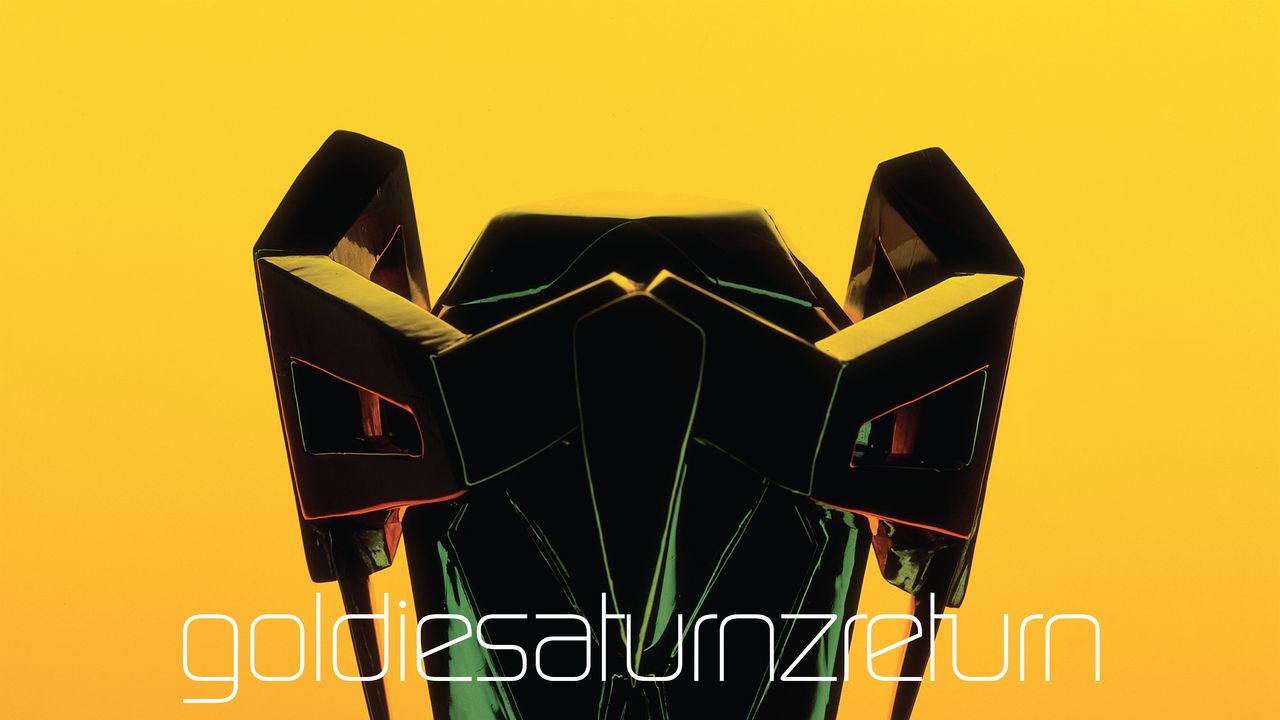
You could never accuse Goldie of lacking ambition. In 1998, just three years after the British producer’s debut album, Timeless, brought new levels of sophistication to the nascent jungle sound, Goldie opted to kick off his second LP with “Mother,” a gut-wrenching, hour-long cry for help. “It’s like looking at your mum’s vagina and knowing: ‘I know this is going to be a very difficult life but it’s the one life you need to make count,’” Goldie later said, neatly summing up the brazen lack of self-consciousness that would make “Mother” one of the most notorious songs of the decade.
Goldie, born Clifford Price in Walsall, England, in 1965, had a complicated childhood. His father disappeared soon after Goldie was born and his mother put her son into care at the age of three, where he remained for the next 15 years. Goldie grew up fiercely driven. After making his name as a graffiti artist in the 1980s, he threw himself headlong into raving and in 1994 became the first jungle artist to sign to a major when he inked a deal with London Records’ dance imprint, FFRR.
Timeless, released a year later, made him a genuine star, reaching no. 7 in the UK album charts at a time when it looked like jungle might take over the world. Everyone wanted to work with Goldie, from Madonna to David Bowie, and FFRR gave him carte blanche to do what he wanted. For his second album, Saturnz Return, he squirrelled himself away in the studio with a seemingly unlimited budget and no label interference.
What Goldie was cooking up, however, was far from what anyone expected. “This was at the peak of my career with drum’n’bass music and I chose to make an album which no one was gonna understand,” Goldie said when the album was re-released in 2019. “It was like a Greek tragedy: the story of a boy with trauma who just wanted his mother.”
Standing at the forefront of this tragedy—disc one, side one—was “Mother,” 60 minutes of wild musical adventure and psychic pain that tracked Goldie’s traumatic childhood using four cellists, eight viola players, 16 violinists, Goldie’s own raw but emotive vocals, and a filthily twisted beat that was sharpened to a point by Optical, then emerging as one of the brightest minds in drum’n’bass.
The song’s scope is jaw-dropping. The first seven minutes are a beatless drift of gas-canister hiss, intended to symbolize the sound of a baby emerging into the world. As the orchestra swells, a voice slowly surfaces. It sounds like a child chorister, classically trained and pure, but it is actually Goldie and vocal foil Diane Charlemagne, in one of the most atypical performances of either artist’s career. The lyrics suggest a child reaching out to his mother from within the womb, vulnerable and uncertain.
As the song ticks past the 20-minute mark, Goldie’s voice gets increasingly desperate and the music darkens. A cymbal taps into life, but the beat is in no hurry to build. Noises emerge, faded and indistinct, the ghostly spinbacks and ectoplasmic synth traces of rave’s haunted past; then a string riff drops, a jungle bassline in the Vienna Musikverein. After a 26-minute tease, the bass drum kicks in, and “Mother” briefly turns into a classic drum’n’bass roller, albeit one with a wildly charismatic man in his 30s periodically screaming over the top about his feelings of abandonment.