


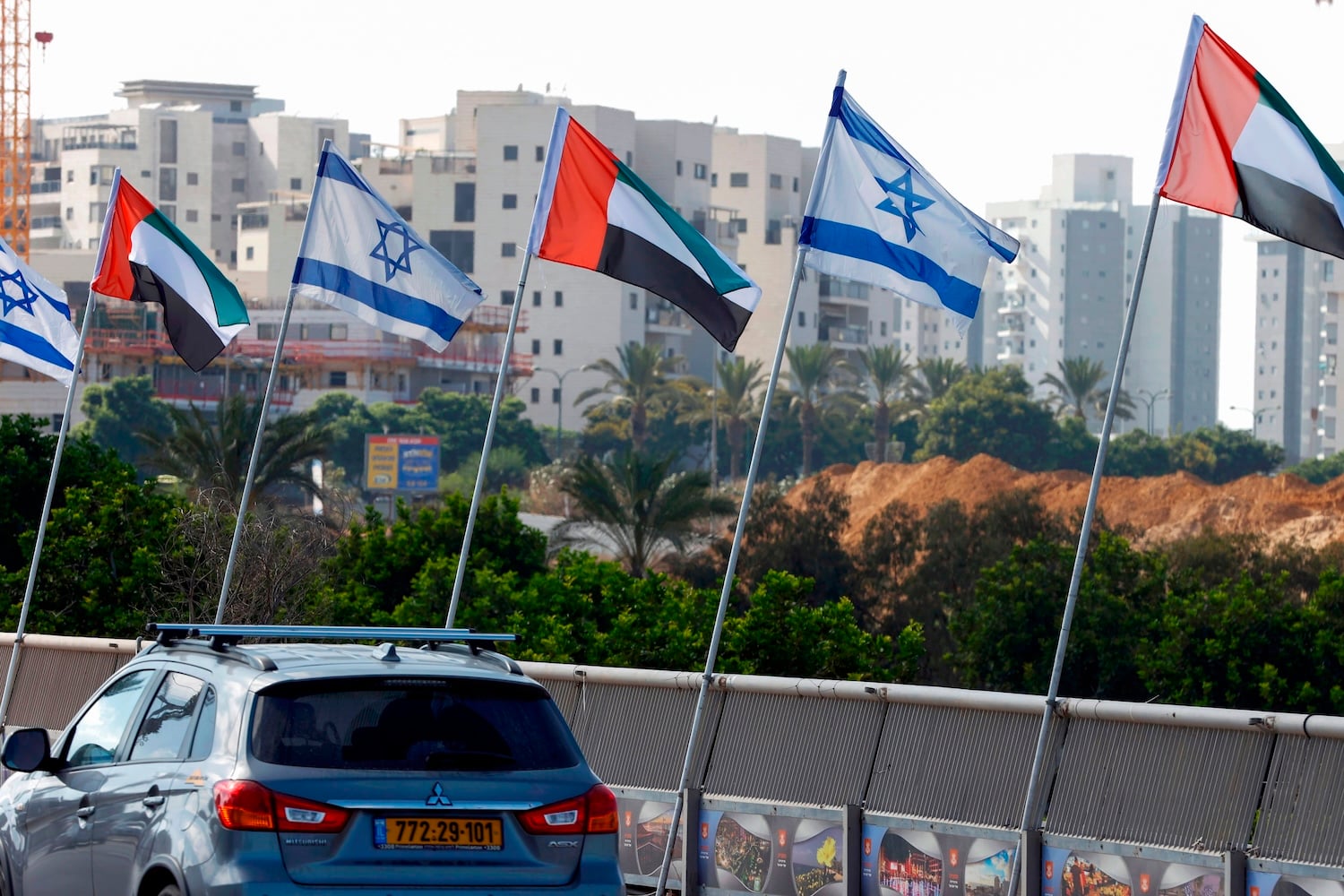
On Sept. 15, 2020, U.S. President Donald Trump presided over the signing of the Abraham Accords between Israel, Bahrain, and the United Arab Emirates. Speaking on the White House lawn, amid a lavish signing ceremony, Trump announced “the dawn of a new Middle East” saying that “these agreements will serve as the foundation for a comprehensive peace across the entire region—something which nobody thought was possible, certainly not in this day and age.”
If Trump can sometimes be overly effusive in evaluating the impact of his own achievements, this time, he was not alone. Many mainstream foreign-policy commentators were quick to praise the Abraham Accords, which were subsequently expanded to include Morocco and Sudan, as one of the few unambiguously good foreign-policy achievements of Trump’s first term. Longtime Democratic Middle East hand Dennis Ross wrote that normalization was an “unexpectedly positive move” that represented an “important contribution to peace-building between Arabs and Israelis.”
While the Biden administration initially held the accords at arm’s length, it soon embraced them as a formula for regional peacemaking. “The Abraham Accords are making the lives of people across your countries more peaceful, more prosperous, more vibrant, more integrated,” Secretary of State Antony Blinken declared at a March 2022 summit in Negev, Israel.
Such claims have now been revealed as fantasy. According to its proponents, the Abraham Accords were intended to strengthen military and economic cooperation between Israel and the Persian Gulf while also bringing a new “outside-in” approach to resolving the Israeli-Palestinian conflict.
In reality, the outside-in logic proved to be dangerously counterproductive, with Israeli-Gulf military cooperation leading to more risky and provocative behavior. Far from promoting peace and stability, the Abraham Accords laid the groundwork for a new era of violence, providing political cover for genocide in Gaza and enabling a reckless war against Iran.
When the text of the normalization agreements called for signatories to work toward regional security and stability, Iran was the implicit target. This was made more explicit in April 2021, when Washington passed the Israel Relations Normalization Act, which mandates that the United States encourage countries to normalize relations with Israel, recognizing the “shared threat posed by Iran.”
In 2022, Congress’s Abraham Accords caucus succeeded in passing the Deterring Enemy Forces and Enabling National Defenses Act, redoubling efforts to combat the perceived threat posed by Iran. The bill requires the defense secretary to cooperate with allies and partners in the Middle East to implement an integrated missile defense capability. Missile defense was essential because of the stockpiles of missiles and drones that Iran and its proxies maintained.
To ensure that Abraham Accords signatories could more effectively collaborate militarily, the Trump administration moved Israel into the U.S. Central Command area of responsibility. Israel joined the United Arab Emirates and Bahrain, among other Middle East states, under the purview of a single Defense Department combatant command. This shift allowed the United States to place common weapons systems across the Middle East and begin coordinating activity in an overarching anti-Iran missile and drone defense system.
The new architecture created layers of defenses that shielded Israel and created new military and intelligence partnerships—outside of regular diplomatic channels—to rapidly mount a defense against regional threats. Expanded military coordination through Central Command afforded Israel access to the airspace over Gulf countries as well, making long-distance offensive military operations logistically simpler.
Arms sales made up a large and growing portion of trade among Abraham Accords members. In 2021, Israeli arms exports increased 30 percent over the previous year, with 7 percent of its total arms sales going to Abraham Accords countries. Bahrain and the UAE purchased nearly $900 million in arms from Israel that year. By 2024, 12 percent of all Israeli arms sales were to other accords signatories, valued at nearly $2 billion.
The UAE specifically ramped up its military partnership with Israel. Israel’s largest arms manufacturer, Elbit Systems, won a $53 million contract to provide avionics to the Emirati air force, and the two countries collaborated on the production of unmanned naval vessels, drones and satellites, cybersecurity, and domestic surveillance technologies.
Arms sales facilitated military-to-military cooperation. In 2021, Israel, the UAE, and Bahrain began conducting combined naval and air force exercises, and the Israeli military, ferried on Emirati planes, began operating from newly constructed UAE military and intelligence operations centers on the Yemeni island of Socotra. In 2022, Israel deployed its Barak air defense system to the UAE.
The United States also rewarded Arab regimes for their cooperation with Israel. Trump announced a $23 billion arms deal with the UAE after signing the accords. The deal included 50 F-35A jets, 18 armed drones, and other equipment. In 2023, the Biden administration signed the Comprehensive Security Integration and Prosperity Agreement with Bahrain. The deal deepened security and intelligence cooperation between the two countries and integrated the Gulf state into the U.S. Central Command’s new regional air and missile defense scheme.
As military cooperation was proceeding apace, things kept getting worse on the Palestinian front. Instead of assuming that a viable Palestinian state is a necessary precondition for Arab-Israeli peace, the architects of the Abraham Accords argued that progress on the Palestinian question would only happen as a consequence of diplomatic normalization between Gulf Arab states and Israel.
Once formal diplomatic and economic ties were established, the argument went, signatories could work together to make progress on Palestinian issues. This logic was given an initial boost when the UAE used its accession to the accords as leverage to prevent the government of Israeli Prime Minister Benjamin Netanyahu from formally annexing the West Bank.
It was clear from the outset, however, that from the Israeli government’s perspective, the accords were in fact a way to permanently marginalize the Palestinians. While they halted de jure annexation, the de facto process has only accelerated. Within a year of signing of the Abraham Accords, there was a nearly 15 percent increase in Israeli settler attacks on Palestinian people and property, compared to the year prior. In 2022, settler attacks increased by 123 percent as compared to 2020. Despite evidence of Israeli army and police support for settler violence, no accord signatory stepped in to curb the violence.
Tellingly, after signing the accords, both the UAE and Bahrain cut their financial support for the United Nations Relief and Works Agency (UNRWA), the U.N. agency devoted to supporting Palestinian refugees—following the Trump administration’s decision to end its own support for the agency in 2018. From 2013 through 2019, the UAE was one of the top 15 donors to UNRWA. In the year that it signed the accords, 2020, the UAE donated just $1 million dollars to the agency.
Anti-Palestinian violence and settlement activity across the Palestinian territories increased so much after the signing of the accords that in September 2023, Abu Dhabi’s ambassador in Washington admitted that the agreements failed to prevent Israeli annexation of the occupied West Bank.
Hamas documents, recovered by the Israel Defense Forces, indicate that Hamas’s leader in Gaza, Yahya Sinwar, said that one reason for the Oct. 7, 2023, attack was to derail normalization. In his view, the Abraham Accords were undermining the salience of the Palestinian cause in Arab politics. If Saudi Arabia joined before securing an agreement on Palestinian statehood, Sinwar’s thinking apparently went, then it would allow the rest of the Arab world to follow suit.
The Hamas attacks of Oct. 7, 2023, and the devastating war that followed ultimately provided the context in which the growing Israeli-Gulf alliance could be turned against Iran.
Israel’s assassination of an Iranian general in Damascus in 2023 initiated a tit-for-tat missile and drone conflict between Israel and Iran and the latter’s proxies in Lebanon and Yemen. Waves of missiles and drones were intercepted by regional and Israeli interceptor systems. When Israel bombed the Iranian Embassy in Damascus in April 2024, the UAE and Saudi Arabia provided Israel with intelligence and active radar-tracking during Iran’s retaliatory response.
In the face of escalating the violence, the Biden administration doubled down on its support for the accords. This choice produced the military and economic cooperation without which Trump’s latest war would have been, if not impossible, far less attractive.
Logistically, on its own, Israel lacks the capability to intercept the volume of missiles and drones that Iran is able to fire. Before the Abraham Accords, Israel coordinated its military activities through a different regional U.S. combatant command, the United States European Command. The accords made it possible for the Trump administration to move Israel into the same combatant command as the Gulf states, and they allowed signatories to publicly begin military cooperation. This military-to-military collaboration in the years preceding the two Iran wars was essential for building the coordination and communication systems necessary for signatories to defend against large Iranian aerial bombardments in unison.
But security cooperation is not an objective good by itself. The question is always, what does it deliver? And here, it delivered less security and more war.
Six years after the signing of the Abraham Accords, the Middle East is unquestionably less peaceful than before. While the Trump administration is, as of this writing, unilaterally extending a delicate cease-fire with Iran, the Islamic Republic continues to maintain its chokehold on the Strait of Hormuz. Israel continues to violate the terms of both the Iranian and Lebanese cease-fire deals and is committing wanton acts of destruction in southern Lebanon as part of its entrenched occupation of a six-mile buffer zone. In Gaza, Israel continues to suspend the flow of essential humanitarian aid. In the West Bank, Israeli settler terrorism aimed at seizing control of Palestinian land, often done with the open support of the Israeli military, is a daily fact of life.
The accords made this possible. They undercut the pressure that Arab states were willing to apply to Israel over Palestinian issues; fed the illusion that the Palestinians could be sidelined and regional security assured by investing in friendly authoritarians; and helped Israel establish itself as a regional hegemon whose reckless warmaking now poses a threat to its own neighbors, to the broader interests of its U.S. patron, and to global prosperity.
The Abraham Accords were sold as a framework for delivering regional peace and stability. They have delivered the opposite. It should have been clear at the time that any “peace plan” premised on sales of arms and repressive technology to authoritarian regimes was bound to fail. The political conflicts that continue to bedevil the region will not be solved through force of arms, no matter what Washington’s ideologues say.
“Even if the [Iranian] regime will be toppled tomorrow, it doesn’t matter,” former Israeli intelligence analyst Danny Citrinowicz said in a recent conversation. “The problem is the Palestinian issue.”
The Trump administration is unlikely to back away from an agreement in which it has invested so much time, resources, and credibility. But the next administration should recognize that the Abraham Accords do not offer a realistic path forward to peace and prosperity, either for the region’s people or Americans.