


When I reviewed the first season of Netflix’s Devil May Cry, my expectations for the Studio Mir take on Capcom’s demon-hunting wahoo pizza himbo, Dante, swung from the dizzying heights of my favorite action hero character getting the Castlevania treatment he deserves to the disorienting confusion of a lapsed Christian wandering through the empty pews of their childhood church. Charitably, creator Adi Shankar‘s first season misreads almost everything that makes the video game series special. And yet, I was willing to give it the benefit of the doubt, partly because I was morbidly curious to see how season two would pick up its muddled metaphor about U.S. occupation and demon immigration with fan-favorite Vergil at the center of its thematic storm.
Now that the second season is out, I’m confused all over again. Not about whether it’s a good adaptation—it isn’t, and spectacularly so. I’m confused about whether the whole thing is a Rube Goldberg-esque parody played straight.
The liminal space between how catastrophically it fails as an adaptation and how eerily precise it feels as a disasterpiece parody that could put Tommy Wiseau’s The Room to shame makes Devil May Cry season two seem like it was engineered in a lab, mainlining Reddit memes, shipping fanfiction, and Shankar’s personal nu-metal AMV fanmix, with a hyperfocus on Devil May Cry 3: Dante’s Awakening and Devil May Cry 5, condensed into a slick animated show I went from pinching my temple watching to being helplessly entertained by.
Devil May Cry season two plunges the world into pure bedlam. After the U.S. military tears open a rift into the demon realm and commits war crimes for god and country on its innocent demonic denizens like an on-the-nose post-9/11 metaphor for the Iraq War, a demon named Arius (Graham McTavish)—who’s funding the war effort and puppeteering the country’s blithering idiot president—finally puts his very obvious plans into motion.
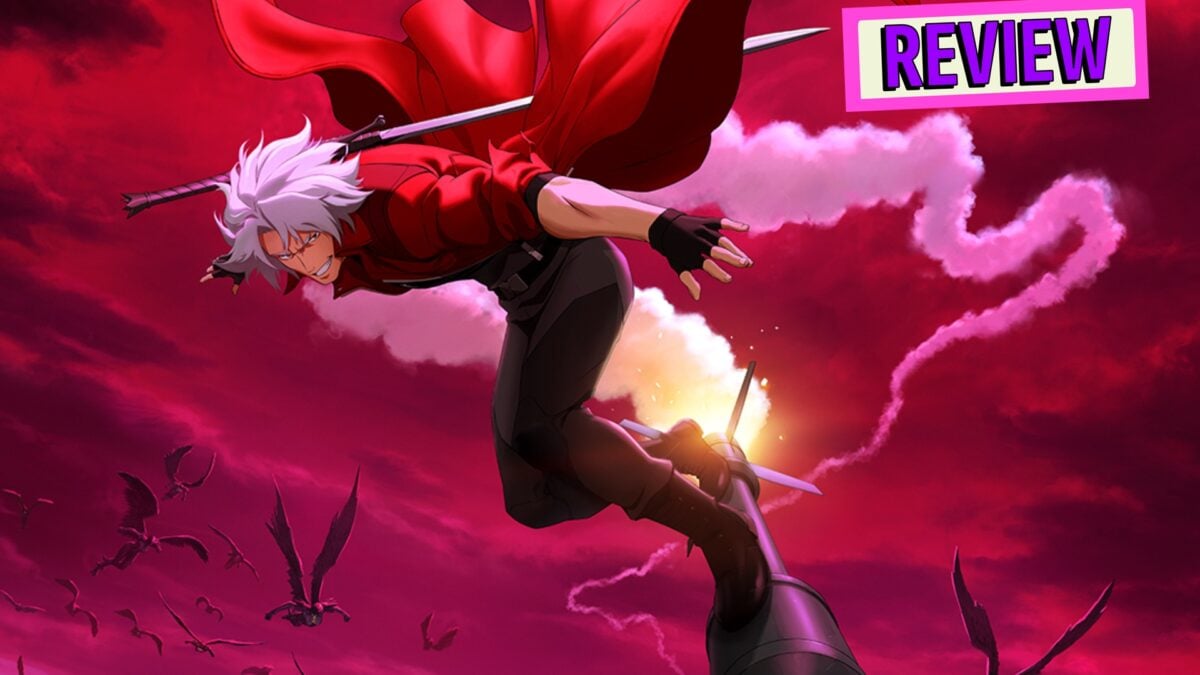
Step one: unfreeze Dante (Johnny Yong Bosch), the demon hunter, who was put on ice after being betrayed by his sailor-mouthed love interest, Lady (Scout Taylor-Compton). Step two: have Dante battle his long-lost twin brother, Vergil (Robbie Damon), who’s being brainwashed by the bigger big bad, Mundus (Ray Chase), the demon who killed their mother and somehow brainwashed him into fighting the war against demons on the side of demons. What follows is a melodramatic tale in which you can sometimes hear the dialogue whenever the licensed music isn’t drowning it out and Dante and Lady battle Vergil to save the world from plunging into further chaos. This is a task that includes tons of quips, dimension-splitting sword slashes, and riding a rocket like a surfboard.
If you’re wondering whether any of the political overtones above exist in the games, they don’t, unless you consider Dante and Vergil’s red and blue trench coats and tunics to be either side of the political aisle. Still, this is Shankar’s world, a world he’s shamelessly admitted he thought he was reviving from the dead (it was very much alive), and I went into season two with an open mind. Not since The Rise of Skywalker have I ricocheted between stunned exasperation and hysterical laughter at the sheer absurdity before me. Mind you, DMC is already a pretty wild show out of the box.
Ask a vocal majority of fans how they felt about season two, and you’ll get answers that sound like someone describing their 13th reason why, comparing the hot streak Capcom is on with its other properties, only for DMC to feel like an odd outlier. I couldn’t shake the sense that what I had watched wasn’t a run-of-the-mill video game adaptation misfire. It felt like an eight-episode prank played on the game’s fans, and a damn good parody at that.
At a certain point, watching Devil May Cry season two stopped feeling like watching a show and started feeling like Shankar would pop out from behind my couch at any moment of the show’s four-hour and 43-minute runtime to reveal I’d been punked. And because it’s such a wild departure from the games—arguably its antithesis at the worst of times and a misread at the best of times—it somehow loops back around as a “mission accomplished” as far as unintentional satire goes.
The show felt less like I was watching a DMC animated series and more like tuning in to lost episodes of The Boondocks featuring Dante from Devil May Cry. That came part and parcel with Studio Mir animating the former, and the show’s attempt at political absurdity felt like the closest thing tonally to it getting a fifth season. It’s not just corny; it’s the whole cob. In season two, the characters (especially Lady) sound like Deadpool, proud of their quips and one-liners, to the point of voicing how funny they are aloud. Generally speaking, the series is still a well-animated show with all the gory, imaginative horror and action of its first season cranked up a couple of notches. As far as gamey comparisons and contrasts go, the things I disliked aren’t something folks who’ve only experienced the series through the show will notice (but please play the games).
Key among them is seeing Sparda at all; Vergil being a dumbass; the opening theme being a generic-as-hell letdown compared to last season, despite Shankar’s propping it up as just cool; the criminal underutilization of the game’s original vocal tracks; a continued lack of demonic weapon showcases in both Dante and Vergil’s arsenals; the final battle being the cherry on top of none of its heroes winning a battle; and as a bonus, how silly that super devil killer bullet made from Dante’s blood was. Still, I couldn’t shake the feeling that the show was somehow bad on purpose as a video game adaptation.
Netflix spelling Vergil’s name wrong on official Devil May Cry merch about sums everything up. pic.twitter.com/M72PfmS9t5
— Isaiah D. Colbert is on Bluesky (@ShinEyeZehUhh) May 12, 2026
I mean, for Christ’s sake, the official Netflix merch store briefly sold a tie-dye shirt with Vergil’s name spelled wrong before yanking it after fans (read: me) pointed it out online. That’s not a simple oopsie for a show’s terminally online showrunner to make with his favorite character (outside of his latest self-insert, Arius). And yet, like the inverse of Wiseau claiming he made The Room bad on purpose, I can’t shake the feeling that the typo was but another element in how every iota of his show felt engineered in a lab as an adaptation so misguided that my brain rewired (possibly out of self-preservation), transforming adaptation into parody.
The few things I did like were the action being cool, thanks in huge part to Studio Mir doing Studio Mir things; the Pavlovian cue of the show’s overindulgent fan mixing, which kept the show from ever feeling like its pacing let up; and Dante and Lady’s relationship, which, despite being threadbare, was still cute to watch (I know when I’m being pandered to, but sugar is still sweet no matter how empty its calories are). Yet even when the show was dangling DanLady moments in my face like jangling keys in front of a toddler—throwing everything from references to True Detective to Twilight and a montage set to Avril Lavigne’s “Sk8er Boi”—it still felt undeserved. Across the board, characters would announce their feelings with all the subtlety of a grenade, never once trusting audiences to infer anything from subtle body language. No nuance, just loud proclamations promptly drowned out by loud gunfire, sword slashes, or its overindulgent licensed music.
Never in my life have I seen closed captioning note music halting and resuming three separate times in the opening minutes of a show’s overindulgent needle drop. Half the time, it felt like the needle drops went on dreadfully long to cut the interns at Netflix Anime some slack, since the show was dropping entire AMVs (that awkwardly loop the chorus) throughout entire action sequences. Likewise, I’ve never witnessed a less cool needle drop of “Bodies” by Drowning Pool—a feat I once thought impossible. And yet, that gripe eventually became a Pavlovian reprieve to my gripes about the show: a bell promising that some good action was coming to soothe the storm building behind my temples. After a while, silly needle drops like Amy Lee’s “My Immortal” came the other way around; for being so dumb, I couldn’t help but like how stupid it was to punctuate the moment it underscored. Somehow, like Blur making “Song 2” bad on purpose, DMC‘s implementation of its score managed to become something I couldn’t help but like, no matter how dumb it was. And that’s a good analogy for the show on the whole.
Yet, through all of it, I couldn’t help but become the Joker and take perverse pleasure in watching Shankar absolutely slaughter my boy. Instead of feeling like sandpaper on my skin, as it did last season, the dumb nonsense landed more like the crowd‑work jabs of a comedian who has locked eyes with you and refuses to look away, as if it were designed to be the perfect parody of the Capcom series as interpreted through the bird’s‑eye chaos of how the fandom talks online. It’s less an adaptation and more of a remix, chopping and screwing every reference within the DMC fandom and pop culture as a whole without ever taking a moment to ask if they should. And I’ll admit it, I kinda liked it in that context.
If you can tilt your head to the side and accept that this farce of an adaptation is actually a really good abridged parody series—like, TeamFourStar-level parody—you too can join me in this deranged corner of enjoyment. But if you’re holding out hope for Shankar’s DMC Netflix series to come back in its second season as a faithful video game adaptation, you’re not getting it. Not in a million years.
Devil May Cry season 2 is streaming on Netflix.
Want more io9 news? Check out when to expect the latest Marvel, Star Wars, and Star Trek releases, what’s next for the DC Universe on film and TV, and everything you need to know about the future of Doctor Who.