


- Key insight: ICBA’s three asks — pause the charter review, rescind a 2021 interpretive letter and undertake a new rulemaking — all run into walls the OCC has already built under Comptroller Jonathan Gould.
- What’s at stake: A trust-chartered crypto firm could hold stablecoin reserves at a Fed master account and push out a dollar product that looks and feels like a bank account but lacks FDIC insurance and the consumer protections that go with one.
- Supporting data: ICBA projects that if stablecoin issuers pay yield on their tokens, the resulting deposit drain could cost community banks $1.3 trillion and cut their lending by roughly $850 billion, hitting small businesses, farmers and rural borrowers the hardest.
Overview bullets generated by AI with editorial review.
Processing Content
A leading trade group for U.S. community banks urged federal regulators on Monday to halt their review of a federal charter application by the parent of crypto exchange Kraken.
Payward, which operates the exchange, filed the application Friday with the Office of the Comptroller of the Currency, or OCC. The proposed entity, Payward National Trust Company, would offer federally regulated custody and related services for digital assets to individuals and institutional clients.
Co-CEO Arjun Sethi said in a
The Independent Community Bankers of America, or ICBA, opposed the application on Monday in a
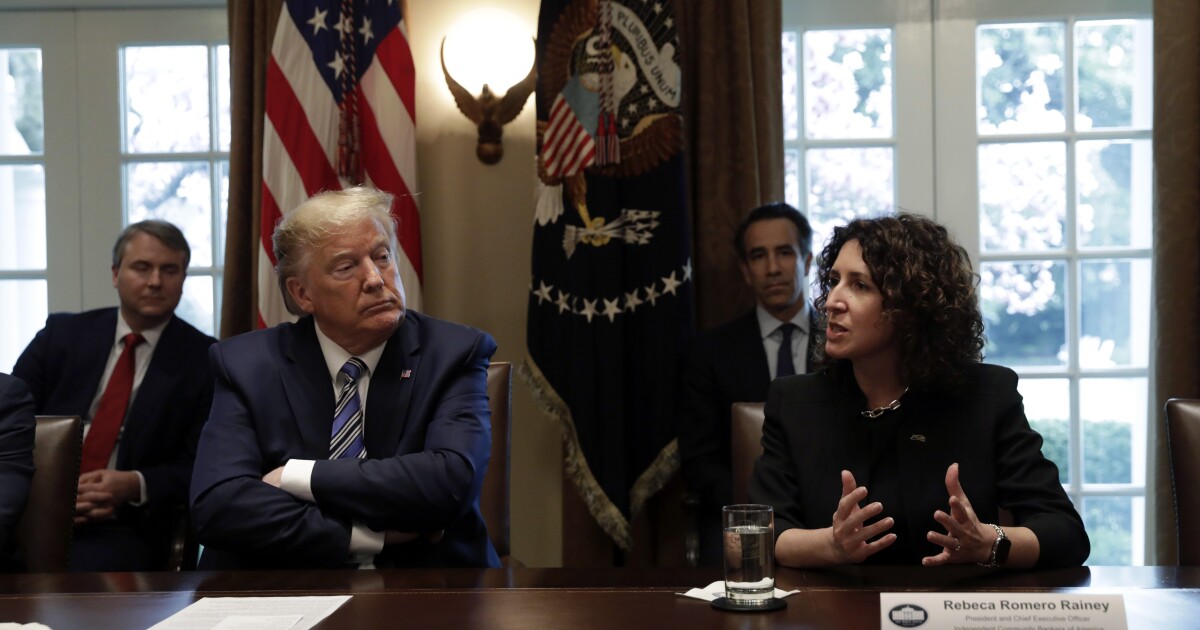
Rebeca Romero Rainey, president and CEO of the association, said Payward’s bid is part of a broader push by crypto firms for stablecoin frameworks, Federal Reserve master account access and national trust charters all at once.
Rainey warned that the combination creates what she called “interconnected risks” for the financial system.
National trust banks cannot take deposits or make loans. But, ICBA argues that a crypto firm holding a federal trust charter can use it to offer products that function like deposit accounts, without Federal Deposit Insurance Corp., or FDIC, coverage.
National trust banks also operate without capital requirements or the liquidity rules that apply to insured banks.
ICBA’s research, cited in an
The group estimates that loss would cut community bank lending by roughly $850 billion and that the bulk of the cut would fall on small businesses, farmers and rural borrowers.
ICBA asked the OCC to do three things: pause its review of the Payward application, rescind a 2021 interpretive letter that broadened the powers of national trust banks and undertake formal rulemaking to clarify the charter’s scope.
The Monday statement is the latest in a series of ICBA filings objecting to crypto-related applications for access to the federal banking system.
The OCC’s opposition is likely to hit a brick wall. It lands at a moment when the agency has, in significant part, already settled the matters about which the trade group wants to argue.
The ‘interconnected risks’ thesis
ICBA’s case against Payward leans on an
The brief warns that three policies currently advancing in parallel are individually defensible but together reshape who can access the federal banking system and on what terms.
The three tracks are a stablecoin regulatory framework under last year’s
The ICBA warns that the policies will, in effect, allow crypto companies to offer bank accounts, but without the regulations that typically accompany bank accounts.
Specifically, the ICBA forecasts that the OCC is on track to allow a trust-chartered issuer to manage stablecoin reserves, hold those reserves at a Federal Reserve master account and push out a dollar-denominated product to customers that works like a bank account but without the regulations of a bank account.
Each of the three pieces, taken alone, fits within an existing legal box. But, combined, they replicate a bank’s product suite while bypassing the rules that apply to banks, the ICBA argues.
Mickey Marshall, ICBA’s assistant vice president and regulatory counsel, wrote in an
It comes with debit card access and dollar-pegged balances. But it does not come with FDIC insurance or the consumer protections that apply to a bank deposit.
Kraken is already putting these three pieces together. In March, the Federal Reserve Bank of Kansas City
A trust charter is the second piece. If approved, Payward National Trust Company would let Kraken custody digital assets and run trading and transfer services tied to that custody under direct federal supervision, similar to what the OCC
The third piece, last year’s GENIUS Act, lets uninsured national trust banks manage the reserves backing payment stablecoins.
Part of a pattern
ICBA has recently filed comment letters against three other crypto-related applications before opposing Payward’s.
In July 2025, ICBA
The trade group also filed
The group ramped up its campaign this spring. In March, it filed
Then, it filed
In April, the group joined a coalition of state banking associations in formally
The opposition to Kraken’s bid for a trust charter is the ICBA’s fourth filing in two months.
At the same time, the OCC has moved in the opposite direction.
In December 2025, the agency
The ICBA’s ask runs into a problem it didn’t create
ICBA’s central legal ask is for the OCC to rescind
The trade group has argued for more than five years that the OCC issued the letter without notice-and-comment rulemaking and effectively rewrote chartering practice in a way Congress never authorized.
The OCC has already moved the substance of Interpretive Letter 1176 into regulation itself with a final rule titled
The new rule replaces the phrase “fiduciary activities” in the OCC’s chartering regulation with “the operations of a trust company and activities related thereto,” confirming that national trust banks can engage in non-fiduciary activities, such as holding stablecoin reserves in custody, alongside their traditional fiduciary work.
The agency has considered and rejected several of the changes ICBA has pushed.
In the preamble to the final rule, the OCC said commenters had asked for a moratorium on new trust bank applications, a more precise definition of which non-fiduciary activities qualify as related to trust operations and additional supervisory frameworks.
The agency said in the preamble that those requests fell outside the scope of the rulemaking and that it would address the concerns case by case as it reviews future applications.
ICBA’s other request that the OCC undertake a formal rulemaking runs into the same wall. The agency just did one earlier this year on this exact question; ICBA filed a comment in February, and the OCC declined to make the changes the trade group asked for when it issued the final rule in March.
The rescission ICBA is seeking has another wall ahead of it: Jonathan V. Gould. He signed Interpretive Letter 1176 in January 2021 as the OCC’s senior deputy comptroller and chief counsel and is now the comptroller.
Gould also signed the final rule that codified the letter into regulation. Every trust charter approval in the current wave has been issued under his leadership.
What happens next
Payward’s application now enters the OCC’s standard licensing review. The comptroller’s
In that approval, the agency laid out an analytical framework for a non-insured national trust bank doing institutional digital-asset custody. The framework authorizes transactional services tied to custodied assets and access to staking, trading and financing products through affiliates.
The agency has not yet published Payward’s application (it likely will publish it this week), so the company’s plans are not yet public. Its current model entails offering fiduciary custody plus related transactional services for institutional clients, similar to Coinbase.
ICBA is fighting on other fronts at the same time. In Congress, the trade group is pressing senators to tighten stablecoin yield language in the pending
ICBA has also filed comments on regulations to implement last year’s GENIUS Act stablecoin law, and it is
The next milestone is the public comment window on Payward’s application, during which the ICBA is expected to comment. The OCC so far has rejected much of what the association of small banks wants it to revisit.