


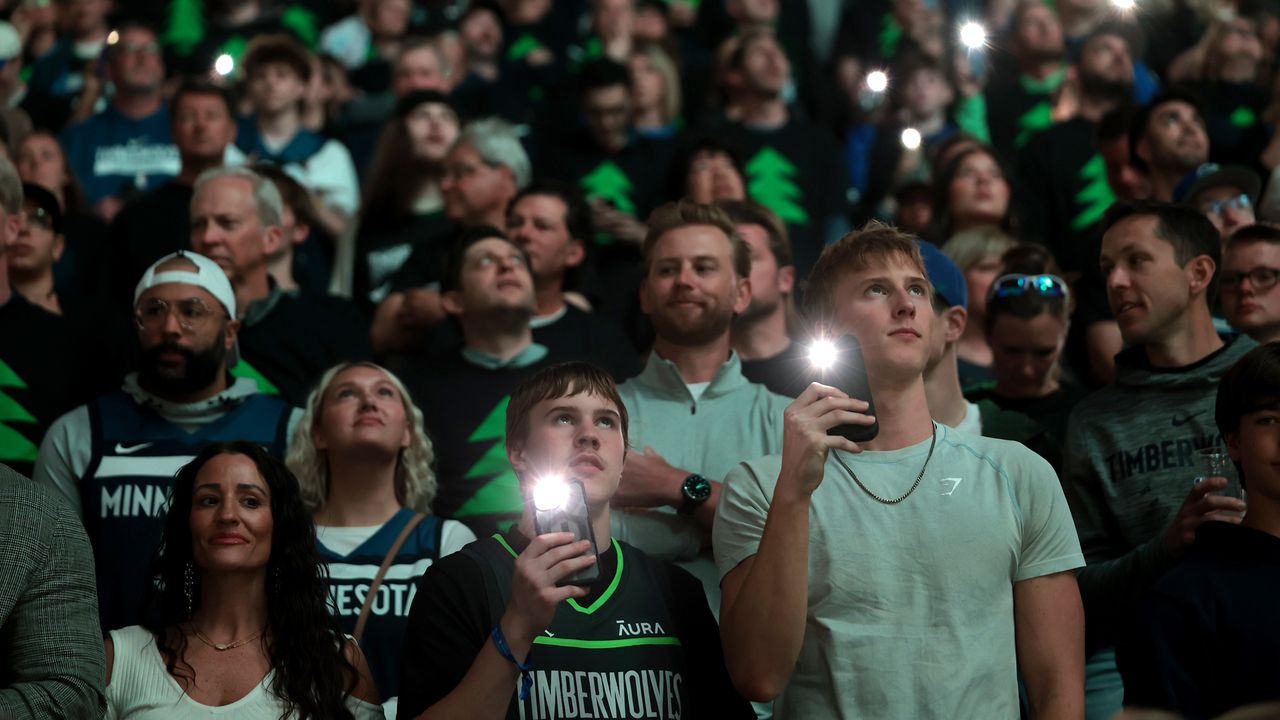
The Timberwolves type of bad, from 2005 to 2022, wasn’t thrilling, and it didn’t lead to some emotional revelation or bonding experience for me. It was mostly just misery—a team that wasn’t good and that wasn’t close to being good, a team that squandered opportunities for franchise-changing draft picks. (I am not especially hung up on this, and I do believe it was the right decision at the time, but I’m haunted by a photo of the 2009 draft board, showing the Timberwolves choosing the point guards Ricky Rubio and Jonny Flynn, right before the Golden State Warriors selected Stephen Curry. Rubio proved to be a solid but not great point guard. Flynn was out of the N.B.A. within three years.)
I have a running joke that is, like many of my running jokes, more consistent than it is funny. It began in 2011, in the early days of posting on what was then Twitter. As the N.B.A. season approached, no matter how bad the Timberwolves had been the year before and no matter how stagnant they were in the off-season, I would send out a message along the lines of, I believe the Timberwolves will be going 82–0 this season. It was a joke in that it was an absurdity, but it was also a joke in that it was an absurdity that I believed, because when there are zeros on both sides of the win-loss column you get to believe a bit in impossibilities. In the weeks and days before the first shot goes up, the sun shines on the spot of the large boulder that you have willingly affixed yourself to, and the boulder feels, momentarily, lighter. Until it doesn’t.
I don’t understand people who come to sports to feel rage, or agony, or panic. At least, I don’t understand those people anymore (I once was one). I have consumed the new golden era of Timberwolves basketball the past few seasons with a sense of calm that I think alarms the rest of my Wolves-fan pals. I think that rooting for a hopeless and hapless team for so long gave me a new perspective on the simplicity of sports: It is the clearest example of zero-sum. There is only one championship, and only one team can win it. For a sliver of time, all of the teams share the same odds, and thereafter the statistics likely don’t work in your team’s favor—or if they do it doesn’t last for long. And so I no longer understand a mentality of fandom that insists that you can only feel good about a team if they win a championship. It seems, to me, that that sets one up for years of disappointment, with, perhaps, one bright spot, or two if you are lucky.
By the time you read this, the Timberwolves could be on the verge of elimination against the San Antonio Spurs, or—against the odds—they could be in a position to prevail once again, in another series win that will be called unlikely but won’t especially feel that way to me. I do believe that the Spurs are a better team than the Timberwolves, not only on paper but also on the floor. They are a team that stifles defensively, and a team that is near-impossible to defend against at all three levels. One highlight of their first-round victory over the Denver Nuggets, for example, was watching Jaden McDaniels, a consistent defensive menace, declare that the Nuggets were “all bad defenders” after Game Two of the series, before going out and scoring thirty-two points in the closeout Game Six. And yet one thing about the Timberwolves—the thing that compels me most about them, I think—is that they seem almost violently propelled by their status as the underdog, or by an awareness that people have little belief in them, whether owing to injuries, to oddsmakers, or to whatever our eyes plainly tell us about a matchup.
I’ve decided that I delight in watching the Timberwolves fight almost as much as I delight in seeing them prevail at the end of the fight. When I turn on a Timberwolves game, even now, I feel distinctly aware that I need to find pleasure in something other than victory, and so I’ve chosen to find pleasure in rooting for a team that doesn’t back down, that shows up ready more often than it doesn’t (though I am, intentionally, not mentioning Game Two of this Spurs series), and a team that has managed to correct all that I believed about it during the dark decades. I am enjoying these Timberwolves precisely because I know how bad it can get, I know how easy it is for a team to slip back into perennial badness, and I am training my heart to not fall too much in love with whatever this different thing is, because there is a chance that, at some point in the future, I will be longing for these Timberwolves while watching a version of the team that is not rising to the same heights. And I’ll have to love that team, too, as easily as I love this one. ♦