


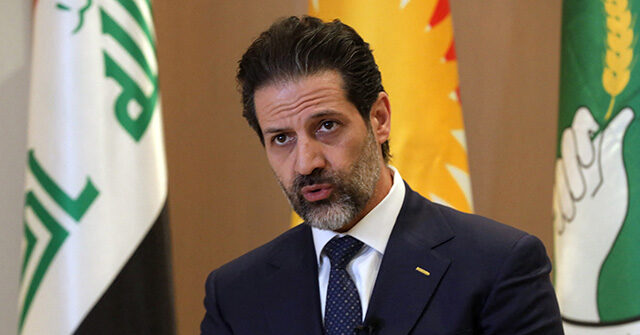
DELPHI, Greece — Qubad Talabani, the Deputy Prime Minister of the Kurdistan Regional Government (KRG) in Iraq, told Breitbart News exclusively here last month that President Donald Trump can secure a massive deal with Iran that creates a worldwide economic boom and is good for both the United States and Iran in the aftermath of the war between the two countries.
Talabani, who helps lead the semi-autonomous region governed by Kurds inside Iraq right on the border with Iran, is the son of the former president of all of Iraq, Jalal Talabani. Talabani’s father held office from right after the fall of Saddam Hussein in 2005 until 2014, and now his son is a leading voice in Iraq and specifically in Kurdistan in pushing for peace and economic prosperity across the region.
“The deal’s got to be between the U.S. and Iran, and he cannot allow a third party to ruin his deal,” Talabani told Breitbart News.
“I think that President Trump again left to his own devices and left to America’s interests, and truly applying an America First agenda, could reach a good deal with Iran,” Talabani added. “That is also good for Iran.”
Talabani told Breitbart News he is rooting for Trump to pull off an amazing deal with Iran, one that has key economic components in addition to ending Iran’s nuclear weapons ambitions.
“I think President Trump is a master of the deal, and I think he knows that a deal needs both sides to buy in for it to stick,” Talabani told Breitbart News. “If a deal is imposed by one side on the other, even if they reach an agreement, it may not stick. So, I think what we need now is a deal that is between the United States and Iran.”
Talabani sat down with Breitbart News for a lengthy exclusive interview in Delphi, Greece, on the sidelines of the Delphi Economic Forum in late April. At that time, in the early days of the now-extended-multiple-times ceasefire between the U.S. and Iran, the early picture of a possible deal was starting to come together.
“Well, first we need peace in the region and in Kurdistan,” Talabani told Breitbart News. “We’re rooting for a deal. We’re supporting a deal, and we’ve made it clear to all sides we’re willing to help in any way that we can whether it’s through back channels, whether it’s to utilize Kurdistan’s strategic location to support any deconfliction — we need this deconfliction. The impact of this war on Iraq, on Kurdistan, was significant, primarily economically as it has impacted the rest of the world. So, we welcome the ceasefire. We welcome the extension of the ceasefire. As they say, it takes more bravery to end the war than it does to start it. I think this is where we are at now, and we’re hoping that President Trump will do the right thing and do what it takes to get a deal that brings peace to the region, brings peace between the United States and Iran, and that will have I think enormous ramifications positively for the rest of the world.”
Talabani said that for a deal to succeed, it has to be solely between the United States and Iran, and not include other third parties.
“I’m hopeful that Iran and the United States reach a deal, and I’m also hoping that other actors do not go out of their way to scupper that deal,” Talabani said.
As for the timeline here, Talabani was unsure how long it will take but hopes it is soon.
“I wish I could tell you. I’m not being coy,” Talabani said when asked how long this will take. “I really don’t know, and nobody knows. I think the only person that could know is President Trump. Again, I will repeat, if he’s left to his own devices, and if other countries are not trying to dissuade him from a deal, then the likelihood of reaching that deal in a shorter period of time increases.”
As for the Strait of Hormuz specifically, Talabani said the beginnings of a deal need to materialize before it opens.
“I think that there needs to be some concrete agreements between the United States and Iran before the strait opens,” he said. “I think if the strait could have been opened militarily, it would have been done by now. So, I think there is an understanding that this strait can only be opened through a deal. So, the Iranians are very good negotiators, and I don’t think they’re going to be very willing to give up this massive card that they have without a return — without something that is concrete. I think if the United States weighs up all of the variables that make up the complete deal this is a big one.”
Talabani represents the Kurds who totally agree with Trump’s assessment of U.S. failures in Iraq — Trump has argued America should have taken the oil, something former Presidents George W. Bush and Barack Obama failed to do — as he told Breitbart News the year before in Delphi. Now, he believes that in the aftermath of the war in Iran, the U.S. should get engaged economically and bring in American energy companies to help develop Iran’s underutilized oil and natural gas assets that have not been realized to their fullest potential for years because of international sanctions. Talabani hailed the possible “economic benefits” of a U.S.-Iran deal for both sides, arguing that for this to fully succeed the negotiations need to go beyond simply the security elements.
“I believe that if you look beyond the security dynamic between America and Iran, there is a whole giant world for an economic angle to this war,” Talabani told Breitbart News. “So much of what has been discussed between U.S. and Iran has been on the nuclear issue, on security, on the ballistic missiles issue, but I haven’t had any discussions about the economic benefits of a deal between Iran and the U.S. and again, this is a mutually beneficial deal, a deal that can greatly increase Iran’s economy but also give American interests access to a whole new market, which has been by and large strangled for the last 40 years. So, the opportunities are vast.”
Talabani said the idea that Iran can get a nuclear weapon is finished now thanks to Trump. But again, for a big deal to succeed the Kurds hope that it will tie together the economic components of energy production — something Trump has done with adversaries and allies worldwide, a sort of trademark move of the president. Of course, Trump has used this same move in places like Venezuela after the capture of Nicolas Maduro but also with allies like here in Greece where natural gas explorations are set to begin offshore early next year by two American energy companies, Chevron and Exxon-Mobil, something that can unleash economic prosperity in the region. Something similar could be on the horizon in Iran.
“I think we’re beyond that now, also because to be fair to the Iranians, they’ve never said they wanted a nuclear weapon, and they made it very clear to Mr. Witkoff that this was not on their agenda, and they’ve made it clear to other world actors,” Talabani said. “The detail was about the level of enriched uranium. How relevant that discussion is today, I’m not privy to the information on the damage done but I think again if we just look at this through a very sliced window of nuclear file, ballistic missile file, then there’s not really much room for a deal. But if we broaden that horizon to look at all of the other benefits for both sides and for the global economy and for America’s economy and Iran’s economy, there are many other variables that could make this a very good deal. Again, if we just limit everything to these two specific cases, I can’t see it. I’m not optimistic.”
Trump himself has similarly said since this interview with Talabani was recorded that there “could be” U.S. energy companies entering Iran as a component of a broader deal with them, telling Breitbart News that could end up happening. And now, with Trump’s trip to China coming up around the corner, it’s likelier and likelier that economic components could emerge as a major part of this equation moving forward.
“China is obviously the big importer of Iranian oil,” Talabani said when asked if China can help Trump land the deal. “But I think you will not find any international actor not wanting the strait to open for maybe different reasons but everyone wants this to open. So, I’m hoping that this will kind of expedite the necessity of a deal because it’s gotten bigger than just what the immediate objectives were before the war started. Now, the economy here in Greece, which is such a massive maritime economy, how many of their ships are now unable to do what they used to be able to do in the Gulf? They’re not used to shipping things by land, right? So, the world is not ready and won’t be ready to adjust to the closure of the strait. So, this is why everybody needs to not just have an opinion but use that opinion to force a deal or to get people closer to a deal.”
Talabani said that what is needed to be included in any end deal is “the economy and infrastructure and what comes with this lifting of sanctions, increased trade, greater inclusion.”
“You know, ultimately, Iran would also need to feel a level of confidence that they’re welcomed players again in the world,” Talabani added.
He even said that a deal could include mineral and rare earth development, too, but also warned that the U.S. should understand how unified Iran is in his view right now.
“I think it’s all about the optics. I think both sides need to come out of this deal feeling victorious, and the victory for President Trump is he came into this war with some objectives, you could argue he fulfilled those objectives,” Talabani said. “At the same time, you have an Iran that has proven to be much more resilient than anyone expected them to be. Now the landscape is conducive for a deal that includes the economy, that includes energy, that includes oil, that includes minerals, right? So, and I think too much is made of this schism between the diplomats in Iran and the IRGC. I think Iran is very unified right now as a state, but also as a nation. They’re reeling from the effects of this war, and the damage done to their country has created a sense of national pride in Iran. I don’t think this is a bad thing for the United States. It’s something that could be tapped into by the United States because again you can show the benefits of a relationship with the United States in a way that perhaps before you could not.”
Talabani stressed again that Iran is very unified.
“The difference between Iran and a country like Syria, and a country like Iraq was in Syria when Assad fell, the state fell,” Talabani said. “In Iraq, when Saddam fell, the state fell because the states were tied to the individual. Iran is not a country where everything was tied to the Ayatollah, Ayatollah Khamenei. It’s a country of institutions. It has a military institution, it has a civilian institution, it has a paramilitary institution. Then it has the religious clerical establishment, and each one has its own infrastructure. I think this was perhaps those around the world that thought by decapitating Iran that you will then in turn bring the collapse of the regime. They miscalculated. Iran is a country that has institutions, and right now those institutions are in sync. The military side are doing what they’re doing, the diplomats are doing what they’re doing. I think there’s greater unity now in Iran than there’s probably ever been.”
Iraq broadly, and Kurdistan specifically, “took hits too” economically, Talabani said.
“Iraq’s main source of revenue is oil, to include the Kurdistan Region,” Talabani said. “So, when the straits are closed, there’s no oil being sold, which means there’s no revenue coming into Kurdistan. A big portion of Kurdistan’s revenue relies on trade between Iraq and Iran, and if there’s no trade, then there’s no revenue. So, the impact on the economy has been massive, and that’s why we’re very eager for there to be progress so the economic angle can begin to normalize. I think that’s one aspect that has been a direct impact on Kurdistan. At the same time, I think we were very clear with everybody involved that the Kurds of Iran should not be used as a tool or as a vehicle to bring about regime change in Iran. We did not think that was a good policy, a good strategy. And I’m very happy that President Trump also came to that conclusion.”
Talabani expanded on that point about how Trump in his view correctly determined that using the Kurds in Iran to effectuate regime change in Tehran would have been not a good strategy by noting he thinks they would have been “massacred.”
“He was able to analyze the situation and realize this was not going to work,” Talabani told Breitbart News. “The Kurds would have been massacred had they have been the tip of the spear in this and so this took up a lot of energy for us to work our relations on all sides including with the Kurds of Iran to say ‘don’t be duped by a third party into thinking that you guys can make this happen.’ Again, to be absolutely transparent, the U.S. knew very early that this was not the vehicle — that the Kurds of Iran should not be the tip of the spear.”