


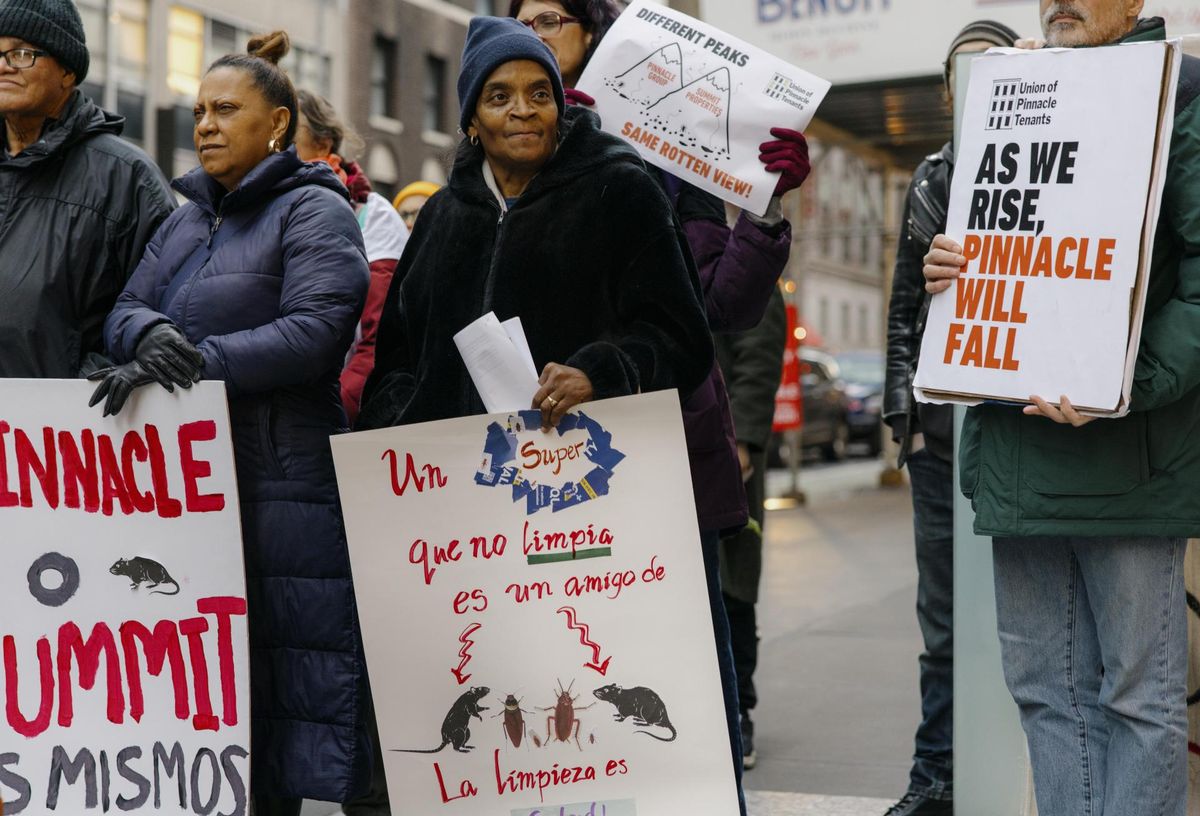
In the weeks after the bankruptcy sale of more than 5,200 New York City apartments closed, the properties’ new management found itself in meetings with a group of tenants demanding repairs to their deteriorating buildings.
The renters are seeking to negotiate on behalf of what has rapidly become one of the largest tenant unions of its kind in New York City, formed during the bankruptcy proceedings of Pinnacle Group.
Unlike tenant movements of the past, the Union of Pinnacle Tenants has powerful allies.
Cea Weaver, whom Mayor Zohran Mamdani tapped to lead the revived Office of Tenant Protection, has sat in on discussions between residents and Summit Properties USA, the buyer of the bankrupt portfolio. The mayor himself has participated in a virtual town hall with the union to listen to its concerns.
“These buildings are obviously really important to the city of New York,” Weaver told Bisnow in an interview. “Making sure that Summit is abiding by what they committed to in the bankruptcy court as a result of the actions that the administration took is really critical. We really want to make sure we’re doing the follow-through.”
UPT may just be the tip of the iceberg.
Courtesy of the Union of Pinnacle Tenants/Scott Heins
The Union of Pinnacle Tenants has hundreds of members across dozens of buildings now owned by Summit Properties.
In his first five months in office, Mamdani has made organizing a key pillar of his administration, specifically encouraging renters to band together against the deep-pocketed real estate industry.
Weaver has met with tenants organizing across portfolios of other major landlords and lenders, Bisnow has learned. Many tenants now have a direct line to city agencies, whereas before each renter had to rely on calling 311 to report issues.
“At the very basic level, we’re not asking for a whole lot. We’re asking for habitable, safe homes,” said Vivian Kuo, a member of UPT’s bargaining team. “Why do we have to unionize to get that?”
New Yorkers are facing soaring living costs during a time of record-low vacancy. At the same time, landlords and nonprofit housing managers warn that they are operating in the red. And while tenant unions don’t have the same legal protections as labor groups, the bigger they get, the more powerful they become.
“When your landlord is this massive real estate company that owns thousands of other units, it feels like common sense to get organized, not just in your building but across other buildings that your landlord owns,” New York State Tenant Bloc and Housing Justice for All Executive Director Sumathy Kumar said. “That’s the only way you’re really going to have leverage.”
The Birth Of A Union
Organizing efforts long predate Pinnacle’s May 2025 bankruptcy filing — though it was happening under a different name.
A group of Brooklyn residents formed Crown Heights Tenant Union in 2013 with a mission to “collectively fight gentrification, harassment, displacement, disrepair, and illegal rent overcharges,” according to the group’s website.
Weaver co-founded CHTU, and her work there helped launch her career in tenant activism. Its membership consists of individual tenants and buildingwide tenant associations. Landlords are strictly prohibited.
On Sept. 29, the group gathered outside of 1296 Pacific St., a property owned by Pinnacle. Tenants in the building were engaged in a five-year rent strike over conditions that they said included roach and rodent infestations and growing black mold and mushrooms. Con Edison had warned that electricity would be cut in the building’s common spaces, including the elevator and security cameras.
That night, tenants from 20 Pinnacle-owned buildings across the city announced that they would be teaming up in hopes of drawing more attention to the deteriorating conditions, forming the UPT.

Courtesy of the Union of Pinnacle Tenants/Breanna Maxine
The formation of the Union of Pinnacle Tenants was announced during a rally held on Sept. 29, 2025.
Prior to the bankruptcy filing, five of the CHTU’s tenant associations were in Pinnacle-owned buildings. By January, 50 tenant associations had formed. Today, UPT has a presence in at least 80% of the 93 buildings Summit purchased, union leaders said.
Originally, their goal was to halt Pinnacle’s bankruptcy auction. On Mamdani’s first day as mayor, he toured a Pinnacle building and said he would try to block the sale.
But by the time the effort gathered steam, it was too late. Bankruptcy court prioritizes maximizing and distributing value to creditors, so Summit owner Zohar Levy’s $451.3M bid for the portfolio was approved Jan. 16.
Ownership didn’t transfer to Summit until April, when it inherited a portfolio riddled with issues. In a filing, Levy estimated there were more than 6,400 open violations with the Department of Housing Preservation and Development but that the problems were confined to just 400 units.
Although the UPT and the city failed in their largest goal, their testimony in court hearings helped ensure Summit committed to rehabilitation. Summit plans to spend $30M over the next five years fixing up the properties. Its lender, Flagstar, agreed to fund an additional $3M revolving line of credit for upgrades.
The process also provided UPT with scale. Prior to the judge’s approval of the sale, a Bisnow investigation revealed that Summit already owned approximately 3,000 units across 90 buildings in the five boroughs. Those units were managed by Jonathan Wiener, who heads Chestnut Holdings and is the brother of Pinnacle’s Joel Wiener.
Overnight, the acquisition turned Summit, a rather unknown real estate player, into one of the city’s largest landlords. UPT expanded by half when it incorporated associations in the Chestnut Holdings portfolio, making it one of the most watched organizing efforts in the city’s history.
“Summit walked into a hornet’s nest,” attorney and lobbyist Brad Gerstman said.

Courtesy of the Union of Pinnacle Tenants/Karya Schanilec
Josie Wells, a member of the Union of Pinnacle Tenants, flanked by Cea Weaver and Mayor Zohran Mamdani at a press conference
After the bankruptcy sale, the city said it would continue to monitor the portfolio to ensure all violations are cured within six months. So far, it has followed through on its promise.
HPD inspectors have conducted walkthroughs, including with “building captains” designated by the UPT, according to Abbie Akande, a union member who participated in what was called a “Go Fix It” campaign.
“The goal was to get as many apartments that needed repairs inspected as possible within a short range of time so that Summit was aware,” Akande said. “This is what Pinnacle left behind. This is what Pinnacle ignored and refused to fix. This is what needs to be taken care of.”
A Change In Power
Before Weaver was a City Hall power player, she was already a villain in many landlords’ eyes.
In 2019, tenant advocates, led by Weaver, descended upon the state capital and successfully pushed for the Housing Stability and Tenant Protection Act, a host of rent reforms that have upended the business model for rent-stabilized multifamily.
HSTPA represented a sea change in political power. The real estate lobby, and particularly the Real Estate Board of New York, had a long history of staving off legislation that would disrupt the industry’s status quo and spent heavily to weaken the HSTPA.
Its efforts failed, and the rent reforms closed loopholes that landlords had long used to deregulate rent-stabilized apartments.
Doing so was a “mainstay and successful component” of Pinnacle’s business, attorneys for the landlord said in bankruptcy filings. Wiener’s firm in 2011 settled a class-action lawsuit that had accused the landlord of harassment, unlawful rent increases and aggressive eviction attempts to make way for higher-paying tenants.
Ownership groups have fought to get HSTPA repealed, filing lawsuits and reaching the Supreme Court, only to be rejected.
The industry still has a loud voice: In 2025, 32% of city lobbyists represented real estate industry interests, according to a report by government relations firm MultiState. On the state level, real estate was the fourth top subject lobbied, behind miscellaneous business, budget appropriations and health, according to the Commission on Ethics and Lobbying in Government.
Despite those efforts, tenant advocates have grown increasingly prominent.
“I see the tenant groups, and they are organized, they are powerful, and they are influential in Albany,” said Gerstman, managing partner of an eponymous government relations law firm. “REBNY has always had a seat at the table, and right now, REBNY is not seeing that same seat.”
‘Just The Beginning Stages’
At the union’s virtual town hall on Feb. 1, Mamdani said the tenants are “the eyes and the ears of the city on the ground.”
“I think of this fight frankly as the same as standing with nurses who are on strike or delivery workers seeking back pay,” Mamdani said.

Mayor Zohran Mamdani tours a Pinnacle-owned apartment in Brooklyn on his first day in office.
Some groups have already looked to the labor movement as they grow. Community Action for Safe Apartments tenant leader Joanne Grell said her group has established partnerships with unions representing taxi drivers and nurses, among others.
“Our rent issues and their issues of not getting accurate wage increases are really one and the same,” Grell said. “We wanted them to know that, and so that’s why we reached out.
“It’s just the beginning stages of the [tenant] unions, but they are definitely in it with us.”
But legally speaking, tenant unions operate quite differently.
“They are not labor unions in the traditional sense and generally do not possess formal collective bargaining rights in the same way employee unions do,” said Francisco Mundaca, a founding partner of The Mundaca Law Firm.
That could change if the state passes the Tenant Power Act. Introduced last month, the legislation would require that landlords negotiate with unions and create a statewide tenant association to assist in organizing. It would also give tenants access to owner information, such as the properties in their portfolios and operating income and expenses.
Although a tenant union may not be able to negotiate rents, its power comes from pressure. Groups can organize to submit complaints to the city en masse or participate in a rent strike.
Legally, a tenant can withhold rent or seek a rent reduction if a landlord fails to provide heat or hot water on a regular basis or rid an apartment of infestations.
“If it’s a 60-unit apartment and 58 units are filing complaints, [government agencies will] take that a lot more seriously than a 60-unit apartment and two units are filing complaints,” said Bryan Sullivan, a partner with Early Sullivan Wright Gizer & McRae.
On April 10, Mamdani’s 100th day in office and 10 days after Summit closed its purchase, UPT met with its new landlord and its partners, consulting firm Strada Ventures and property managers Rick Elezi Management and Nieuw Amsterdam Property Management.
In the union’s corner was a representative from HPD and lawyers from the Legal Aid Society.
The group delivered a list of proposals, which included recognizing the union as a bargaining representative and not pursuing any back rent accrued during Pinnacle’s ownership. It also requested that Summit disclose information on repair budgets and vendor hires.
“Based off of all of the meetings that we’ve had, it seems that they were not prepared to deal with such an organized delegation of tenants,” UPT member Hampatu Moyano Condia said.

Courtesy of the Union of Pinnacle Tenants
The Union of Pinnacle Tenants hung signs to protest the bankruptcy sale.
In an April 22 letter obtained by Bisnow, Summit told UPT that it “is in the initial phase of assessing building conditions, ongoing work, operational needs, and resident communications.”
“We encourage further communication sharing and dialogue, however, we must comply with the regulatory and legal framework under existing housing law,” the letter says. “We are happy to work with the UPT and other representatives of our residents, but each resident has their own rights and protections under the law that must be respected.”
Legally, tenant unions can’t act on behalf of individual tenants without proper authorization, according to Mundaca.
“Their influence is often driven more by coordination, public visibility and tenant protection laws than by any statutory bargaining authority,” Mundaca said.
In its letter, Summit said it is looking for ways to improve tracking, communication and field coordination for repairs, but it can’t share “contractors’ proprietary information,” including those contained in bidding documents or invoices.
The landlord also assured tenants that it will abide by regulations and is developing a policy to address rental arrears, which similarly “involve complex legal and factual considerations.”
“Summit supports structured, responsible engagement with residents, but any framework must be clearly defined, balanced, and consistent with applicable law, while ensuring operational stability and long-term sustainability,” a spokesperson for Summit said in a statement to Bisnow.
Weaver has attended follow-up meetings with Summit and the union. She said her role in the meetings is “primarily to observe,” though her presence alone carries weight.
UPT and other tenant unions provide Weaver and other city officials with a point person who can verify if a condition is systemic through a building or portfolio, she said.
Increased enforcement pressures could drive building values down further and cause owners who would otherwise invest in buildings to exit the market, Besen Partners Chief Sales Officer Ron Cohen said.
“Whenever investors in multifamily and even other asset classes, like hotels, hear the term ‘union’ or ‘unionization,’ they know that’s going to significantly increase their operating expenses as well as operating friction,” Cohen said. “In turn, they either run the other way or underwrite those assets way differently, i.e., for considerably lower values.”
A Rising Tide
Pinnacle is the only case in which Weaver is directly involved in tenant-landlord discussions, but it is far from the only union the city has expressed support for.
Just last week, Mamdani, Weaver and HPD Commissioner Dina Levy met in the Bronx to announce a $31M court judgment against Karan Singh and Rajmattie Persaud, the owners of Robert Fulton Terrace and Fordham Towers. Levy and Weaver were both previously involved in tenant organization efforts at the properties.
The city said that it plans to use the ruling as leverage in foreclosure proceedings occurring at the properties.

Mayor Zohran Mamdani and Cea Weaver announce a record $31M in penalties against the owners of Robert Fulton Terrace and Fordham Towers on May 6.
“What I ask tenants here for is the continued voice that they have brought to the table, because part of the reason that we are standing before you is because tenants organized for this moment,” Mamdani said at a press conference, announcing the record fine.
The administration has similarly gotten involved in the sale of Emerald Equity Group’s 850-unit portfolio. A tenant union is advocating for the East Harlem/El Barrio Community Land Trust to buy the 38-building portfolio.
The mayor’s office has also hosted Rental Ripoff hearings, inviting tenants to speak directly with senior officials about building issues. The conversations are another way for the administration to pinpoint landlords with portfolio-wide problems, rather than logging complaints for individual units.
During her speech at the first event, Weaver encouraged residents to band together.
Last month, Mamdani announced Organize NYC, a volunteer-led canvassing effort to encourage New Yorkers to participate in government. The initiative’s first mission is to increase testimony at Rent Guidelines Board hearings. The board, which will ultimately decide whether to freeze rents, acts independently from the mayor but hears from landlord and tenant groups before its final vote this summer.
The calls for organizing have been fruitful. More and more tenant unions are popping up across the five boroughs and gaining sway.
Since Community Preservation Corp. and Related Fund Management took over servicing a Signature Bank loan book backed by 35,000 apartments, they have held listening sessions with tenants, according to emails Bisnow obtained between the lenders and the city.
Notes from those meetings, along with emails from tenants, detail experiences of hazardous living conditions and harassment. CPC declined to comment.
Many of those loans are distressed, creating an opening for tenant action.
“As you know, CPC has commenced several foreclosures,” a representative from advocacy group TakeRoot Justice wrote in an email. “We are advising tenants in those buildings to file answers to be a party to the foreclosure proceedings and have held trainings on how to do so.”

Courtesy of the Union of Pinnacle Tenants/Breanna Maxine
The Union of Pinnacle Tenants has grown to become one of the largest tenant movements of its kind in the city’s history.
Several government agencies, as well as landlord and tenant groups, participate in regular meetings concerning the portfolio that CPC and Related acquired. Weaver attended one of those meetings on April 28.
Weaver said she meets with landlord groups, just like she meets with tenant associations.
“To me, having a strong union is about improved service delivery and more clarity about both what tenants’ responsibilities are and owners’ responsibilities are,” Weaver said. “I think owners are equally looking for a more responsive code system.”
That includes instances where a violation may be physically resolved but the infraction isn’t removed from internal databases. Ways to improve the system, along with streamlining referrals for tenant complaints and increasing resources, will be outlined in the soon-to-be-released Rental Ripoff report.
The Mayor’s Office to Protect Tenants now consists of just two people. Weaver is hiring a chief of staff at the moment and expects to “grow the team pretty significantly from there.”
During the height of pandemic lockdowns, Weaver stood in support of the #CancelRent movement. In her previous roles, she has helped residents organize rent strikes. However, she said this unionization push isn’t about tenants avoiding paying bills.
“This idea that tenants just don’t have to pay rent anymore once they get unionized is one of the misconceptions I think we’d really like to uproot,” Weaver said.
Naturally, the relationship between landlords and a tenant union may be fraught. It doesn’t have to be, UPT members said.
Akande, who also serves on the union’s bargaining team, said she has been disappointed in talks with Summit, although she has seen repairs being made in various units and in the lobby of her building. Tenants remain distrustful due to their experiences with their previous landlord.
“To be fair, Summit and their subordinates, they inherited a mess,” Akande said. “The union can help them clean up that mess, but they have to work with us.”