


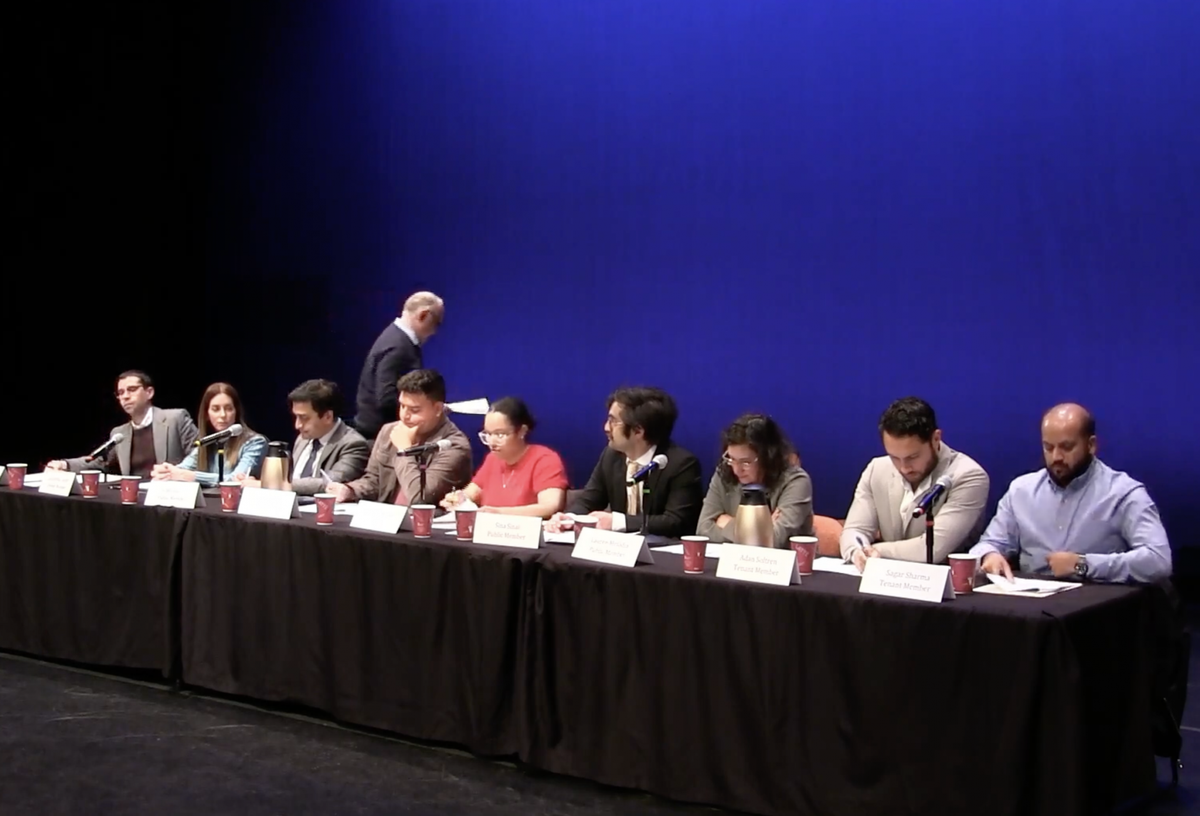
In a highly anticipated preliminary vote, New York City’s Rent Guidelines Board kicked the door wide open for a rent freeze across the city’s 1 million apartments.
Members of the Rent Guidelines Board at the preliminary vote on May 7, 2026
The nine-member body approved an increase from 0% to 2% for one-year leases and 0% to 4% for two-year leases. Tenant advocates chanted “Freeze Our Rent” in protest as members voted in favor.
The vote is not final, but it does provide insight into where the board stands. Because Mayor Zohran Mamdani campaigned on a promise to freeze rents, Thursday’s vote was particularly significant.
“New Yorkers are being crushed by the cost of living, and they need real relief,” Mamdani said in a statement following the vote. “I’m encouraged to see the Board taking seriously the data around affordability, operating expenses, and the pressures facing both tenants and small property owners as it sets this preliminary range.”
His administration has been encouraging members of the public to participate in RGB hearings, gathering volunteers to canvass the city and launching Organize NYC, “a long-term initiative to bring mass public participation into the work of governing.”
In a statement following the vote, New York Apartment Association CEO Kenny Burgos claimed that the vote contradicts the RGB’s own findings that show costs increasing and bashed the board for “choosing politics over people.”
“An owner’s ability to pay for operating costs should matter to every tenant,” Burgos said. “This threat of a rent freeze nearly guarantees our owners and tenants will live in declining conditions for years to come.”
Six more public meetings are scheduled, the last of which is set for June 25. That is when the fate of roughly 2 million people living in rent-stabilized buildings, as well as their landlords, will officially be decided.
Since moving into Gracie Mansion, Mamdani has been careful not to outwardly advocate for a rent freeze the way he did on his campaign trail. The RGB is required by law to act independently, though its members are appointed by the mayor and include representatives for tenants, landlords and the general public.
Before leaving office, former Mayor Eric Adams attempted to stack the board with fresh appointees but was unsuccessful. Mamdani appointed six members in February, giving his choices a two-thirds majority.
Rents were raised a cumulative 12% under Adams’ tenure, including 3% for one-year leases and 4.5% for two-year leases in 2025.
On Thursday evening in the LaGuardia Performing Arts Center in Queens, members representing tenants proposed a range that would have nixed any ability for landlords to raise rents and would have allowed for a rent rollback. In its 57-year history, the RGB has never decreased rents.
Their baseline started at negative 3% for one-year leases and negative 4.5% for two-year leases. The maximum was 0%.
Owner representatives proposed rent increases of between 3% and 5.5% for one-year leases and between 6% and 8% for two-year leases.
Both failed to garner a majority of the votes.
Tenant advocates commonly call on the board to freeze, or even roll back, rents, but the movement has picked up momentum over the past year, culminating in Mamdani’s election. At last year’s vote, a group of protestors unveiled a banner with 20,000 signatures from residents in favor of a rent freeze.
Prior to Thursday’s preliminary vote, Community Action for Safe Apartments Tenant Leader Joanne Grell said she was confident the range would include 0%, especially after she helped organize the door-knocking campaign to collect signatures.
“It stopped [the narrative of] tenants being victims, and it became tenants being powerful,” Grell said.

New York City Mayor Zohran Mamdani has made freezing stabilized rents a signature political issue.
Both private and nonprofit landlords argue that a rent freeze would hamper their ability to maintain their properties or keep up with mortgages.
Between April 2025 and March 2026, operating costs for apartments containing rent-stabilized units have increased 5.3%, according to RGB research. It also projected costs increasing by 4.5% for a one-year lease and 8.5% for a two-year lease moving forward.
Between 2023 and 2024, the board estimated net operating income rose 6.2% on average.
Landlord groups have denounced the RGB’s NOI report because it comes with a lag, includes buildings with free-market units and doesn’t account for debt service. Landlord advocates have argued that because the Housing Stability and Tenant Protection Act of 2019 tanked building values, owners can no longer afford their mortgages, along with upkeep.
In the Bronx, where the housing stock is older, NOI ticked down by 0.1%. Laws enacted in 1974 converted many buildings into stabilization, with the largest concentration in the borough.
“The RGB, in its final vote in June, must provide separate rent orders for buildings constructed pre-1973, or these older properties are going to fall further into economic distress and ultimately into the hands of predatory landlords, or worse, the city will add this housing to its abysmal NYCHA portfolio,” Small Property Owners of New York Board President Ann Korchak said in a statement.
Former Mayor Bill de Blasio oversaw three rent freezes in 2015, 2016 and 2020. In 2021, rents on one-year leases were frozen for the first six months, followed by an increase of 1.5%. But because those votes came before the HSTPA, they were opposed less vociferously by the real estate industry.
An April analysis of 14,500 units found that 32% of buildings are no longer generating enough income to cover their debt, up from 26% the year prior. The survey was put together by the Community Preservation Corp., a nonprofit lender to thousands of rent-stabilized units. As of December, CPC’s delinquency rate was 12%.
Tenant advocates have shot back that the debt was based on assumptions that landlords could engage in harassment campaigns to destabilize apartments. The package of laws closed loopholes that bad actors would use to hike rents.
“We need to take a look and see if our rent money is actually going into making sure our buildings are well-maintained, or is it actually going to pay down landlords’ debts or be used for landlords to buy more buildings while our homes are getting neglected?” New York State Tenant Bloc and Housing Justice for All Executive Director Sumathy Kumar said in an interview before the vote.