


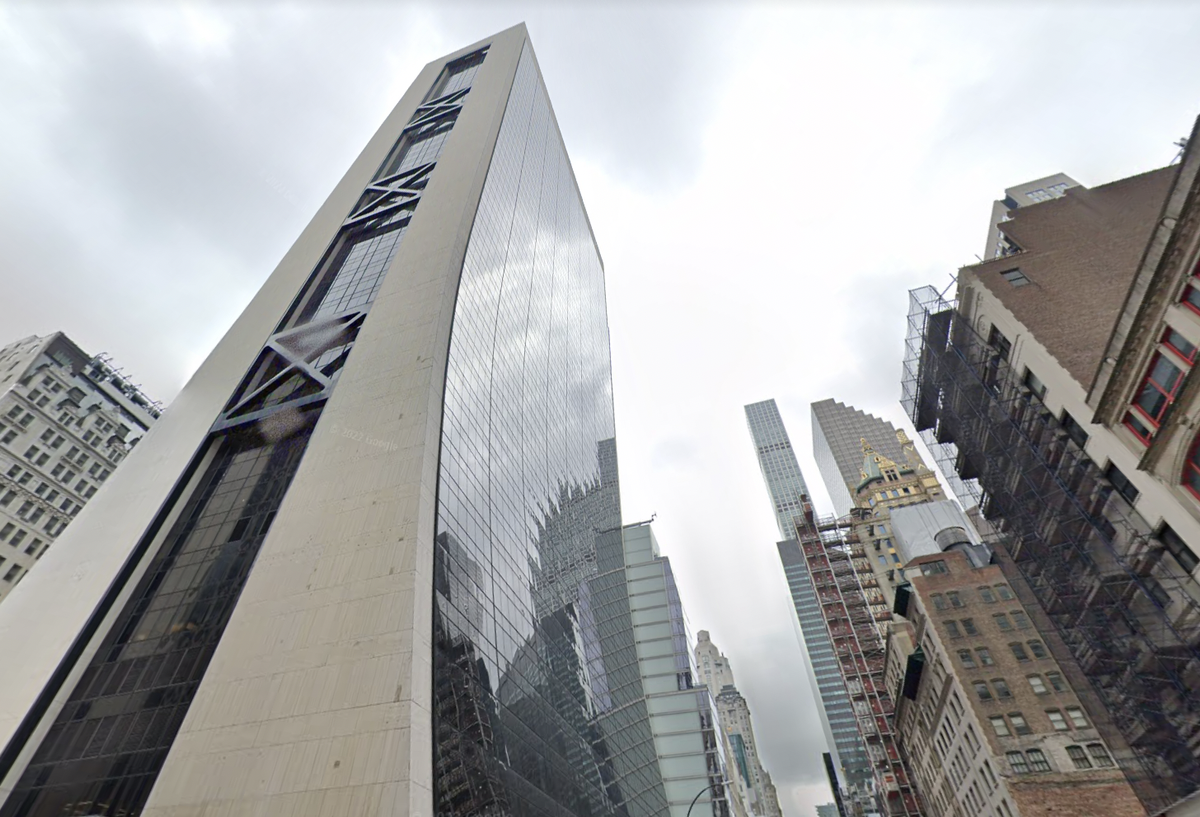
Sheldon Solow famously kept occupancy low for decades at 9 W. 57th St., preferring exclusivity over cash flow at the office tower overlooking Central Park.
His son, Stefan Soloviev, took a different approach after inheriting the family business in 2020. He spent $53M renovating the building, pushed occupancy above 91% and is now poised to cash out in a major way.
Soloviev is set to pocket more than $500M through a refinancing of the Billionaires’ Row tower.
9 W. 57th St.
The Soloviev Group has lined up a $1.8B CMBS loan from Bank of America, Wells Fargo and Citi Real Estate Funding to refinance 9 W. 57th St., according to S&P Global.
The five-year loan will pay off the building’s existing $1.2B mortgage, which matures later this year. About $857M of that debt is securitized in the JPMCC 2016-NINE CMBS trust, with the remainder spread across several conduit CMBS loans.
The refinancing will also fund $40M in closing costs and $34M in landlord obligations. The remaining $526M would be returned to Soloviev in cash, according to S&P Global’s presale report.
The mortgage is expected to close on May 27. The building’s existing debt, originated in 2016, carries a 2.85% rate, according to the Morningstar Credit database.
A Bank of America spokesperson declined to comment.
Shortly after this story’s publication, Soloviev Group announced that it closed the refinancing at an interest rate of 4.97%. When the tower is stabilized, it will be valued at $3.9B, according to the release.
“This refinancing is a clear validation of the strength of 9 West 57th Street and the collaborative success of lead lender Bank of America, and secondary leads Wells Fargo and Citibank,” Soloviev said in a statement.
The 50-story, 1.7M SF tower opened in 1974 after Solow spent decades assembling the site. The building is often simply called Nine West because the shoe company was founded there and took its name from the address.
Solow was known as a notoriously difficult landlord, sometimes rejecting tenants for seemingly arbitrary reasons, including misidentifying an artist whose work hung in the building, The Wall Street Journal reported.
Soloviev, 50, took his family’s original surname when he was 23. Since taking over the business, he has brought in new works by Picasso, Matisse and Miró, added a 20K SF fitness center and upgraded the building’s amenities to better compete with newer towers like One Vanderbilt and those in Hudson Yards, the WSJ reported last month.
Those efforts appear to have paid off. The building averaged 71% occupancy over the past 24 years but was 91.7% leased at the end of April, according to S&P Global. Its net operating income also jumped 45% between 2021 and 2025, rising from $106.1M to $153.4M.
Its largest tenant is Apollo Global Management, which leases 430K SF and subleases an additional 32K SF from Sculptor Capital Management. Apollo also has the option to expand into multiple floors as they become available.
Chanel, Sculptor and Davidson Kempner Capital Management are also major tenants. Even as occupancy has climbed, Soloviev has continued to command some of the market’s highest rents.
In March, Soloviev announced a record New York City office lease at $327.50 per SF for the building’s top floor. The tenant was later revealed to be HBeyond, a company owned by the family of a Mexican billionaire.
Soloviev signed seven leases totaling 58K SF that begin this year and next at an average rent of $205 per SF, according to S&P — well above Midtown’s average asking rent of $84.77 per SF in April, according to CBRE.
The refinancing underscores how aggressively lenders and bond investors are still chasing top-tier Manhattan office assets despite higher interest rates. More than $14B of CMBS debt was issued against New York City office properties in 2025 alone, the most since 2021, Bisnow previously reported.
In March, SL Green and its partners refinanced One Madison Ave. for $1.7B, cashing out more than $300M in the process.
UPDATE, MAY 7, 5 P.M. ET: This story has been updated with details and a statement from a Soloviev Group announcement released shortly after this article’s publication.