


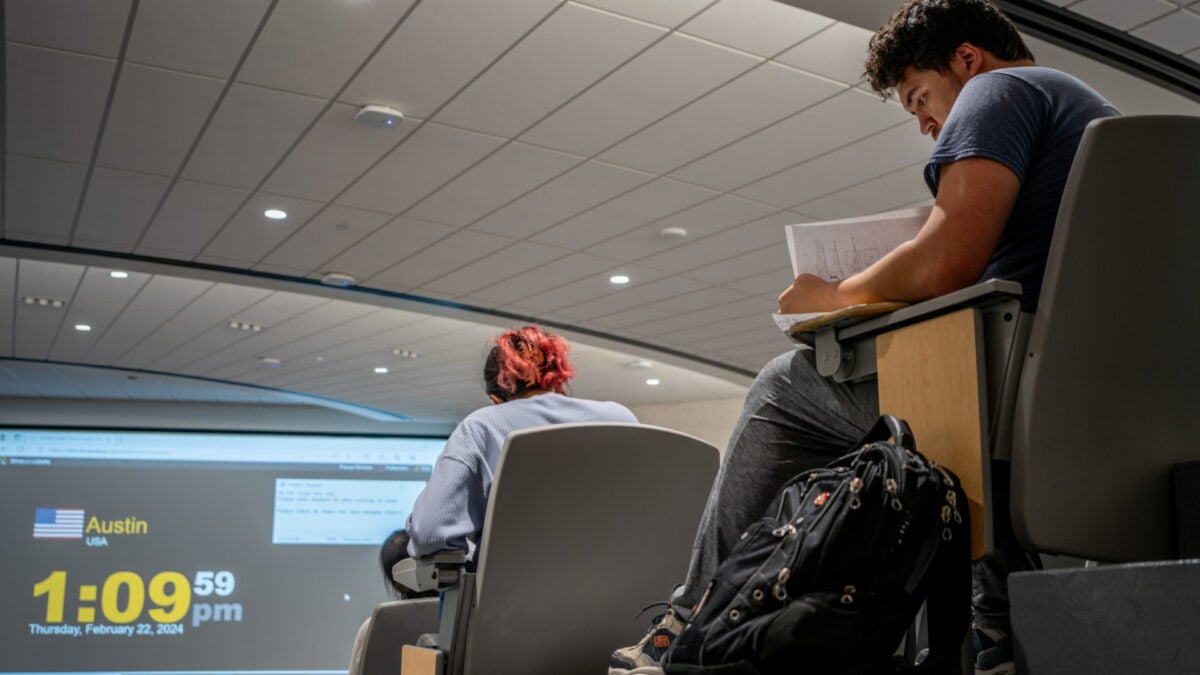
The booming use of generative AI by students is leading to rising grade inflation at universities, according to a working paper published this week by the University of California, Berkeley.
There are three ways generative AI can be used by students: augmentation, where the tools perform a supporting role assisting in things like research while the student completes the bulk of the work themselves; reinstatement of new AI-based tasks; or through displacement, where it completely automates the work that a student would otherwise perform themselves, such as writing an essay. All three use cases can improve grades, while only augmentation and reinstatement can further correlate with actual learning and skills building.
Some academic tasks, like unsupervised take-home assignments, essays, and other homework, are perfect opportunities for AI displacement, as opposed to proctored exams, oral presentations, or in-class discussions.
As part of the study, UC Berkeley senior researcher Igor Chirikov analyzed over 500,000 student-course enrollments across 84 departments at a large Texas university from 2018 to 2025. He found that grade increases were mostly concentrated in courses “with higher shares of writing and coding tasks,” where take-home assignments carried the most weight, concluding that students are using AI to cheat on some schoolwork and get better grades. Overall, the researchers found that “AI-exposed courses” saw a 30 percent increase in “A” grades since ChatGPT hit the market.
That’s not particularly shocking; it’s a generative AI use case as old as the dawn of ChatGPT. Plus, a student’s GPA could be make-or-break for their future, determining acceptance into postgraduate academic programs and lucrative early-career job opportunities. So, in a world where most industries are leaning into AI often at the expense of the young graduate job market, it makes sense that the average student would seek out an easy way to guarantee their future.
What is interesting is that, four years into the widespread presence of generative AI in our daily lives, the study shows that American universities have yet to catch up with its consequences.
With more AI-enabled grade inflation, employers will have a tougher time weeding out strong young graduate candidates, the study says. But even more importantly, this increased reliance on AI in academia is bound to create an incompetent workforce that is dependent on AI.
“If AI displaces skill-building tasks during learning, students may graduate with weaker capabilities in precisely the domains where AI is strongest, reinforcing a feedback loop between AI in education and AI in production that could accelerate automation,” Chirikov writes.
So an academic system that caters to AI-enabled grade inflation would create a workforce that does not know how to perform the core duties of their jobs, which in turn would create increased reliance on AI in the workforce and even more wholesale automation of jobs, on the road to a much-feared AI jobs armageddon that some experts claim is already underway in some industries.
Some universities are planning to take action against this grade inflation, though whether the planned measures will be truly successful is up for debate. At Princeton, where roughly 30% of seniors admitted to cheating mostly via generative AI in a recent survey, faculty voted this week to overturn a 133-year-old honor code that allowed students to take in-person exams without a faculty member proctoring.
Meanwhile, at Harvard, faculty are voting on a proposal to cap A grades to no more than 20% of the class.