


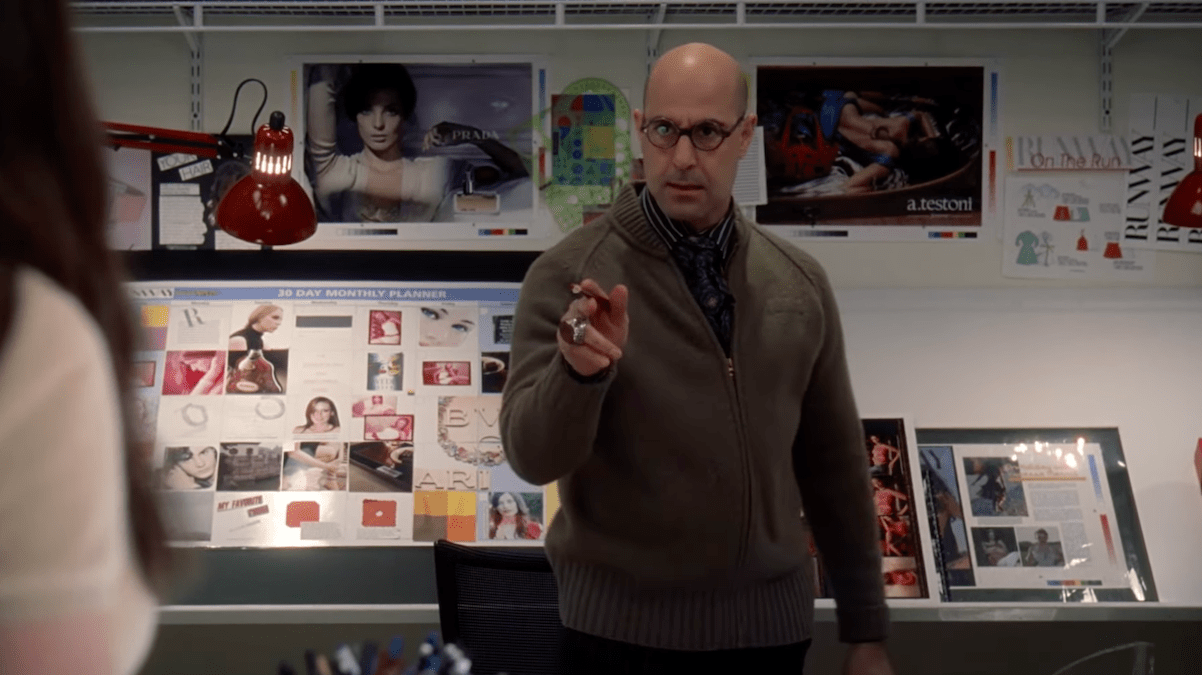
Unsurprisingly, he also offers little sympathy for Andy’s desire to be recognized for her hard work. However, his speech frames even Miranda herself as insignificant in the grand scheme of the fashion industry. “She’s just doing her job,” Nigel explains, depersonalizing his boss’s behavior to draw attention to the institution that is the magazine Runway. “Don’t you know that you are working at the place that published some of the greatest artists of the century? Halston, Lagerfeld, de la Renta. And what they did, what they created was greater than art because you live your life in it.”
However, then, Nigel shifts attention away from genuflecting individuals for their genius and instead turns to the average person. Where Miranda’s speech framed the little people as unwitting and ungrateful pieces whose choices are determined by their betters, Nigel’s speech extends hope to even those who aren’t icons.
“You think this is just a magazine, hmm? This is not just a magazine,” he declares. “This is a shining beacon of hope for—oh, I don’t know. Let’s say a young boy growing up in Rhode Island with six brothers, pretending to go to soccer practice when he was really going to sewing class and reading Runway under the covers at night with a flashlight.”
When put this way, the work done by Nigel, Miranda, and everyone else at Runway seems less like reinforcing an aristocracy and almost republican, if not democratic. Runway, in Nigel’s imagination, offers a place for those who don’t have one otherwise, especially for those who do not believe they belong anywhere else. With Runway‘s goal reframed, Andy’s aloofness seems cruel and selfish, which Nigel further points out.
Effective as the speech is, written by Aline Brosh McKenna and adapted from the novel by Lauren Weisberger, the key moment comes right at the end. That’s when director David Frankel pulls the camera close-up to Nigel as he lightly pushes the soft end of his pen onto Andy’s forehead, to replicate the childish star he believes she wants for her work.
The gesture could be condescending, and perhaps if any other actor had done it, it would be condescending. But Tucci plays the moment as playful, affirming, perhaps even kind. It’s just one of many such moments in Tucci’s performance as Nigel. He delivers withering lines about Andy’s fashion choices, and backs up his critiques with his own natty apparel, but there’s a softness in his eyes, a warmth in his voice that makes the observations something other than cruel cuts.