


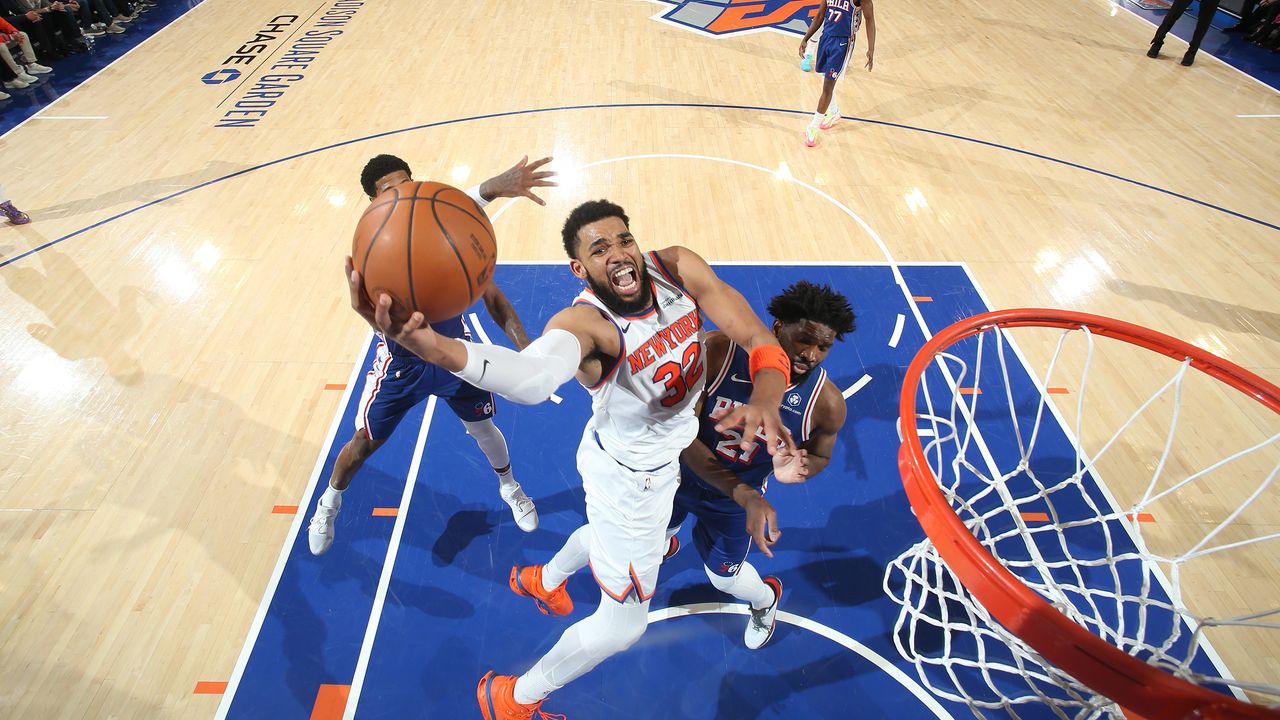
Was it worth it? A jaded New Yorker might say no one should care: the money is coming from the Knicks’ crustaceous owner, Jim Dolan, after all. And fifty-three million dollars is a lot of money, but fifty-three years without a title is a lot, too. There were costs, though—not only the loss of Randle, who’d been pivotal in returning the Knicks to the playoffs, but also the loss of DiVincenzo, a popular player who’d been so close to Brunson that he was a groomsman at Brunson’s wedding. After arriving in New York, Towns had a career year in 2025, and the Knicks made it to within two games of the finals before bowing out to the Indiana Pacers. But Towns struggled defensively in that series and was on the bench during a crucial fourth-quarter stretch in Game Two. The Knicks coach, Tom Thibodeau, was fired after the team lost the series, and Mike Brown was brought in—in large part, it was thought, to help “unlock” the potential of Towns. While leading the Sacramento Kings, Brown had coached Domantas Sabonis, another big man who could also shoot and had superior court vision. But, instead, the opposite seemed to happen. Towns spoke openly about feeling lost in Brown’s system, and Brown called out Towns for poor effort. After the Knicks followed a promising start to this season by going 2–9 during a stretch in January, stories about the Knicks’ “Karl-Anthony Towns problem” began to proliferate.
But after three games in the first round of the playoffs, with the Knicks down to the Atlanta Hawks, 2–1, Brown put Towns with the ball at the three-point line, and the diminutive Brunson darted toward the center. The need for defenders to respect Towns’s willingness to shoot threes opened lanes to the basket that he happily drove down. More startling, though, was his passing. Again and again, he flung the ball to a teammate cutting behind a defender or along the baseline for an easy score. With the offense running through Towns for those three games, through the first game of the second round, the Knicks didn’t just look like title contenders; they looked like one of the best teams in history.
Then, less than a minute into the second quarter of Game Two against the 76ers, Towns picked up his third foul. He played all of eight minutes in the first half. Any number of other Knicks played the hero, willing the team to a gutsy victory, showing sudden grit after so many easy blowouts. Brunson scored the points; Mikal Bridges was a rejuvenated terror; Josh Hart was everywhere; OG Anunoby suffocated the 76ers on defense. But, in the second half, Towns was the one who mesmerized me—palming the ball far from the basket until he spied the flash of a cutting teammate, or galloping to the rim himself.
After the game, I checked the New York Post headlines: “Karl-Anthony Towns Nearly Prevented His Own Knicks Dominance.” Never change, New York!
In Game Three, Towns was again limited by foul trouble, playing only twenty-six minutes, and when he was on the floor in the first half, the 76ers’ offense found some success attacking him. But Brunson, as usual, was sublime, wrong-footing the 76ers over and over with his staccato moves and magnetized shots. Other Knicks stepped up, particularly on the defensive end; Bridges finished the game with a layup and dance moves, after stymieing the 76ers star Tyrese Maxey. He seemed like he was having the time of his life. And Towns still managed to drive the offense without scoring, finishing with eight points, seven assists, and twelve rebounds—including four on the offensive end, leading to the second-chance points that were one key in the team’s win. During the playoffs last year, he averaged under two assists per game.
What did take the team so long to figure out Towns’s role as a point center? It’s not as simple as just putting Towns at the top of the arc, or asking him to “buy in”—another phrase I heard repeatedly on New York sports radio. On similar plays during the season, he had a tendency to start too far back. It’s not enough to ask Brunson to set a pick; he has to take the correct angle. And so on. Why is the team suddenly playing stellar defense, after inconsistent performances all season? Everyone right now is playing with the kind of urgency and precision that make that system possible—and other ones as well. Now the Knicks are one game away from the Eastern Conference Finals, and they’d be favored to win that series. What could they do against a team like the Oklahoma City Thunder, the champions, or the San Antonio Spurs? Patience. We may find out. ♦