


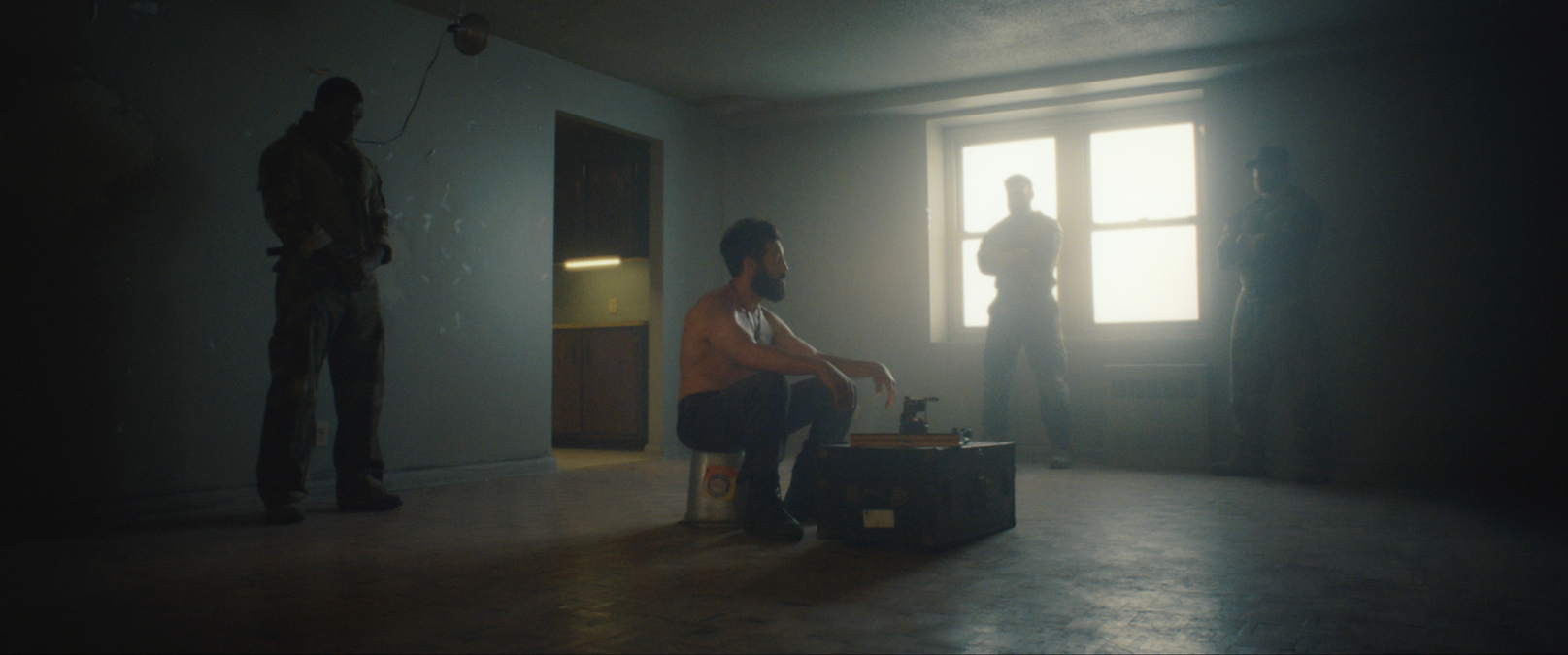
Thus ends act one of One Last Kill. Act two, which takes up 20 of the special’s 45 minutes, consists of nothing more than watching Frank murder the hordes who attack his apartment building. There’s a little something in there about how the loss of Frank’s family mirrors Ma Gnucci’s loss, and something about how the U.S. mistreats its veterans, but those ideas don’t get much attention. Instead, the special keeps shouting about how Frank has lost everything to violence, has committed violence in return, and now must forever doling out violence anew—but at least he’ll help a couple of kids and their nice parents (one of whom is played by The Wire alum Andre Royo).
Of course, One Last Kill has no interest in exploring the fascist implications of a hero who finds meaning only by killing those who threaten the true community. That missed opportunity is damning enough, but worse is the fact that the action scenes are handled with just as much indifference. The special has stuntmen and coordinators certainly doing hard work, but shaky cameras, poorly blocked shots, and a reliance on music cues (including a Hatebreed needle drop) reduce the action to a derivation of something from a 20-year-old episode of The Shield.
Part of the problem stems from director Reinaldo Marcus Green, whose visual style tends toward the literal, even when trying to be impressionistic. In a moment of crisis, Frank watches a boy run between two school buses, only to find himself, in full Punisher gear, passing by the other side. The one bravura shot of the special is a brief oner following Frank, his head covered by a hoodie, trying to ignore the constant screaming, suffering, and brutality around him.
But given that Jon Bernthal shares writing and producing credits with Green, he must bear equal blame for One Last Kill‘s shortcomings. Bernthal is generally one of the more watchable performers in genre film and television, and he fully commits himself to the part. Every bit of sweat and spit shows up on screen (as does his incredible hair, free of grey; Frank Castle apparently has a stock of Just For Men in his armory). It’s just that Bernthal has no take on the character other than “sad, angry.” Most of Frank’s dialogue consists of grunts and inarticulate shouts, all pitched at a level of intensity that burns out after 10 minutes—well before the final credits roll.
Judith Light fares slightly better as Ma Gnucci, partially because she has only one scene, but also because she chews the scenery so brazenly that One Last Kill briefly becomes ironically funny. If the rest of the special followed her lead, then the special could have been a compelling piece of macho camp. But One Last Kill doesn’t want you to laugh at its subject matter. It wants you to take its themes very seriously, even if it isn’t sure what that theme is.
Full of passionate intensity, but lacking the conviction to explore any of its ideas or treat any of its characters as human beings, One Last Kill has only loud and badly shot action, scene after scene of bad people doing horrible things to one another, sometimes to the benefit of an innocent little child. In the end, the best thing you could say about One Last Kill is that it proves that Marvel can tell stories with different tones—one hopes the Punisher will be a little less gnarly and a little more three-dimensional when he pops up in Spider-Man: Brand New Day this July—and that not everything in the MCU requires homework. Despite some nods to the Netflix series and an appearance by Deborah Ann Woll as Karen Page from Daredevil, Frank exists in a world without the Avengers.