


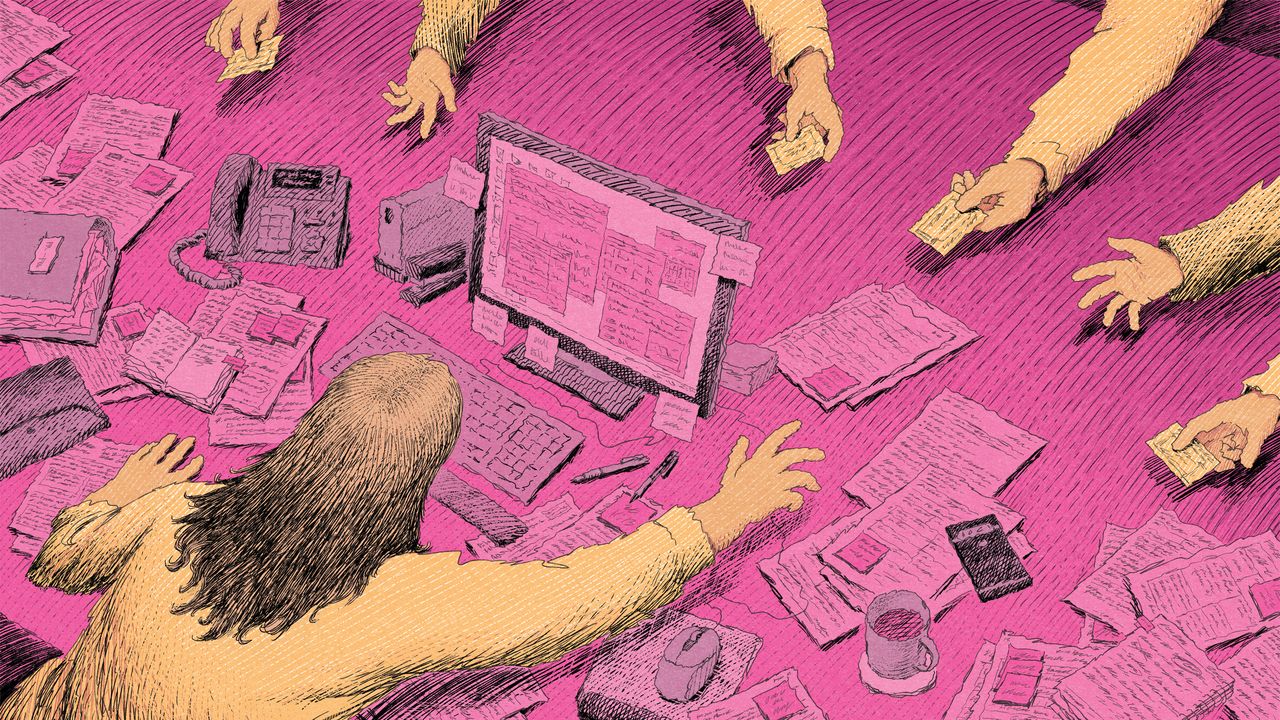
Social Security’s community touch was worn down in stages. Because of downsizing, wait times on the 1-800 number soared last year, with reports of hours-long holds. Bisignano promised to bring waits down to under ten minutes. To achieve that goal, he pulled various S.S.A. employees off their usual jobs—field-office customer service, payment processing, appeals, I.T.—to answer national calls. Kathleen Romig, a former Social Security official and a fellow at the Center on Budget and Policy Priorities, described this approach as “whack-a-mole management.”
One day, Jean spoke to a payment-processing worker who had received only three hours of training, compared with the usual three months, before donning a headset. “She didn’t know what she was doing and could see that the customer was ours,” Jean said. Bisignano claimed that automation of field-office phone lines was “enabling 30 percent of calls to be handled through convenient self-service options.” He cited a figure of ninety per cent for the 1-800 number, and Jean suspected that this is where the system was headed: full automation. She understood that some queries, such as status updates on pending applications, “could be skimmed off the top,” but she didn’t believe that a bundle of ventriloquized code could handle the harder cases, such as a widow trying to decide when to claim her benefit versus her dead husband’s. (The S.S.A. spokesman told me, “Americans are receiving better and faster service as a result of innovative technology and strategic staffing.” He added that all customer-service representatives “receive appropriate training” and have access to “ongoing technical support.”)
Field offices were having to respond to 1-800 calls on top of those coming through their direct lines. And even direct calls were becoming indirect. As part of the regional consolidation, offices in distant counties could now answer calls and schedule appointments for Jean’s office, and vice versa. “Before, local calls would have all been answered by a person here—a community person,” she told me. “Now I’ve got to put you on hold because I’ve got to figure out who in which office is handling your claim.” Beneficiaries on the West Coast were mistakenly scheduled for in-person appointments with Jean’s team. Other matters sat around for months, ricochetting between field offices and through cyberspace:
“I go back in and double-check,” Jean said. “Everybody has so much work to do. It’s all falling behind.”
Reported wait times for the 1-800 number did go down—to under seven minutes, as of April—but Romig, the former agency official, told me that there are various ways to fudge the numbers. For one thing, as noted in a 2025 report by the S.S.A.’s inspector general, the agency was counting the wait for customers who requested a callback, rather than staying on the line, as zero. Jean noticed that the wait times displayed on her internal scorecard often exceeded an hour. And the agency didn’t track whether or not a caller’s problem was addressed. “So many calls are people like me being told by A.I., ‘Do you want to hang up?’ ” Jen Burdick, a legal-services lawyer in Philadelphia, told me. “Eventually, I get mad and say yes.”
Some metrics described as wins by Bisignano signalled trouble to advocates and observers. The number of pending initial claims for disability benefits had dropped by thirty per cent since 2024, and the average processing time was cut by forty per cent. A report by disability-rights organizations acknowledged the reduced backlog, but found that seven per cent fewer people were applying for disability in the first place and that the grant rate had fallen by three per cent. (That said, the number of beneficiaries has decreased since 2015, as a result of demographic shifts and frustrations with the application process, Nancy Altman, the president of the nonprofit Social Security Works, told me.) An earlier study, published in the American Economic Journal, found that field-office closures led to a sixteen-per-cent decline in disability recipients in the surrounding areas.