


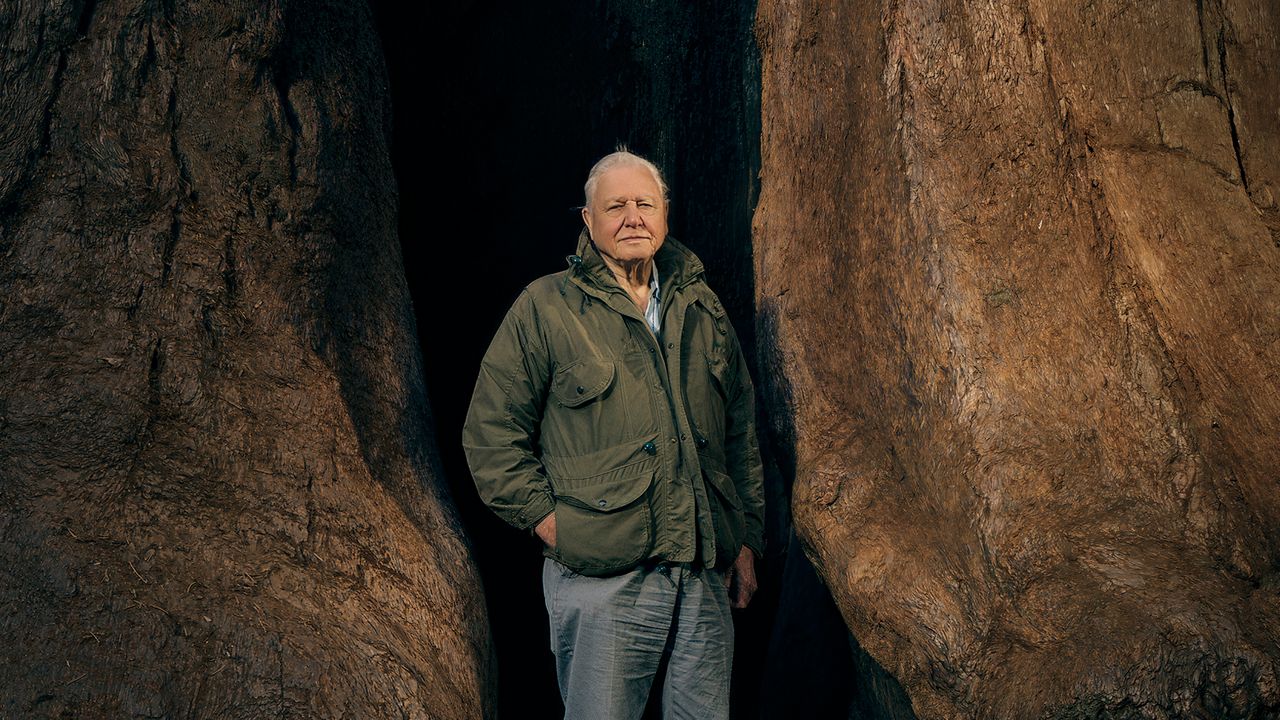
David and Richard were close, and there are pleasing junctures at which their careers locked together like a ball and socket. As an actor, for instance, Richard played the benign resurrector of dinosaurs in Steven Spielberg’s “Jurassic Park,” while David, in a 2016 documentary, “Attenborough and the Giant Dinosaur,” brought news of a titanosaur—a placid vegetarian from Argentina, and perhaps the largest animal that has ever moseyed upon the Earth. We dutifully gawp at Spielberg’s movie, yet the simple scene in which David compares the length of his own thigh bone with that of the titanosaur’s, which resembles a medieval battering ram, is no less of a marvel. The whole sequence takes about thirty seconds.
Attenborough was educated at Cambridge. Having done his national service in the Royal Navy, he went into publishing, got stuck, applied for a job in radio at the BBC, and was surprised to be offered a trainee position in something called “television”— a medium of which he knew almost nothing. As he confesses in a memoir, “Life on Air,” he certainly didn’t own a TV. In the United States, NBC, ABC, and CBS were up and running by 1948, but, when Attenborough entered the fray of British broadcasting, in 1952, there was only one channel. Evening programs were introduced by a man in a tuxedo, or a woman in equally formal garb, and rounded off by the playing of the national anthem. The BBC being a public service, nothing as vulgar as an advertisement was there to spoil the soirée.
Given a chance to appear on camera, Attenborough consented, though at first to no great effect. Decades later, he dug up a memo from the person who had overseen his initiation: “David Attenborough is intelligent and promising and may well be producer material, but he is not to be used again as an interviewer. His teeth are too big.” So that’s why no walrus has ever hosted a talk show. Despite this handicap, further opportunities arose for the young Attenborough, and his break came with the series “Zoo Quest,” in which a small crew flew to remote patches of the world, filmed and captured rare animals, and brought them back to London Zoo—an adventure that, as Attenborough admits, was founded on the assumption, as yet unquestioned, that “there was an unlimited supply of exhibits in the wild.”
In the London studio, some of the kidnapped creatures were shown to the public on live TV, with clips from the expedition spliced into the program. The clips were shot on 16-mm. film, using a clockwork camera. The first season of “Zoo Quest,” in six episodes, took Attenborough and three colleagues to Sierra Leone, in search of Picathartes gymnocephalus, or the white-necked rockfowl, a bird of notoriously secretive habits. When the designated presenter—Jack Lester, the curator of reptiles at London Zoo—fell ill, it was Attenborough who took the helm, at no extra pay. On the brink of the final episode, with the main goal still unattained, he found himself being driven down a street in central London, in a convertible. By his own account, he was spotted by a nearby bus driver. “ ’Ere, Dave,” he said. “Are you going to catch that Picafartees gymno-bloody-cephalus or aren’t you?”
Two conclusions can be drawn from this greeting. First, it demonstrates that factual broadcasts, as much as drama, can benefit from a feathering of suspense; Attenborough has grown ever more skilled in the careful meting out of information. (To behold an Australian lyrebird imitating its woodland neighbors, including a kookaburra, in the 1998 series “The Life of Birds,” was startling enough; to hear it parrot a camera’s shutter, and its motor drive, made you fall off the couch.) Second, given that “Zoo Quest” kicked off in 1954, Attenborough has been appearing on British screens, and thus staking a modest claim in the public consciousness, for more than seventy years, a reign yet more enduring than that of Queen Elizabeth II, who was his senior by less than a month.
On several occasions, indeed, starting in 1986, Attenborough was the producer of the Queen’s Christmas broadcast to the nation—an annual custom, televised since 1957. For a veteran of “Life on Earth,” I guess, who was quite content in the company of damselflies, mudskippers, yapoks, quolls, and star-nosed moles, even a species as rare as Regina britanniarum will have held few, if any, terrors. Such is the trust and affection that Attenborough enjoys in his native land that, were the monarchy to be abolished tomorrow and a President of the United Kingdom required in a rush, Attenborough would be the prime candidate. No one else would come close. What is equally certain is that he would turn down the post with alacrity.