


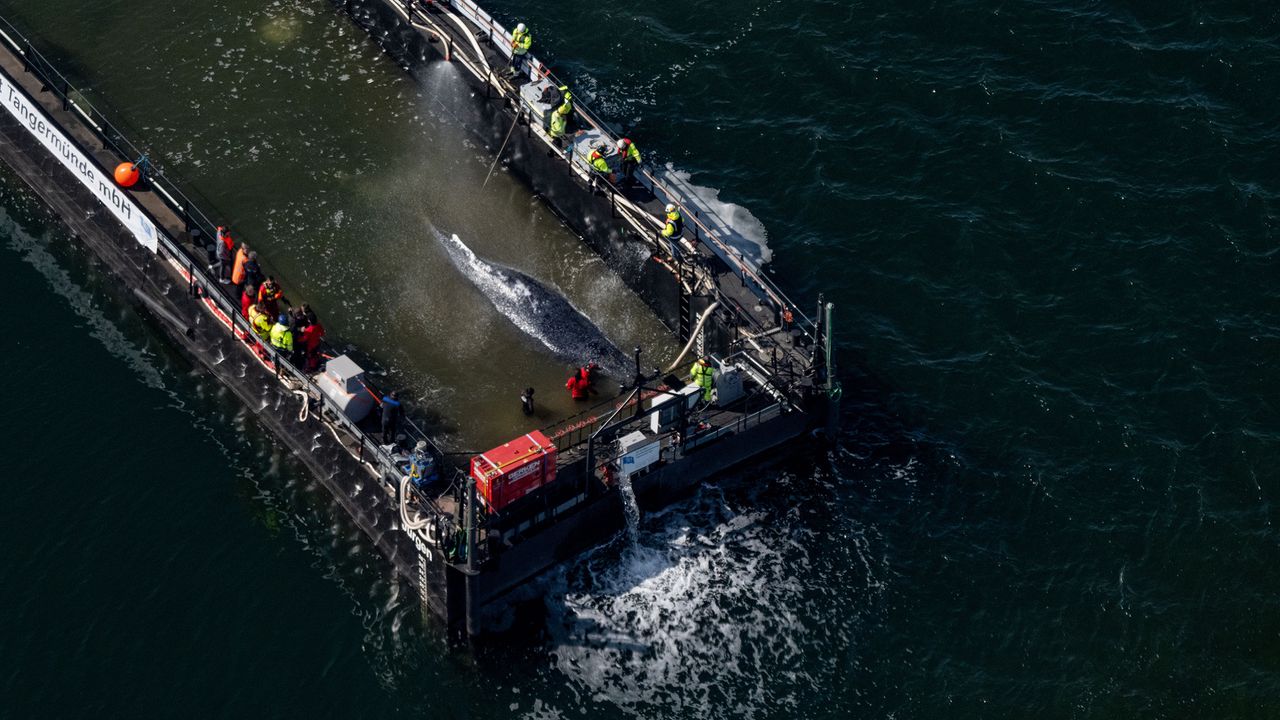
From the shore, under a gray sky, the whale looked like a sliver of rock protruding from the sea. Every so often, a spray of water exploded from its blowhole. After gazing out at it for a few minutes, I turned around and spotted Till Backhaus, the environment minister for the state of Mecklenburg-Vorpommern, surrounded by a small troupe of German reporters. I fell in beside him. “We have committed to accompanying this whale to the very end,” he told me. “This is an emotional topic for me personally, because when you love animals, you die with the whale.”
In the middle of our conversation, Backhaus’s cellphone started to ring. It was Lehmann, the biologist. He wanted to talk to Backhaus about what could still be done. Lehmann was convinced that the institutions that had taken responsibility for the whale were failing; he was decrying them on social media. Members of the public were becoming increasingly angry that experts seemed to be giving up. People who had taken part in rescue missions were even receiving online death threats. Meanwhile, two German multimillionaires were clamoring to mount a private rescue operation. No one, it seemed, was content to leave the whale in peace.
There is something wondrous about whales. Their grandeur and immensity manage to surprise us even in an age when humans are building larger and larger things. A whale is huge and alive, as majestic as a mountain yet as graceful as an eel; it demonstrates the magnificence of the planet and proves that wild things still exist. In equal measure, a beached whale is appalling. On land, a whale’s vastness becomes its downfall: its own weight crushes its internal organs. A whale that can’t be rescued seems like a sign that we have failed to protect the riches we stumbled into.
Shortly after Lehmann’s first visit to the whale, he took to social media with footage of himself squatting in the shower, naked. “This is how you look after two nights without sleep, without food, after hours in 3-degree Baltic sea water,” he wrote, which is about thirty-seven degrees Fahrenheit. He accused I.T.A.W. experts of excluding him from rescue operations because they thought he was obsessed with self-promotion. “The most exhausting part of a mission is always just people, never animals,” he wrote.
A few weeks later, Lehmann uploaded an hour-long YouTube documentary that quickly racked up millions of views. He included footage of Stephanie Groß, an I.T.A.W. veterinarian, pointing out that his filming plans would be another source of stress for the whale. “I think that this documentation is incredibly important,” he tells her.
“This is a documentation that you will use on your own channels,” she replies.
“You guys can have it all,” Lehmann says. “I don’t even want to be here.”
“Then what are you doing here?” Groß asks. In a subsequent clip, she calls Lehmann a troublemaker.
Lehmann’s posts had charisma. A cameraperson filmed him addressing rescue volunteers; mesmerizing drone footage set to emotional music showed him swimming next to the whale. He portrayed himself as the lone person with the courage and clear-sightedness to form a bond with the animal. Backhaus and other officials kept insisting that Lehmann hadn’t been excluded, but they no longer had control of the narrative. On social media, the whale had been dubbed Timmy, after the first sandbank that he was stranded on. There was a sense that the people in charge of the operation were incompetent or, worse, deliberately prevaricating. The experts kept saying things that no one wanted to hear.
Whale biologists generally hold that a whale that repeatedly strands itself usually has severe underlying health issues; even towing it back out to deeper waters may not keep it from starving or drowning. This whale was in terrible condition. His skin was blistered, cracked, and tinged a strange yellow, as though he were rotting. The culprit was freshwater skin disease: the whale couldn’t cope with such low salinity levels. No one knew how deep into his digestive system the gill net might have gone. He had lacerations on his back, almost certainly caused by a collision with a ship. Clearly, humans were responsible for much worse than failing to rescue the creature. Even the excavator that nudged the whale seemed to have caused injury: footage of the effort showed a bright bloom of blood tinting the waves. As time went on, water began to collect in the whale’s lungs.