


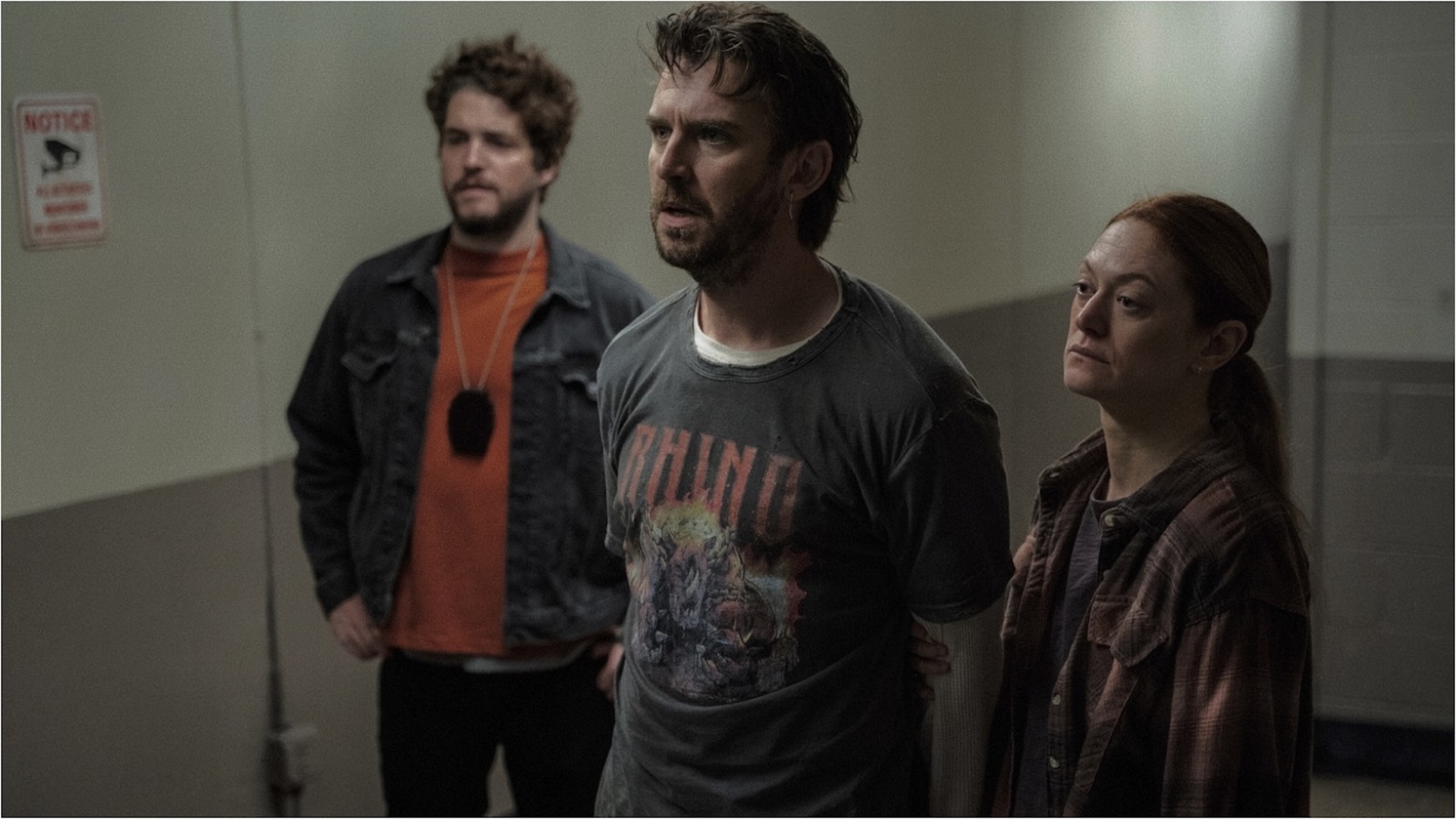
Devil in Silver follows Pepper, a working-class man from Queens who finds himself unexpectedly committed to the fictional New Hyde Psychiatric Hospital after the cops who arrest him are too lazy to fill out the paperwork to book him properly. As he slips through a series of horrifying cracks in the medical and legal systems meant to protect the most vulnerable among us, he becomes trapped in a world that’s frightening enough — without the threat of the mysterious dark force that lurks behind a locked silver door.
“For us, the first way into telling this story was by telling the story of someone who genuinely believes he is wrongfully held there,” Cantwell says. “Which isn’t to say that plenty of people who arrived there don’t feel that way, but by following his immediate experience of saying, ‘I don’t belong here,’ it’s a way for the audience to meet all the characters who faced that same moment and then have to at times resign themselves to being stuck there almost by some kind of existential cosmic force that seems to never let them leave. We felt like that on its own would be a really interesting strategy to engage the audience in what is often the real tragedy of these places: The failure to heal, the failure to serve their populations. A lot of these institutions are not as good as they could or should be.”
As befits its grim subject matter, the series’s atmosphere is dark and oppressive, and its setting quickly becomes a character in its own right, complete with flickering lights, dimly-lit hallways, and an air of general neglect. Of course, the mental institution is a setting that’s very familiar to fans of psychological thrillers and horror stories, appearing in films and TV series ranging from One Flew Over the Cuckoo’s Nest and Shutter Island to American Horror Story. Often used to explore themes of powerlessness, confinement, isolation, and anxiety, they’re locations that are disturbing enough on their own without adding in the threat of literal monsters.
“It was a series of production decisions that helped get us there,” director Karyn Kusama says when asked about how The Terror sets New Hyde apart from other infamous asylums in the world of horror storytelling. “Not the least of which reason was that our actual location was a former prison. It was a former correctional facility in Staten Island. So the spaces were already extremely small and terrifying. Terrifying literally because of the neglect and the degradation of the materials, but then also practically quite terrifying because we had to put film crews in these spaces with cameras and dolly tracks. We really had to work with spaces that, by their very nature, were very claustrophobic. I think that really helped us understand how trapped people might feel in these environments and how hopeless it can feel. And I hope that [darkness] makes the humor and the community that comes out of this group of characters even more interesting and engaging.”
For all its decidedly creepy settings and unsubtle threats of monstrous beings lurking behind ward doors, Devil in Silver is a surprisingly human story, one that revolves not only around Pepper’s imprisonment, but the experiences of his fellow patients, who are all equally trapped in their own ways. The other residents of New Hyde are fully three-dimensional figures, with diagnoses, histories, and desires of their own. And bringing that humanity to the forefront was very important to the show’s creatives.
“The kind of people – both patients and staff – that you usually find in institutions like this in movies or TV, often can be very flat and kind of stereotypical one way or the other. Think Nurse Ratched or the secondary patients on Shutter Island or something like that,” LaValle says. “Wonderful creations, obviously, but not the thing that we were going to do. If we [could] make these people feel as real as they do in the book, if not more real than they do in the book, because we spend even more time with them, then I’ll be happy. Chris’ own history in TV showed me that he really cared about human beings and writing really powerful, dramatic stories for human beings.”