


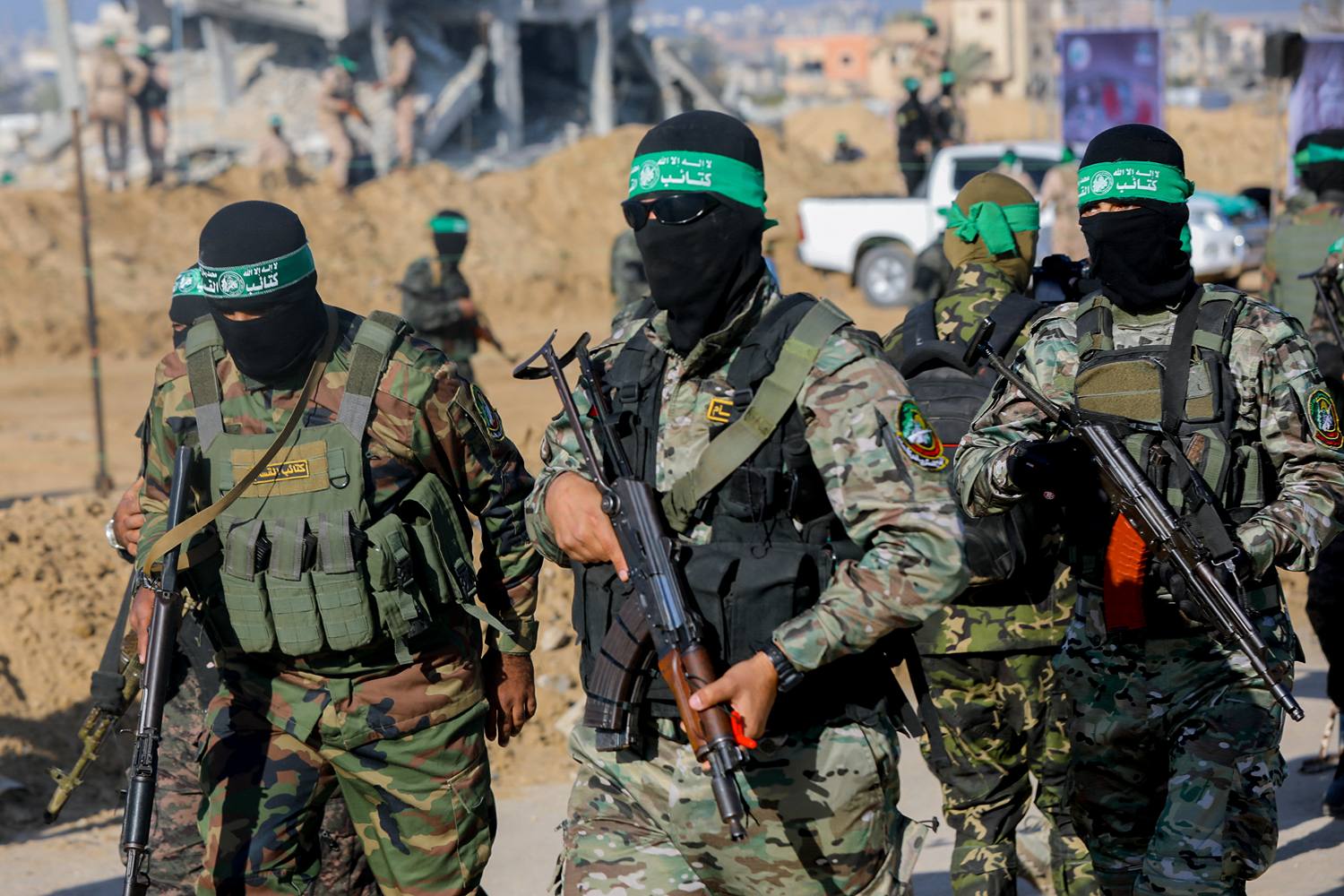
From the moment U.S. President Donald Trump announced a 20-point peace plan for Gaza last September, it was apparent that disarming Hamas would be among the biggest obstacles to moving the process forward. Months into the fragile cease-fire, Trump’s peace plan has stalled amid an impasse over disarmament. Gaza now appears in danger of remaining in an indefinite limbo in which Hamas controls a portion of the territory while Israel occupies the rest.
With its attention largely focused on Iran at present, the Trump administration has yet to provide a clear strategy for how it hopes to move past this quagmire in Gaza. U.S. Secretary of State Marco Rubio said on April 27 that the “entire agreement relies upon them [Hamas] disarming and demilitarizing” and that until that happens, “all of it is in question.” Though Rubio also said there were “promising signs” that an agreement to demilitarize Hamas was closer, the reality on the ground and developments in the days since paint a starkly different picture.
The Palestinian militant group still refuses to lay down its weapons. Hamas rejected a proposal from the U.S.-led Board of Peace to begin gradually disarming by April 11. During more recent negotiations, Hamas reportedly said it would not disarm until phase one of the plan was complete and Israel fully withdrew from the strip. But Israel, which has expanded its control of Gaza to nearly two-thirds of the territory, has said it will not pull its troops from the strip until Hamas disarms.
“Despite notable achievements so far since the cease-fire was signed, we are seeing one step forward, two steps backward. Hamas, as expected, is playing for time, and since everything is contingent on its disarmament, not much can move forward otherwise,” said Shira Efron, the distinguished chair for Israel policy at RAND, a security think tank.
“Neither side—Israel, Hamas, even the Palestinian Authority—really wants this to succeed. But they don’t want to be blamed for its failure. So they’re all going through the motions, pretending to play ball. But no one is making the enormous effort, and it’s an enormous undertaking, to move the plan forward,” said Efron, who is based in Tel Aviv.
The United States in January announced that the Gaza peace plan was moving into phase two, which is meant to involve the establishment of a transitional technocratic government, demilitarization, and reconstruction. But as things stand, the technocratic government (called the National Committee for the Administration of Gaza) has been unable to begin its work in Gaza, the strip is not demilitarized, and large-scale reconstruction has not begun.
Though key aspects of phase one have been completed, such as the return of all hostages, critics have said other components still haven’t been sufficiently addressed—and rights groups consistently warn that the humanitarian situation in Gaza remains dire. “The fact is that the sides have not fully implemented phase one, they have not moved into phase two,” Efron said, and both sides “never even fully signed” onto Trump’s peace plan.
With the global spotlight on the Iran war and stalemate over the Strait of Hormuz, questions have been raised about whether the deadlock over Hamas’s disarmament could reignite the Gaza conflict. Khaled Khiari, the U.N. assistant secretary-general for the Middle East, Europe, the Americas, Asia, and the Pacific, said at a Security Council meeting late last month that “talks on the disarmament of Hamas and other armed groups have thus far not resulted in an agreement, raising concerns over the potential return to widespread hostilities.”
Khiari emphasized that the cease-fire was already “increasingly fragile” amid ongoing Israeli airstrikes and armed activities by Hamas and other groups, with civilians bearing the brunt of the violence. Since the truce began in October, more than 800 Palestinians have been killed in the coastal territory, according to the Health Ministry in Gaza. Four Israeli troops have been killed by militants in Gaza during the same period, according to Israel.
There are an array of reasons why Hamas is opposed to disarming, including its ideological foundations—it’s an armed group whose identity rooted is in resistance and taking the fight to Israel. Hamas, which has controlled Gaza since 2007, is also concerned about its political future in postwar Gaza. The Israeli government is fervently opposed to Hamas maintaining power, and the Board of Peace plan rules out the group having any role in Gaza’s future governance.
It’s not “particularly shocking” that the peace process has not moved forward given both Israel and Hamas have “objectives that are in opposition to the other,” said Daniel Byman, a professor at Georgetown University’s School of Foreign Service and the director of the Warfare, Irregular Threats, and Terrorism Program at the Center for Strategic and International Studies.
Members of Hamas also have practical reasons to want to remain armed, Byman added, including concerns that Israel and the group’s rivals would move to “arrest and kill them” if they laid down their weapons. “They’ve had that experience in the past where Palestinian rivals have gone after them and caused a lot of problems,” Byman said.
Israel has armed other factions in Gaza that have clashed with Hamas since the cease-fire began, which also disincentivizes disarmament. The number of anti-Hamas groups in Gaza has grown since October, according to a recent analysis from ACLED, an independent organization that monitors and gathers data on conflict worldwide. ACLED identified at least five anti-Hamas groups that have been operating from Israel-controlled areas. The activities of these groups have “intensified” since February, ACLED’s report said, which was around the time the Trump administration was making a push to advance phase two of the peace plan.
The fact that Israel is arming other groups in Gaza “is a problem because it lowers Hamas’s motivation to lay down their personal arms fearing for their own safety,” Efron said. However, she doubts it’s “the key problem.”
“Hamas defines itself as a muqawama, a resistance movement—and arms are core to their identity,” Efron said.
The U.S.-Israel war with Iran, and Israel’s fight against Hezbollah in Lebanon, has also led to a complicated regional dynamic that leaves Hamas—long reliant on Tehran for support—more isolated. The group is also in the process of choosing a new leader and, like Gaza itself, is in a period of immense uncertainty.
Trump’s plan opens the door for the Palestinian Authority—which controls parts of the occupied West Bank and is dominated by Hamas’s main political rival, Fatah—to eventually take back control of Gaza. In late April, a city in central Gaza held a municipal election that has been characterized as a symbolic effort by the PA to connect Gaza’s political future to the West Bank.
“The fortunes of Hamas are being tested both locally and also internationally,” said Clionadh Raleigh, the president and CEO of ACLED. Disarmament “must seem pretty terrifying” to Hamas as it operates under increasing constrictions in a “much more dangerous world,” Raleigh said.
While experts widely agree that disarming Hamas is crucial to the long-term stability of the region, some also question the wisdom of making disarmament a precondition for so many other aspects of Trump’s plan—particularly without offering the militant group more incentives. The plan does offer amnesty to Hamas members who disarm, but this hasn’t been enough to push the process forward.
“Hamas is essentially being threatened with ‘disarm or you’ll die,’ but disarming this way is akin to surrender, and they don’t surrender. It’s not their MO. So the chances of disarmament as hoped for are not big. To do this really smartly, there needs to be a process that offers the group some reasons to do it—not just threats,” Efron said.
The disarmament of the Irish Republican Army (IRA) was made possible in part because the 1998 Good Friday Agreement established a power-sharing government in Northern Ireland that offered a path to political representation for Sinn Fein, the group’s political wing. Even so, the IRA did not fully disarm until 2005—seven years after the agreement was signed—and this wouldn’t have happened without sustained pressure from dedicated mediators.
Along these lines, some experts say the Trump administration has dropped the ball and neglected the Gaza peace process since the cease-fire was announced.
“This requires fairly steady diplomatic attention that is occasionally backed up by high-level support,” Byman said. “And that really isn’t being done. It’s easier to just not focus on this. And as a result, the people of Gaza are suffering tremendously. And there’s no long-term resolution to this beyond a day-to-day, slow-motion crisis.”
In response to a request for comment, the White House said: “In the months since the historic ceasefire, we have made tremendous progress on implementing President Trump’s 20-Point Peace Plan. As the President stated, ‘we are committed to making sure that Gaza is demilitarized, properly governed, and beautifully rebuilt.’
“The President has been clear that he is committed to the full implementation of his historic 20-point plan, including Hamas’s commitment to fully disarm. We are urging the international community to unite in pressing Hamas to disarm and to support the Board of Peace in becoming a full partner in that effort. Anything short of full demilitarization undermines Gaza’s recovery, Israel’s security, and regional stability.”