


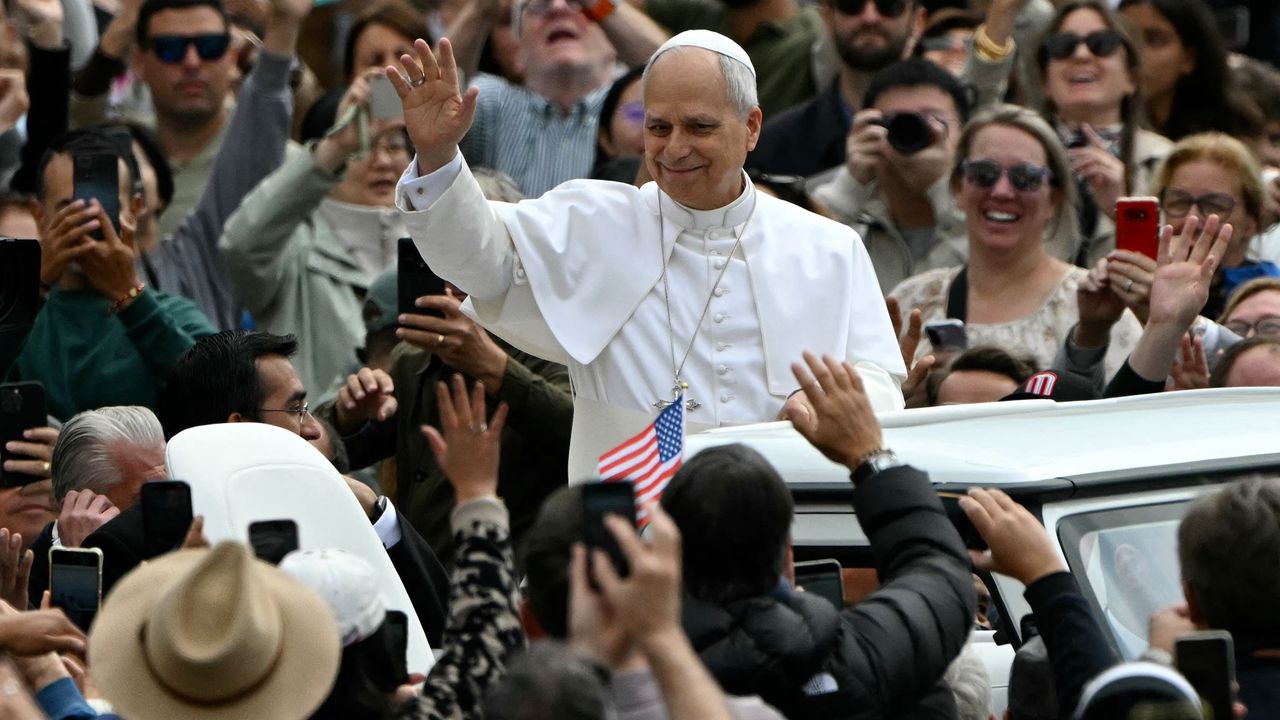
The Pope has responded to the war in Iran in stages, since answering a reporter’s question on March 31st, by saying about the President, “Hopefully, he’s looking for an off-ramp.” An eleven-day trip to Africa in April seemed destined to be a low-key affair (the Italian daily La Repubblica declined to send its Vatican correspondent), but a day before it started Trump posted a diatribe against Leo on Truth Social, calling him “WEAK on crime” and “terrible for Foreign Policy.” An in-flight press briefing offered the Pope a chance to reply. He took it, saying, “I have no fear, of either the Trump Administration, nor speaking out loudly about the message of the Gospel.” His remarks brought to mind those of Pope Francis, who, during a flight from Rio to Rome, in 2013, answered a question about a supposed “gay lobby” at the Vatican by asking, “If someone is gay and is searching for the Lord and has good will, who am I to judge?” They also recalled the exhortation with which John Paul II began his pontificate, in 1978: “Be not afraid!”
In the media, the battle was joined: the President versus the Pope, and the White House has fed the narrative. Trump has continued to denounce the Pope; on Monday, three days before Rubio’s scheduled audience, the President told the conservative radio host Hugh Hewitt, “I think he’s endangering a lot of Catholics and a lot of people,” adding, “He thinks it’s just fine for Iran to have a nuclear weapon.” Vance, for his part, challenged Leo’s right to speak on political matters and implied that he didn’t grasp the Catholic principles of what constitutes a just war. Leo, meanwhile, said in Africa, “Woe to those who manipulate religion and the very name of God for their own military, economic and political gain, dragging that which is sacred into darkness and filth,” while noting that “the world is being ravaged by a handful of tyrants.” Toward the end of the trip, Leo told reporters that he had no interest in “trying to debate” the President, saying that his comments had been drafted weeks earlier. But, like John Paul’s words in Poland in 1979, Leo’s words in 2026 have addressed a global conflict squarely if obliquely.
Leo’s willingness to confront Trump is striking in several respects. For one thing, the American Pope’s words seemed to consolidate the opposition to the war on the part of European countries that Trump had spooked, in January, with his claim that the U.S. was going to “take” Greenland from Denmark. Spain opposed the war in Iran from the beginning; Great Britain, Germany, and Italy offered limited support—the last by refusing to allow U.S. warplanes to stop at an airbase in Sicily (saying that the request had come too late). Now a coalition of the unwilling has firmed up. And the Pope, who might have made the Vatican a locus of U.S. interests, is instead making the Church a counterweight to U.S. wealth and power.
In any event, denunciations of war have been a constant in Leo’s ministry (and in that of recent Popes). A photo from 1983 shows Prevost in a group of other young priests in Rome, one of whom is holding a sign that reads “AGOSTINIANI PER LA PACE.” The occasion was a protest against the Reagan Administration’s plan, as part of an arms buildup in Europe, to station cruise missiles in Sicily. At age twenty-eight, then, the future American Pope was a public critic of U.S. military might. On Tuesday evening, speaking to reporters as he left Castel Gandolfo to return to the Vatican, he dismissed Trump’s claim that he supports Iran’s pursuit of a nuclear weapon on simple historical grounds. “If someone wants to criticize me for proclaiming the Gospel, let them do so truthfully,” he said. “For years, the Church has spoken against all nuclear weapons, so there is no doubt there.”
Recent opinion polls suggest that Trump’s vitriol toward Leo—and his weird posting of an image of himself as a Jesus-like healer—have displeased Catholics of all political dispositions, including MAGA ones. Leo, by contrast, has been making efforts to engage with conservative and traditionalist Catholics for much of his first year as Pope. Last Saturday, in Rome, for example, he had an audience with members of the Papal Foundation, a U.S.-based group of wealthy benefactors who support Vatican initiatives in developing countries. When the group met in Rome last spring, just prior to the conclave, Christopher Lamb of CNN notes in a new book about Leo, one donor said that “this room could raise a billion to help the Church, so long as we have the right Pope.” The chair of the foundation’s board is Cardinal Timothy Dolan, the archbishop emeritus of New York, who has made much of his friendship with President Trump, and its lay membership includes many tradition-minded Catholics of the type that Trump and the G.O.P. have assiduously courted—and yet they showed up to support the Pontiff. (The foundation approved fifteen-million dollars in grants for 2026, a record for the group.) In brief remarks, Leo stayed on message: “Christ desires that his disciples be instruments of peace,” he said. MAGA pundits have been trying to drive a wedge between Leo and conservative Catholics, and the encounter suggested that they have not succeeded—and that Trump’s media barrage against the Pope has turned out to be a spectacular act of self-sabotage.