


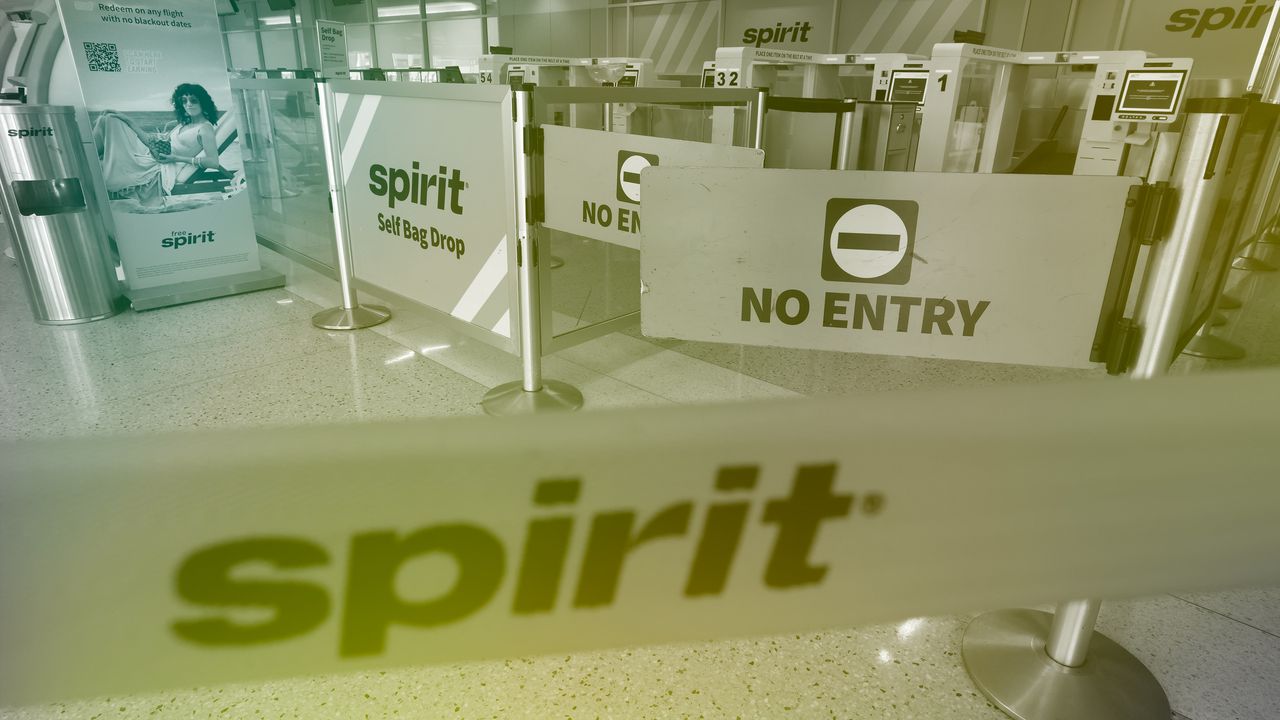
The yellow planes will fly no more. Though that may be good news for the major carriers and admirers of Adam Smith, it isn’t necessarily good for members of the flying public, particularly those willing to forgo proper carry-on bags, in-flight meals, padded seats, and a full-size seat pocket. Despite Spirit’s reputation for delays and nickel-and-diming on everything from luggage to water, its planes were relatively new, its safety record was good, and its base fares often couldn’t be beaten. “We are aiming for customers who pay out of their own pocket,” Ben Baldanza, Spirit’s then C.E.O., said in a 2015 interview. “Most want to spend money when they land. They want to stay at a nicer hotel.” At one point, Spirit flew more than eight hundred flights a day, and, as the Department of Transportation’s Office of Inspector General noted in a 2024 study of the Spirit Effect, its bargain prices prompted legacy carriers to reduce their cheapest fares in a way that competition from other low-cost carriers, like JetBlue and Southwest, hadn’t previously done. This was a boon for budget-conscious fliers everywhere. Now the airline’s demise has cleared the way for competitors to raise their prices—and has left roughly seventeen thousand people out of work.
Should Trump have pushed ahead with a government bailout despite the objections of creditors and competitors? In 2008-09, when the Bush and Obama Administrations rescued G.M., they claimed force majeure: the global financial crisis and the recession it engendered. (Rattner helped to organize that bailout.) Right now, the source of the disruption in the airline industry is the President’s blundering rather than a financial meltdown that originated on Wall Street. But the general principle might have been the same: in times of acute crisis, it’s sometimes wise to buck the market.
The fall of Spirit also raises a broader question. Why do ultra-discount carriers like Spirit and Frontier often struggle in this country, whereas in Europe airlines like Ryanair, Wizz Air, and EasyJet seem to be able to make the same no-frills business model work—with huge benefits for travellers? When I opened the eSky website last week and looked at flights for early next month, I found a round trip from Dublin to Prague for ninety-two dollars, on Ryanair, and one from Luton (near London) to Geneva for a hundred and eleven, on EasyJet. If you look further ahead, you can often find even cheaper fares. What’s different about this country?
One issue is geography. Europe is more densely populated than the U.S., and it has more secondary airports near major population centers. That’s important, because landing fees and terminal charges are a high cost for airlines, particularly at big, busy airports. European discount airlines get around this problem by using smaller airports. In serving Paris and Brussels, for example, Ryanair runs flights out of Paris-Beauvais and Brussels-Charleroi, which are about fifty miles and forty miles, respectively, away from the city center. “There aren’t many ex-military airports that are sitting around the U.S. empty,” Hubert Horan, a Phoenix-based independent airline consultant who spent several years working for Swissair, told me. “In Europe, these airports came to Ryanair with pots of money and said please come here.”
Another challenge facing budget airlines, perhaps even a bigger one than geography, is that the airline industry is highly concentrated: four companies—American, Delta, Southwest, and United—control about three-quarters of the domestic market. They have strategically positioned hubs that they dominate, such as United’s at Newark, and strong loyalty programs, both of which make it difficult for new entrants to compete. Although the European airline market has been becoming more concentrated recently, it’s still more competitive than the U.S., and many of the older carriers, such as British Airways, Lufthansa, and KLM, are primarily focussed on long-haul travel. “Compared to U.S. low-cost carriers like Spirit, Ryanair and EasyJet had a much larger set of markets where they weren’t facing competition from the legacy carriers,” Horan explained.
Despite these disadvantages, Spirit grew rapidly during the early two-thousands and made a profit through 2019. In the end, however, it became a victim of its own success. After years of seeing Spirit lure leisure travellers, the major airlines, led by Delta, responded with humble basic-economy fares of their own. Although these fares were usually higher than those on competing Spirit flights, they were often in the same ballpark. This was the Spirit Effect, which the Biden Administration cited in 2023, when it sued to block a merger between Spirit and JetBlue on the grounds that a tie-up would reduce competition and lead to higher fares.