


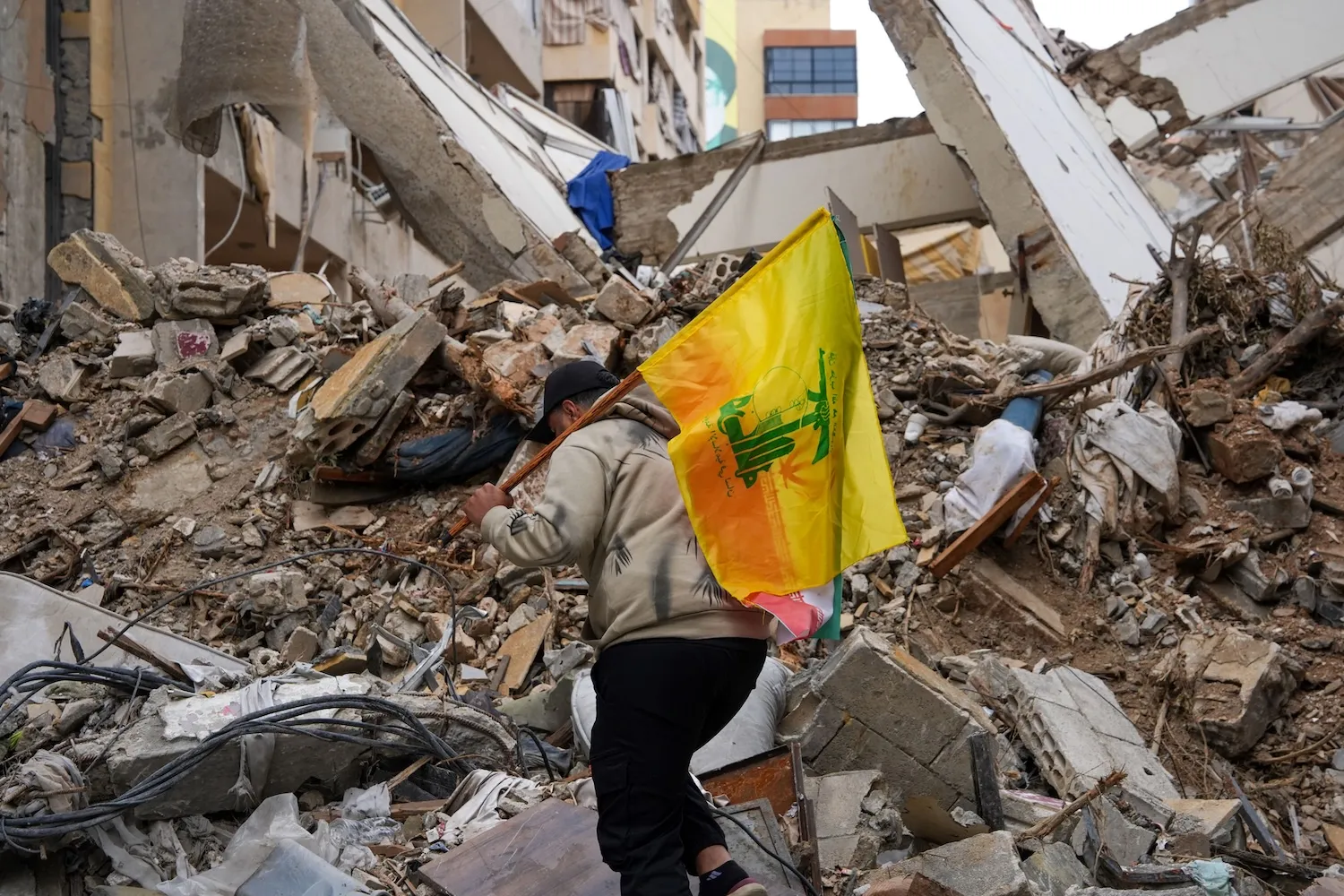
For the first time since 1993, Lebanon and Israel are talking to each other directly. But the question that overshadows their agenda in Washington is about a party that won’t be present: Hezbollah, the Iran-backed Shiite militia whose resistance to disarmament has become a major fault line in the wider crisis across the Middle East.
Last September, the Lebanese government launched its most ambitious disarmament plan ever. It saw some early success seizing weapons and deploying Lebanese Armed Forces soldiers south of the Litani River. Then came the U.S.-Israeli strikes on Iran, Hezbollah’s retaliatory rocket barrage into northern Israel, and Israel’s devastating air and ground campaign in Lebanon, which has killed more than 2,500 people and displaced over a million since March. Despite a tenuous cease-fire with Israel, Lebanon’s disarmament efforts against Hezbollah have ground to a halt.
For the first time since 1993, Lebanon and Israel are talking to each other directly. But the question that overshadows their agenda in Washington is about a party that won’t be present: Hezbollah, the Iran-backed Shiite militia whose resistance to disarmament has become a major fault line in the wider crisis across the Middle East.
Last September, the Lebanese government launched its most ambitious disarmament plan ever. It saw some early success seizing weapons and deploying Lebanese Armed Forces soldiers south of the Litani River. Then came the U.S.-Israeli strikes on Iran, Hezbollah’s retaliatory rocket barrage into northern Israel, and Israel’s devastating air and ground campaign in Lebanon, which has killed more than 2,500 people and displaced over a million since March. Despite a tenuous cease-fire with Israel, Lebanon’s disarmament efforts against Hezbollah have ground to a halt.
In the United States and Israel, the conventional response to such an impasse with Hezbollah is to press harder: more sanctions, more conditional aid, more military escalation. But these approaches all rest on a flawed diagnosis, treating the issue as something that can be imposed from the outside, ignoring the popular domestic support that any sustainable disarmament requires. As long as a critical mass of Lebanese citizens see Hezbollah’s arms as necessary, any disarmament—whether negotiated or forced—will be temporary.
In a recent study completed in December 2025 as part of the Cross-Border Conflict Evidence, Policy, and Trends (XCEPT) research program at King’s College London, we surveyed a nationally representative sample of more than 2,000 Lebanese citizens and conducted additional hourlong conversations with 300 participants. We found that only 18 percent of Lebanese express political support for Hezbollah, in line with its recent electoral results. But almost half—45 percent—resist its disarmament. Why are there so many people who do not support Hezbollah politically yet want it to hold on to its weapons?
To answer this question, we tested the most prominent explanations for the group’s popular support and compared how respondents who scored higher or lower for each factor differed in their backing of Hezbollah, after accounting for demographic and regional differences. What we found challenges fundamental assumptions about the disarmament question. The reasons people may support Hezbollah politically and the reasons they oppose its disarmament are driven by entirely different concerns—and conflating the two invariably leads to the wrong policy conclusions.
Three explanations dominate the conversation about Hezbollah’s staying power. The most familiar is sectarianism, the argument that Hezbollah has embedded itself so deeply in Shiite communal life that support is essentially a function of religious identity and social ties. Decades of institutional presence in mosques, schools, and neighborhood organizations have created what in Arabic political discourse is known as bi’a al-hadina, a “nurturing environment” that scholars have documented extensively in Beirut’s suburbs. Indeed, in our data, sectarianism (measured as how strongly Shiite religious faith shaped one’s identity and decision-making) is the dominant driver of political loyalty. Among those with strong social ties to Shiite communities, political support for Hezbollah is 30 percentage points higher compared with the rest of the population. But that same logic is essentially irrelevant for explaining the same group’s opposition to Hezbollah’s disarmament, which is only three points higher than the rest of the population.
Another prominent explanation points to Hezbollah as a provider of services, filling the vacuum left by a dysfunctional Lebanese state. Yet we found that respondents from lower socioeconomic backgrounds and with weaker social support networks—that is, people who would be more in need of direct subsidies, salaries, or assistance with medical bills and electricity—were in fact slightly less likely to support the group, both politically and on disarmament. This was true regardless of their religious sect. Instead, our survey data shows that Hezbollah’s support cuts widely across population segments. The profile of a typical opponent of disarmament is not one of material dependence. Merely substituting the group’s service infrastructure, however important as a policy goal in its own right, will not automatically shift public opinion on the weapons question.
A third explanation centers on security. Hezbollah has long presented itself as Lebanon’s only credible deterrent against Israel, a perception that fighting in recent years has further entrenched. As one participant noted: “I am in the south, and I see only Hezbollah and the Amal Movement defending it. Where is the army? Where is the president? Where is the prime minister? Did anyone defend the south? They don’t want to defend the south—only by words.” One in 5 surveyed reported severe exposure to war and political violence since 2023; more than half of participants said they felt existentially threatened by Israel. Both factors play a clear role in opposing disarmament. Those who felt more threatened and were more exposed to the conflict were 17 percentage points more likely to want Hezbollah to keep its weapons.
But by far the most powerful factor in explaining opposition to disarmament was something different: moral grievances against the Lebanese government itself. Citizens who said they had lost trust in the state and felt a deep sense of injustice were 29 percentage points more likely to oppose disarmament—regardless of their sect, socioeconomic status, or exposure to war. Those who most categorically rejected the notion of disarmament were not Hezbollah’s most devoted partisans but those who were most convinced that the state had failed them.
What do these grievances look like? First is the lack of procedural fairness: the perception that government leaders do not treat people and communities equally but instead allocate resources according to political favoritism—who you know and which sect you belong to. Then there is the perceived absence of accountability and justice. One prominent example is the Beirut Port explosion. More than five years on, the investigation has been systematically obstructed and remains a defining wound in public memory. A third aspect is pervasive, day-to-day corruption, such as when the collapse of the banking system wiped out ordinary people’s savings while elites shielded their assets abroad.
Together, these grievances resulted in a collapse of trust so deep—fewer than 1 in 4 in our data said they felt some trust in the government—that the state has simply lost its moral license to demand a monopoly on violence, as our XCEPT colleague Inna Rudolf has pointed out.
Our findings complicate the view that Lebanese society has broadly unified behind disarmament, anchored by recent polling from Gallup in which 79 percent of Lebanese said the army should be the only group with weapons. This consensus is thinner than it appears. First, the Gallup data was collected last summer, when disarmament was still a relatively loose policy aspiration floated by the new government and a decimated Hezbollah was even considering agreeing to partial disarmament. Shortly afterward, the Lebanese government approved the army’s disarmament plan and began enacting it; Shiite-aligned leaders started mobilizing opposition, and Hezbollah rearmed. The poll also excluded some areas in the south, the Bekaa Valley, and Beirut’s southern suburbs. These are the regions where Hezbollah is most present—and where attitudes toward disarmament matter most for understanding the political dynamics. Finally, whereas the Gallup survey asks a question about the Lebanese Army, our survey directly asks: “Should Hezbollah be disarmed?” In a context where the government pushing disarmament is widely seen as untrustworthy, respondents may endorse the army, a relatively popular institution, but resist the government’s specific agenda to disarm Hezbollah.
This pattern holds nationwide in our study, but it intensifies in precisely the areas that matter most. In southern Lebanon and the Bekaa Valley—Hezbollah’s strongholds, where opposition to disarmament stands above 70 percent—grievances outweigh even the security rationale. While security concerns related to the state’s inability to defend against Israel are an important factor, even where the threat from Israel is most acute and real, it is the moral falling out with the Lebanese government that moves the needle most.
One woman in Beirut’s southern suburbs was clear-eyed about the state’s failures (“I pay for electricity, but it does not come. The state wronged me.”) and insisted that disarmament could only follow from a state that had first earned legitimacy: “You need a strong state, a state that strikes with an iron fist, a state that, when it imposes something on you, has already given me my rights. When you impose on me after giving me my rights, then I must comply.” That, she said, had not happened and expressed skepticism about disarming Hezbollah.
Another telling example can be found at the opposite end of the country. In the north, near Akkar, where people are predominantly Sunni or Maronite, political loyalty to Hezbollah is negligible (5 percent), yet 41 percent oppose the group’s disarmament. Sectarianism cannot explain this, nor can Hezbollah’s service provision, which is largely absent there. What Akkar does have is a record of state abandonment. The governorate consistently ranks as Lebanon’s most deprived, trailing the rest of the country on poverty, infrastructure, healthcare, and education. For communities that have seen so little from the central government, the demand to trust that same state with a monopoly on force rings hollow.
The implications of this data are uncomfortable for every major actor at this moment. For the United States and its allies, a long-held foreign-policy doctrine of carrots and sticks—premised on the assumption that Hezbollah’s strength can be eroded by substituting its public services or sanctioning it through external pressure—may be targeting the wrong motive entirely. Hezbollah may find that the services it provides will not win it much additional support. More important is the state’s lack of providing services, as well as how its citizens feel treated throughout this process.
Yet the Lebanese government, for all its internal challenges, has not been failing in a vacuum. For years, Israeli attacks have devastated precisely the infrastructure and institutions that a reforming state would need to rebuild credibility. The last three years saw schools, hospitals, municipal buildings, and fragile networks of local governance that connected citizens to their state degraded or destroyed by Israel. Each cycle of destruction hands the government a ready-made excuse for inaction while simultaneously reinforcing the very perceptions of injustice and state incompetence that our research found to be the strongest motive among Lebanese for opposing Hezbollah’s laying down its arms. Israeli aggression is working against mitigating the threat from Hezbollah sustainably, a key policy goal that it shares with Lebanon, the United States, and the international community.
While Israel and Lebanon continue to negotiate amid a shaky truce, Hezbollah has already signaled that it considers itself unbound by whatever comes of the two states’ negotiations. Some hawks in Jerusalem and Washington will view this as proof that only force can settle the matter. But the nearly half of Lebanese who resist disarmament are not driven by what military or economic pressure could achieve. They watched their government preside over repeated crises and concluded that a state so badly broken cannot be trusted. No military operation or sanctions package will substitute for the one thing that might actually work: a unified vision of a Lebanese state worth disarming for.