


Welcome back to World Brief, where we’re looking at Russia kidnapping tens of thousands of Ukrainian children, the potential end of the U.S.-Iran cease-fire, and Kenya seeking French investments during the Africa Forward Summit.
‘Destroying Ukrainian Identity’
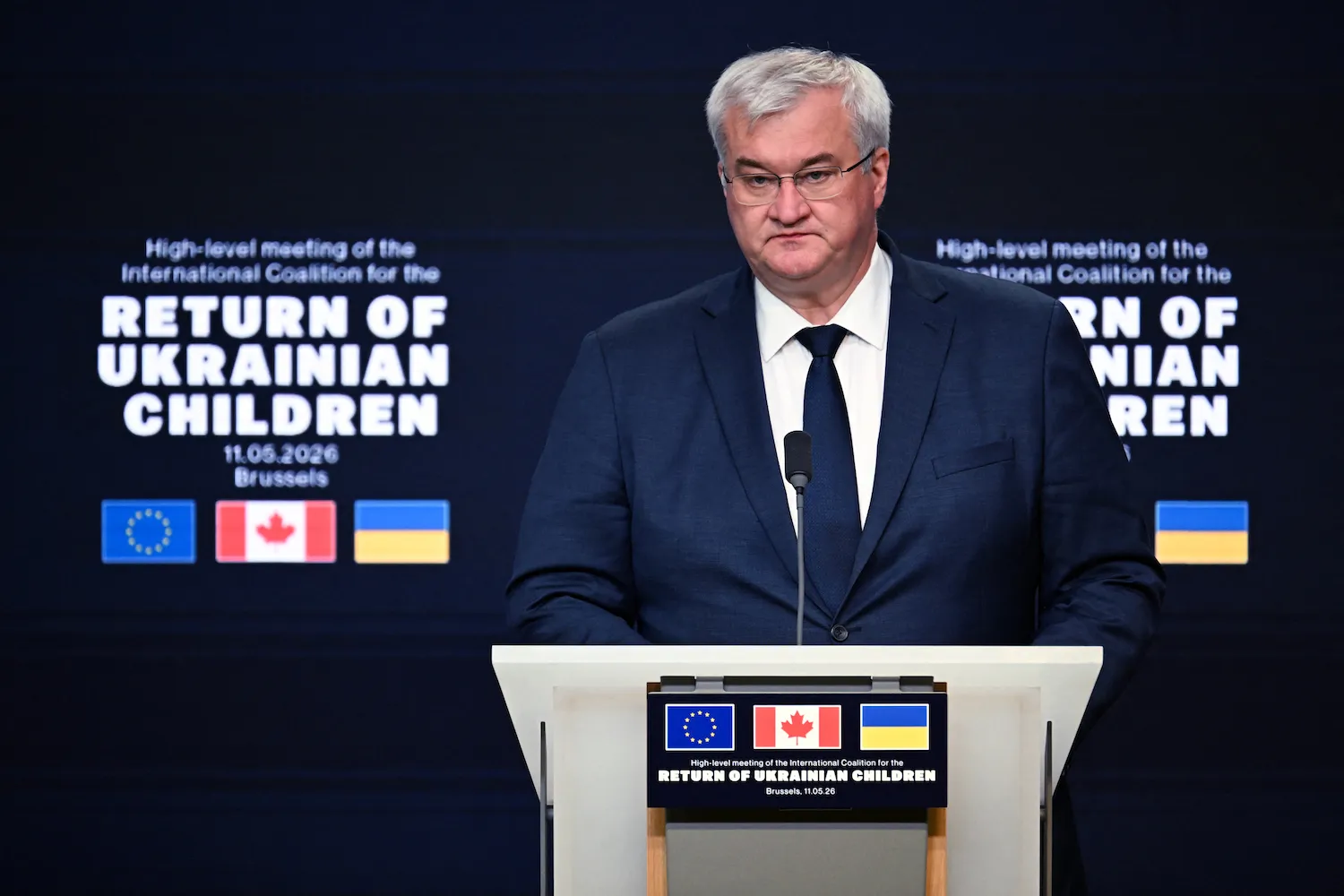
The European Union imposed sanctions on Monday targeting 16 individuals accused of helping Russia kidnap tens of thousands of Ukrainian children and forcibly deport them to Russia or its occupied territories.
“This is not collateral damage,” Ukrainian Foreign Minister Andrii Sybiha said. “This is a deliberate Russian policy aimed at destroying Ukrainian identity. Children are forced to forget who they are, where they come from, and even their language.”
Russia has abducted nearly 20,500 children from Ukraine since Moscow began its full-scale invasion in February 2022, according to the EU Council. Many of these minors have been forced to give up their cultures, change their identities, receive Russian passports, and be put up for adoption. Others have been sent to schools for indoctrination or to military camps, where they are trained to fight for Russia’s armed forces or for pro-Russian militias inside Ukraine.
“Russia is trying to erase their identity,” Latvian Foreign Minister Baiba Braze said on Monday. “When you look at the Genocide Convention, it’s one of the features of the genocide crime.” Under the 1948 Genocide Convention, “forcibly transferring children of the group to another group” can be defined as an act of genocide.
More than 130 people and entities are now under EU travel bans and asset freezes in connection to Russia’s systematic, large-scale kidnappings. That includes the 16 individuals sanctioned on Monday—among whom were heads of children’s camps, military officers, and government representatives—as well as new sanctions placed on seven Russian centers suspected of indoctrinating or training these children.
“War has really many faces, but stealing the children is really one of the most horrific,” EU Enlargement Commissioner Marta Kos said on Monday, adding that Moscow must pay for its crimes. In March 2023, the International Criminal Court (ICC) issued an arrest warrant for Russian President Vladimir Putin, accusing him of being personally responsible for the abductions.
Around 2,200 minors have since been returned to Ukraine, but identification and reunification remain difficult. Children taken at a young age can be hard to recognize after years spent apart from their families, and an active war zone makes their safe return even more complicated. On Monday alone, both Russia and Ukraine reported fighting along the front line—in direct violation of a U.S.-brokered cease-fire that they agreed to adhere to from May 9 to May 11.
An end to the war still appears out of reach. Although Putin hinted during his World War II Victory Day speech on Saturday that the Russia-Ukraine war “was coming to an end,” he later stressed that Moscow’s “special military operation” (the Kremlin’s term for the conflict) must continue until all of Russia’s goals are met. Those include Ukraine’s demilitarization as well as Russian control of the entire Donbas region—two red lines for Kyiv.
During that address, Putin also suggested that former German Chancellor Gerhard Schröder act as the mediator for all future negotiations with Europe. However, the EU dismissed that demand on Monday, citing Schröder’s close ties to Putin; the former leader served as chair of Russia’s Nord Stream gas pipeline until Russia began its full-scale invasion of Ukraine.
Today’s Most Read
The World This Week
Tuesday, May 12: EU defense ministers convene in Brussels.
The Bahamas holds a general election.
Thailand’s Constitutional Court delivers a ruling on the legality of the country’s conscription system.
Thursday, May 14: Chinese President Xi Jinping hosts U.S. President Donald Trump.
India hosts a two-day conference of BRICS foreign ministers.
The U.S. State Department begins another round of two-day Israel-Lebanon peace talks.
Friday, May 15: The deadline expires for Peru to determine the candidates in its presidential runoff.
Sunday, May 17: A three-week extension of the 10-day cease-fire in Lebanon expires.
Cape Verde holds parliamentary elections.
The autonomous Spanish region of Andalusia holds parliamentary elections.
Monday, May 18: G-7 finance ministers begin a two-day meeting in Paris.
Polish President Karol Nawrocki begins a two-day trip to Italy.
What We’re Following
A dying cease-fire? Trump warned on Monday that the U.S.-Iran cease-fire was on “life support,” after the White House rejected Tehran’s counterproposal to end the conflict. “I would call it the weakest right now after reading that piece of garbage they sent us,” the U.S. president said. “I didn’t even finish reading it.”
Last week, the United States offered a deal that would halt the fighting, reopen the Strait of Hormuz, and lay the framework for future nuclear talks. The draft, sources told Axios on Wednesday, included plans to discuss a moratorium on Iran’s nuclear enrichment and a clause prohibiting Iran from operating underground nuclear facilities. Tehran responded on Sunday with its own proposal, which insisted on “war reparations by the U.S., full Iranian sovereignty over the Strait of Hormuz, an end to sanctions, and the release of seized Iranian assets.”
Trump has accused Iranian officials of promising to accept some U.S. conditions, only to change their minds when it came time to submit a written proposal. Iran has not publicly agreed to give up its enriched uranium and has repeatedly stressed its right to continue such enrichment for civilian purposes. Tehran also maintains that it has no ambitions to create a nuclear weapon.
Paris’s investments in Africa. The two-day Africa Forward Summit kicked off in Nairobi on Monday, with French President Emmanuel Macron announcing billions of dollars in investments to diversify the continent’s trading partners. “A lot of solutions are made in the U.S. or made in China,” Macron said during a panel on technology and artificial intelligence. “I think we have a common fight … which is to build our strategic autonomy for Europe and Africa.”
Last April, Kenya terminated a $1.5 billion highway expansion deal led by Vinci, a French construction company, and instead handed the project to Chinese contractors. The decision, made after Kenyan authorities warned of too much risk with the French consortium, highlighted the decline of French influence on the continent. Rising anti-French sentiment following coups in several West African countries has also upset bilateral relations between Paris and its former colonies.
Now, though, Nairobi hopes to use the Africa Forward Summit—held for the first time in an Anglophone country—to attract French investors to the pan-African free trade area. Already, Macron has pledged to invest 14 billion euros in key development projects across the continent, including a 700-million-euro deal to modernize a terminal at Kenya’s Mombasa port.
Impeached again. Philippine lawmakers overwhelmingly voted on Monday to impeach Vice President Sara Duterte, paving the way for a Senate trial that could obstruct her presidential campaign in 2028. However, as the Senate is packed by the Duterte family’s allies—and starting Monday, the new Senate president is a Duterte loyalist, Sen. Alan Cayetano—experts believe that a conviction is unlikely.
Duterte is accused of misusing public funds and betraying voters’ trust by threatening to assassinate Philippine President Ferdinand Marcos Jr.; she is the daughter of former Philippine President Rodrigo Duterte, a longtime foe of Marcos who currently awaits trial at the ICC for abuses committed during his “war on drugs.”
Last year, the country’s lower chamber impeached Duterte shortly after she claimed to have arranged for an assassin to kill Marcos if she was murdered. However, the Supreme Court declared those proceedings unconstitutional, allowing the Senate to shelve the allegations.
The Senate will convene as an impeachment court as early as Wednesday to vote on the House’s latest ruling. Duterte has repeatedly denied all wrongdoing, and her legal team has called the process a “witch hunt.” If convicted, Duterte would be immediately removed from office and barred from ever holding future positions. If acquitted, she would remain vice president and be protected from further impeachment hearings for one year.
Odds and Ends
Miners in Myanmar have discovered a massive, rare ruby in the country’s war-torn upper Mandalay region. According to state-run media last Friday, the purplish-red jewel measures at 11,000 carats and weighs nearly 5 pounds, making it the second-largest gemstone ever discovered in the country; Myanmar produces around 90 percent of the world’s rubies. Its estimated value is still unclear, but experts suggest that the gem’s superior color and quality give it a hefty price tag.